Venezuela’s deepening political and economic crisis has revived a long-running global debate over United States involvement in foreign governments, as Washington’s pressure campaign against President Nicolás Maduro echoes past interventions across Latin America, the Middle East, and beyond. Through sanctions, diplomatic isolation, and support for opposition forces, the US has once again adopted tools that critics say resemble a familiar foreign policy playbook, one that has shaped political outcomes in multiple countries over the last seven decades.
The United States’ role in Venezuela escalated significantly after it refused to recognize the legitimacy of Maduro’s re-election and instead backed opposition figures, arguing that democratic norms had been violated. Washington imposed extensive sanctions on Venezuela’s oil industry, financial institutions, and senior officials, framing the measures as necessary to restore democracy and accountability. Yet similar justifications have accompanied earlier US actions in countries where outcomes proved far more complex and destabilizing.
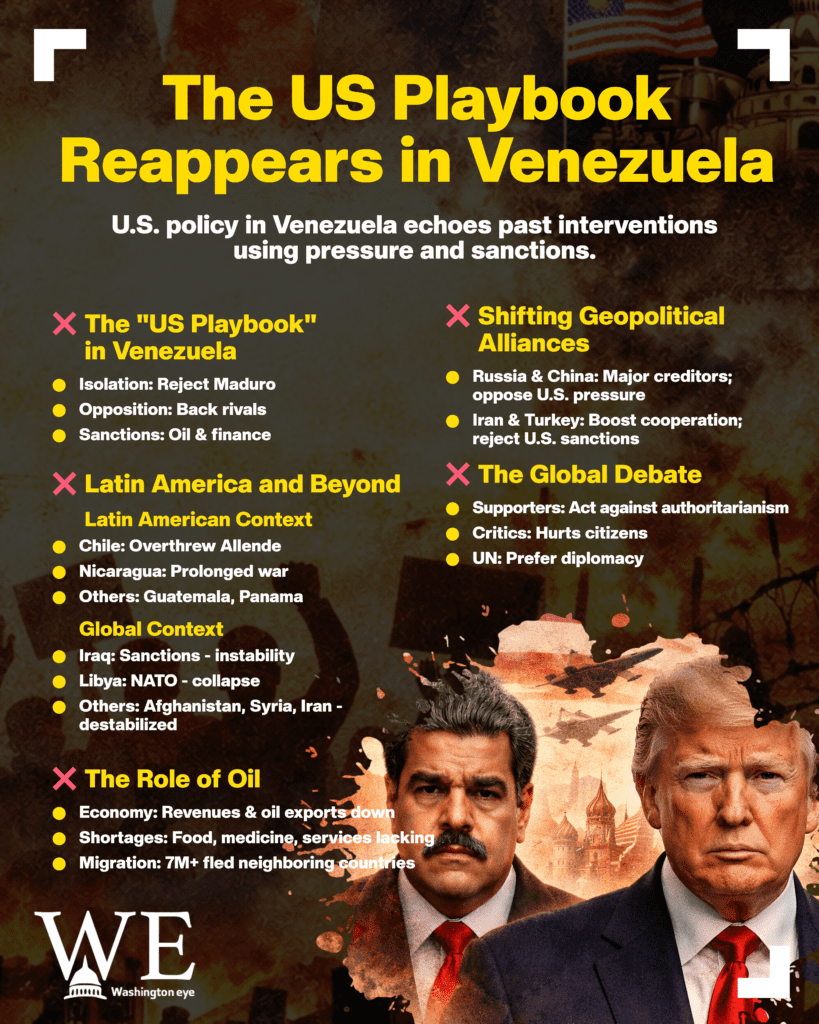
In Latin America, the historical record of US involvement is extensive. During the Cold War, Washington intervened directly or indirectly in Guatemala (1954), Chile (1973), Nicaragua (1980s), and Panama (1989), often citing the need to counter authoritarianism or ideological threats. In Chile, US-backed economic pressure and political destabilization preceded the overthrow of President Salvador Allende, leading to years of military dictatorship. In Nicaragua, support for Contra rebels against the Sandinista government prolonged conflict and humanitarian suffering. These cases remain deeply embedded in regional memory and shape skepticism toward US actions today.
Outside Latin America, parallels are frequently drawn with the Middle East. In Iraq, years of US-led sanctions during the 1990s severely weakened the civilian economy before the 2003 invasion removed Saddam Hussein, destabilizing the country for decades. In Libya, NATO intervention in 2011, supported by the US, was justified on humanitarian grounds but resulted in state collapse and prolonged conflict. Afghanistan, Syria, and Iran further illustrate how sanctions, regime pressure, and political isolation often produce unintended consequences.
Venezuela’s strategic importance adds another layer to the debate. The country holds the world’s largest proven crude oil reserves, making it a critical player in global energy markets. Critics argue that resource control has historically influenced US policy decisions, pointing to past interventions in oil-rich regions such as Iraq and Libya. While US officials deny resource motivations, analysts note that energy security, geopolitical competition, and influence over regional blocs continue to shape Washington’s approach.
The economic impact of US sanctions on Venezuela has been profound. Oil exports have dropped sharply, state revenues have declined, and access to international financial systems has been restricted. Although humanitarian exemptions exist on paper, international agencies report shortages of food, medicine, and essential services. The crisis has forced more than seven million Venezuelans to flee, placing immense pressure on neighboring countries such as Colombia, Brazil, Peru, and Ecuador.
Politically, US pressure has also reshaped Venezuela’s global alliances. Caracas has strengthened ties with Russia, China, Iran, and Turkey, countries that openly oppose US sanctions and view them as violations of national sovereignty. China and Russia, both major creditors to Venezuela, have accused Washington of using economic coercion to impose political outcomes. Iran’s growing energy cooperation with Venezuela further reflects how sanctions often push targeted states toward alternative power centers rather than compliance.
More Read

International reactions remain divided. The European Union has supported targeted sanctions while calling for negotiations, while several Latin American governments have shifted away from confrontation toward dialogue. The United Nations has repeatedly warned that broad sanctions can worsen humanitarian crises without guaranteeing political reform, urging solutions centered on diplomacy rather than pressure alone.
Supporters of US policy argue that past failures do not justify inaction. They maintain that allowing authoritarian governments to consolidate power undermines democratic norms globally. From this perspective, Venezuela represents a moral and political test case, whether the international community is willing to confront repression even when outcomes are uncertain.
Critics, however, argue that history offers clear lessons. From Latin America to the Middle East, repeated US interventions have often weakened institutions, polarized societies, and prolonged instability. They warn that Venezuela risks becoming another example where external pressure hardens ruling elites while ordinary citizens bear the cost.
As Venezuela’s crisis continues, the reappearance of an old US playbook raises difficult questions about whether foreign policy has evolved, or whether history is once again repeating itself under new circumstances.