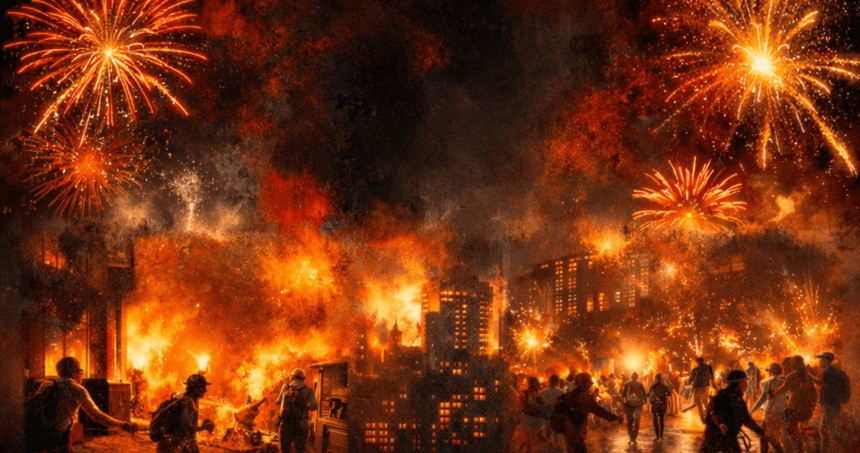
As midnight rolled across the planet, first over the Pacific and hours later across Europe and the Americas, New Year celebrations followed the sun in a familiar rhythm: countdowns, champagne, street parties, and fireworks. But the same spectacle that marks a fresh start each year also delivers a recurring toll of burns, eye trauma, fires, and occasional mass-casualty disasters, renewing calls for tighter controls on private pyrotechnics and safer public displays.
In cities that welcome the new year early, Auckland, Sydney, and across East Asia, fireworks remain the visual shorthand for a global “reset,” amplified by social media’s real-time time-zone relay. By the time Europe lights up, millions have already watched skies explode in earlier time zones and are primed to recreate the moment. The result is a rolling wave of demand for fireworks, and a predictable spike in injuries as amateur handling meets alcohol, crowds, and improvised devices.
Europe has long wrestled with the line between tradition and risk, and this year’s holiday period was again overshadowed by tragedy. In Switzerland, a New Year’s celebration at the Le Constellation bar in Crans-Montana ended in catastrophe after indoor “fountain candle” sparklers, often used as bottle-top party effects, ignited material near the ceiling, triggering a fast-moving blaze. Authorities said 40 people were killed and 119 injured, many of them young, and prosecutors opened a negligence investigation into those managing the venue.
The Swiss disaster was not a traditional outdoor fireworks accident, but it underscored a central New Year’s pattern: celebratory pyrotechnics, confined spaces, and crowded exits can turn seconds into tragedy. Fire safety experts repeatedly warn that indoor pyrotechnics and sparklers, treated casually because they look small, can ignite interiors quickly and produce heavy smoke before people recognize danger.
Germany, where private fireworks are culturally entrenched, has faced growing debate after repeated years of severe injuries, property damage, and attacks on emergency services. Recent coverage has highlighted how the “start the year with a bang” custom can turn into trauma in dense neighborhoods, where powerful fireworks and homemade devices are set off at street level. Europe’s broader experience has been similar: past New Year’s periods have seen fatalities from fireworks accidents in Germany and mass disturbances in major cities, fueling recurring proposals for stricter limits or bans on consumer fireworks.
Beyond Europe, the injury burden is often measured not in dramatic single events, but in hospital admissions. In the Philippines, health authorities reported hundreds of fireworks-related injuries during the holiday period, with cases climbing into the hundreds by early January, an annual pattern officials track closely. In the United States, national safety data also points to a persistent problem: federal consumer safety officials reported fireworks-related deaths and thousands of injuries in 2024, alongside warnings that misuse and malfunctions are common factors.
What makes New Year’s Eve uniquely dangerous is the combination of timing and behavior. Fireworks are often detonated in crowded streets at exactly midnight, when visibility is reduced, attention is split between phones and festivities, and many celebrants have been drinking for hours. Children and bystanders can be injured by unpredictable trajectories, misfires, or debris. Eye injuries are a particular concern because even brief exposure to explosive fragments or burning material can cause permanent damage; one reason many medical groups and safety agencies continue to push for eye protection, controlled distances, and professionally managed public shows instead of backyard launches.

Supporters of fireworks argue that the tradition is a rare, shared public joy, one that brings communities outdoors, supports seasonal vendors, and creates a unifying moment across time zones. Critics counter that the costs fall on emergency rooms, firefighters, and neighbors whose streets become launch pads, and they point to the repeatability of the harm: the same injuries, the same fires, the same debates, year after year.
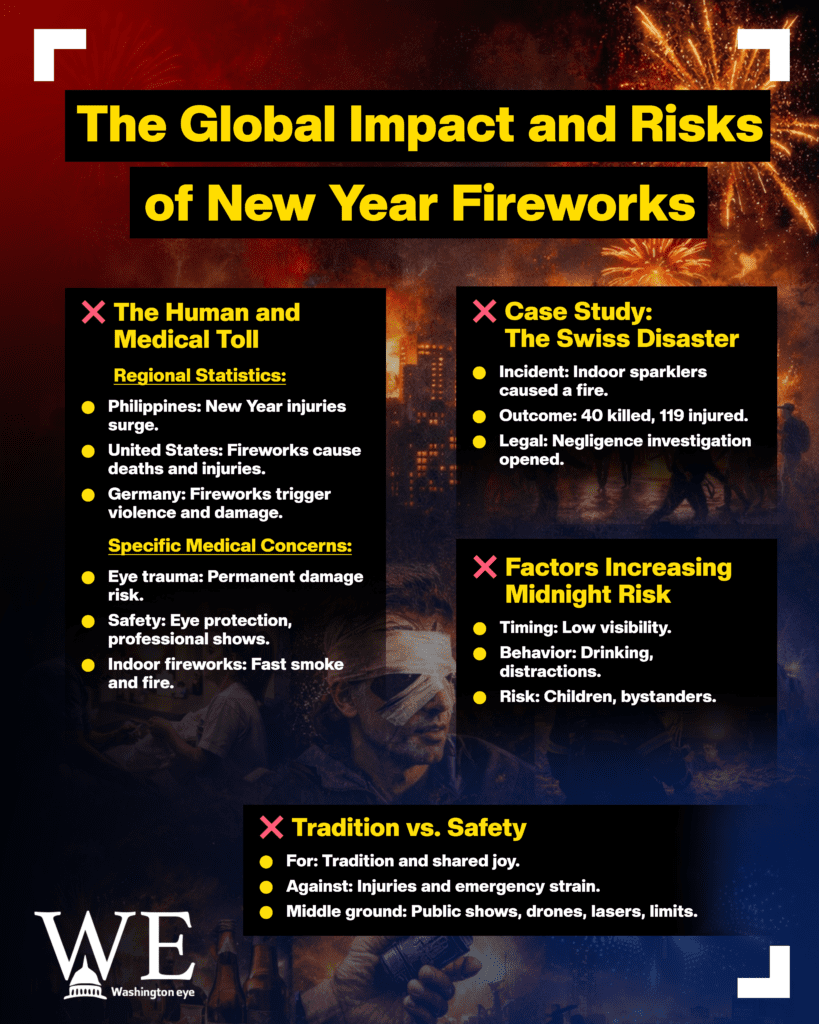
Officials in many places now promote a compromise: limit consumer fireworks while expanding centralized public displays, drone light shows, or laser-and-music events that can deliver spectacle without explosive risk. Yet every New Year demonstrates the same reality: as long as private fireworks remain widely available and culturally expected, the midnight celebration will keep producing not only bright skies, but also sirens, burn units, and investigations.