Oil still runs through the arteries of the global economy. From fueling transport and industry to shaping foreign policy and national budgets, crude oil remains one of the most strategically important commodities in the world. While energy transition debates intensify, the distribution of proven crude oil reserves continues to determine which countries wield long-term influence over global energy markets, prices, and geopolitics.
Proven crude oil reserves refer to quantities of oil that geological and engineering data show can be extracted with reasonable certainty under current economic and technological conditions. These figures change over time, influenced by oil prices, new discoveries, improved recovery techniques, and political stability. As of the most recent global assessments, a small group of countries controls the overwhelming majority of the world’s recoverable oil.
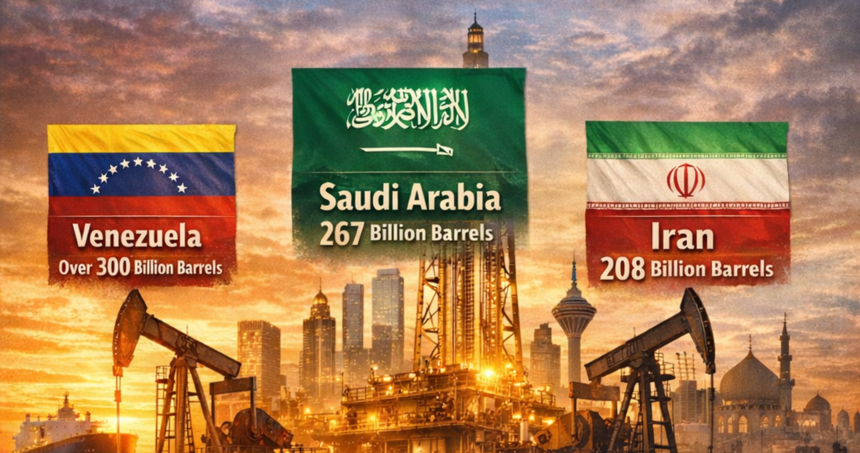
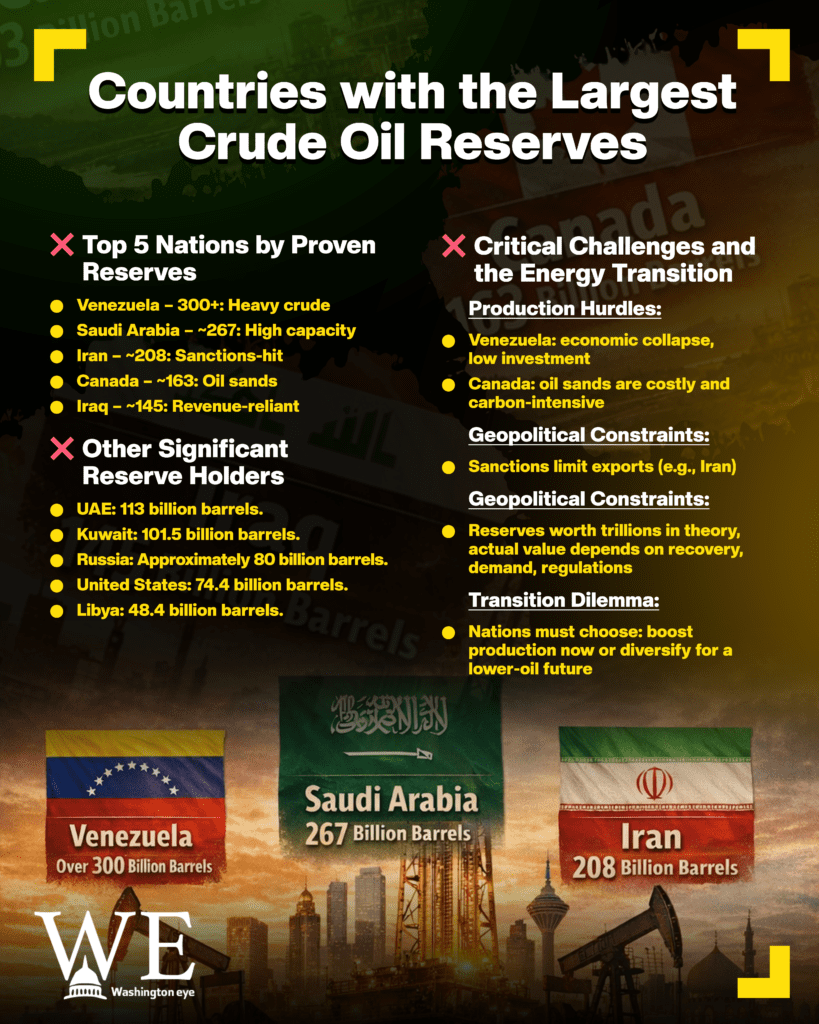
Venezuela tops the list, holding the world’s largest proven crude oil reserves at over 300 billion barrels. Most of this oil lies in the Orinoco Belt and is classified as heavy or extra-heavy crude, which is costly to refine and transport. Despite its vast resource base, Venezuela’s production has been constrained for years due to economic collapse, lack of investment, sanctions, and political uncertainty. As a result, its enormous reserves translate into potential power rather than immediate market dominance.

Saudi Arabia follows closely, with approximately 267 billion barrels of proven reserves. Unlike Venezuela, Saudi Arabia has both the capacity and infrastructure to rapidly convert reserves into production. As the leading member of OPEC and a central player in OPEC+, Riyadh uses its oil capacity as a strategic tool, balancing markets, influencing prices, and reinforcing its geopolitical standing. Oil revenues remain a cornerstone of the Saudi economy, even as the kingdom pushes forward with diversification under Vision 2030.
Iran ranks third globally, with around 208 billion barrels of proven reserves. Its oil sector, however, has long been affected by international sanctions, limiting exports and foreign investment. Nevertheless, Iran’s reserves give it long-term leverage, especially in negotiations tied to regional security and nuclear diplomacy. Any easing of sanctions could significantly alter global supply dynamics.
Canada holds the fourth-largest reserves at roughly 163 billion barrels, largely concentrated in Alberta’s oil sands. These reserves are among the most expensive and carbon-intensive to produce, making Canada’s oil industry sensitive to global prices, environmental regulations, and climate policy debates. Still, Canada remains a major exporter, particularly to the United States.
Iraq, with about 145 billion barrels, completes the top five. Oil is the backbone of Iraq’s economy, accounting for the vast majority of government revenue. While production has increased steadily, political instability, infrastructure challenges, and regional tensions continue to affect the country’s ability to fully capitalize on its reserves.

Other major reserve holders include the United Arab Emirates (113 billion barrels), Kuwait (101.5 billion), Russia (around 80 billion), the United States (74.4 billion), and Libya (48.4 billion). Collectively, OPEC countries control nearly 70 percent of global proven crude oil reserves, underlining the group’s enduring relevance in energy markets.
At current average oil prices hovering around $60 per barrel, the theoretical value of these reserves runs into trillions of dollars. However, this “paper value” is misleading. Production costs, recovery rates, environmental constraints, and future demand all shape how much of this oil will actually be monetized. A barrel underground does not equal a barrel sold.
The global energy transition further complicates the picture. Rising electric vehicle adoption, renewable energy expansion, and climate policies are expected to slow oil demand growth over the coming decades. For reserve-rich countries, this creates a strategic dilemma: accelerate production to monetize assets sooner, or conserve reserves while diversifying economies to reduce dependence on oil.
Ultimately, the countries with the largest crude oil reserves still hold significant influence, but power in today’s oil market depends less on volume alone and more on stability, technology, and market access. In a changing energy landscape, reserves remain a source of strength, but no longer a guarantee of control.