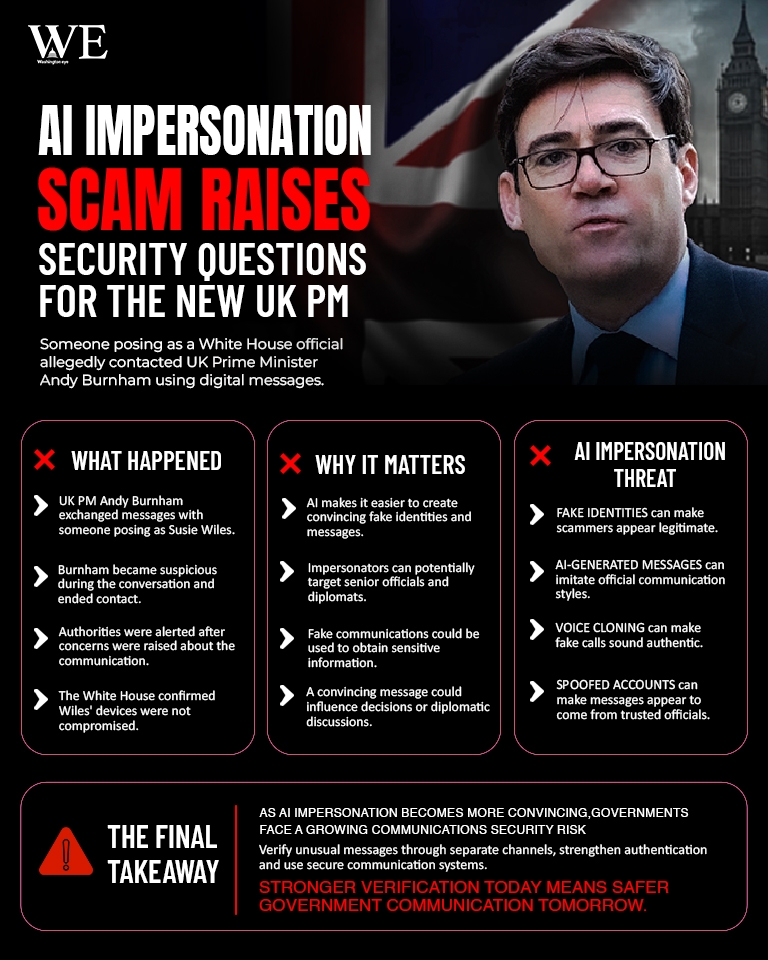
British Prime Minister Andy Burnham has reportedly been caught up in a growing international problem: sophisticated attempts to use artificial intelligence to impersonate senior government officials.
According to reports, Burnham recently exchanged several messages with an individual he believed was Susie Wiles, the White House chief of staff. The communication was brief and reportedly contained nothing of major consequence. However, suspicions were raised during the exchange, prompting the British leader to end the conversation and notify the appropriate authorities.
The incident has attracted attention because it highlights how easily trusted political communication can be targeted by increasingly convincing digital deception. Rather than requiring access to a government network or personal device, impersonation scams can rely on fabricated identities, spoofed accounts and AI-generated communications to create the appearance that a message is coming from a powerful official.
British officials have declined to discuss the episode in detail, citing national security considerations. The British Embassy in Washington reportedly alerted the White House, which confirmed that Wiles’ own devices had not been compromised.
The episode comes amid a series of warnings from US authorities about criminals and other malicious actors using AI to mimic senior officials. The FBI has previously investigated attempts involving an individual pretending to be Wiles and contacting influential Republicans and business figures.
A separate case involved someone posing as US Secretary of State Marco Rubio and reaching out to foreign ministers. Such incidents demonstrate why government communications have become an increasingly attractive target for digital impersonation.
Modern AI tools can produce convincing written messages, imitate voices and potentially generate realistic video, making it increasingly difficult for recipients to determine whether they are communicating with a genuine official.
The risks are particularly serious in diplomacy, where even a seemingly routine conversation can involve sensitive political information. A fake message from a senior official could be used to gather intelligence, manipulate negotiations, spread false instructions or damage relationships between governments.