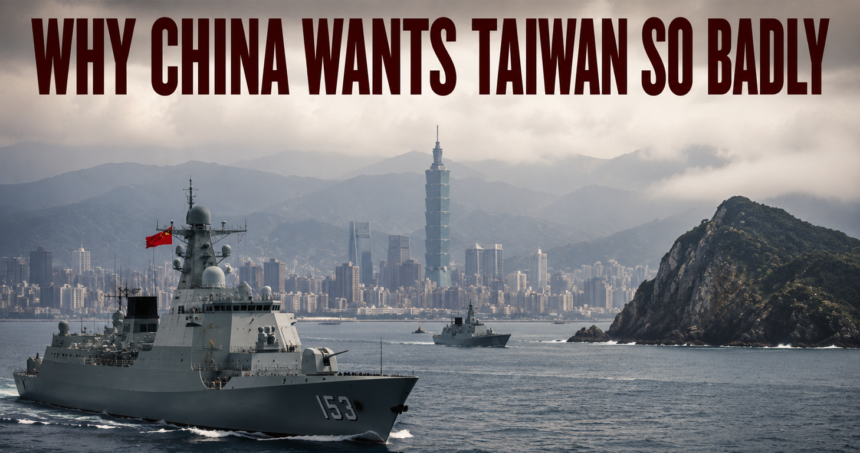
Few geopolitical disputes carry as much historical weight and strategic significance as the question of Taiwan. As military activity around the Taiwan Strait continues to intensify in 2026, many observers are asking a fundamental question: Why does China want Taiwan so badly?
For Beijing, Taiwan is far more than a small island located about 180 kilometers off China’s southeastern coast. It is a matter of national identity, historical legitimacy, territorial integrity, military strategy, and global power. For Taiwan, however, the issue is one of self-governance, democracy, and the right of its people to determine their own future. The competing narratives have turned Taiwan into one of the world’s most dangerous geopolitical flashpoints.
The roots of the dispute stretch back more than a century. Taiwan was governed by China’s Qing Dynasty until 1895, when it was ceded to Japan after China’s defeat in the First Sino-Japanese War. Following Japan’s surrender in World War II in 1945, control of Taiwan was transferred to the Republic of China (ROC). However, the Chinese Civil War soon changed the island’s fate. In 1949, Communist forces led by Mao Zedong established the People’s Republic of China (PRC) on the mainland, while the defeated Nationalist government, known as the Kuomintang (KMT), retreated to Taiwan and continued operating there.
Since then, both sides of the Taiwan Strait developed separately. Beijing has consistently maintained that Taiwan is an inseparable part of China and that reunification is a historic mission. The Chinese government insists there is only “One China” and considers Taiwan a breakaway province that must eventually be reunited with the mainland.

For China’s leadership, especially under Xi Jinping, Taiwan represents unfinished business from the civil war era. Reunification has been framed as essential to achieving what Beijing calls the “great rejuvenation of the Chinese nation.” Chinese officials argue that no Chinese leader can afford to permanently lose Taiwan without appearing weak domestically. The issue is therefore deeply tied to the legitimacy of the Communist Party and Chinese nationalism.
Strategic considerations also play a major role. Taiwan occupies a critical position in the so-called “First Island Chain,” a series of islands stretching from Japan to the Philippines. Control over Taiwan would provide China with greater access to the western Pacific Ocean and potentially reduce military constraints imposed by rival powers. Analysts often describe Taiwan as a key gateway for projecting naval power beyond East Asia. China’s recent maritime activities and military exercises around Taiwan highlight the island’s strategic importance.
Economics further increases Taiwan’s value. The island is home to some of the world’s most advanced semiconductor manufacturing facilities and plays a vital role in global technology supply chains. Any conflict involving Taiwan could disrupt industries ranging from smartphones and automobiles to artificial intelligence and defense systems. Although Beijing rarely presents economics as the primary reason for reunification, Taiwan’s technological importance adds another layer to the dispute.
Taiwan, however, has evolved into a vibrant democracy with its own government, military, constitution, elections, and foreign economic relationships. Many Taiwanese citizens identify primarily as Taiwanese rather than Chinese and oppose rule by Beijing. Taiwan’s leaders argue that the island’s future should be decided by its 23 million residents rather than by the Chinese government.
The disagreement has become increasingly visible in recent years. China has expanded military patrols, air incursions, naval operations, and large-scale exercises near Taiwan, while Taipei has strengthened its defenses and sought closer security cooperation with partners, particularly the United States. Taiwan recently launched new combat readiness exercises amid growing concerns over Chinese military pressure.
A critical view of the dispute reveals that history alone cannot fully explain modern realities. Critics of Beijing’s position argue that Taiwan has operated separately for more than seven decades and has developed its own political identity. They contend that any future arrangement should reflect the wishes of Taiwan’s population. Conversely, Chinese officials insist that sovereignty and territorial integrity are non-negotiable principles and reject any suggestion of Taiwanese independence.
Internationally, most countries do not formally recognize Taiwan as an independent state, yet many maintain unofficial relations with Taipei. The United States follows its own “One China Policy,” which differs from Beijing’s “One China Principle,” while continuing to support Taiwan’s self-defense capabilities. This delicate diplomatic balance has helped prevent conflict but has not resolved the underlying dispute.

As tensions continue to rise, Taiwan remains at the center of a struggle involving history, sovereignty, democracy, security, and global power. Whether the future brings peaceful dialogue, continued rivalry, or a more serious confrontation will likely shape not only relations between China and Taiwan but also the broader international order in the decades ahead.