

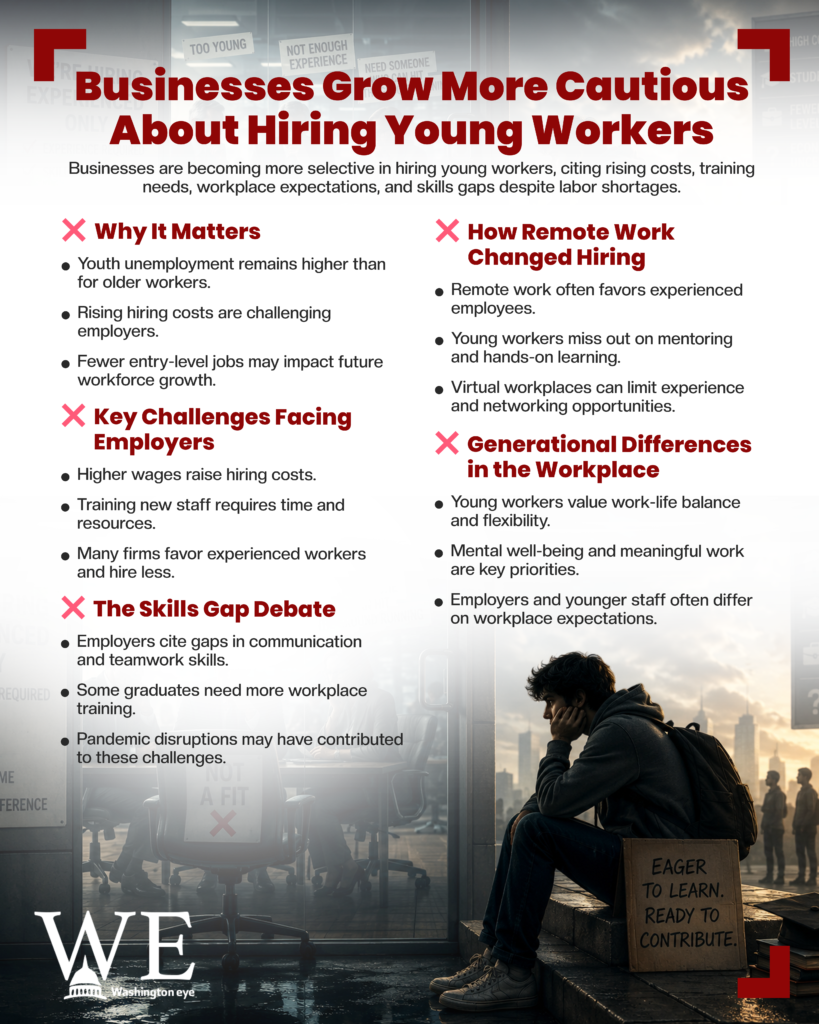
Businesses across several countries are becoming increasingly cautious about hiring young workers, particularly members of Generation Z entering the workforce. While employers acknowledge that younger employees bring creativity, digital literacy, innovation, and fresh perspectives, many companies say rising costs, training demands, changing workplace expectations, and skills gaps are making entry-level recruitment more challenging than ever. The debate has intensified in 2025 and 2026 as youth unemployment rises in several developed economies despite ongoing labor shortages in some sectors. Recent studies, employer surveys, and government inquiries suggest that businesses are not necessarily unwilling to hire young people, but many are becoming more selective in how and when they do so.
One of the biggest concerns cited by employers is the increasing cost of hiring inexperienced workers. In the United Kingdom, business groups have warned that higher minimum wages, increased payroll costs, and additional employment obligations are making companies think twice before recruiting entry-level staff. Many firms now prefer candidates with previous work experience because training a new worker requires time, money, and managerial resources. Small and medium-sized enterprises, which traditionally serve as a gateway into employment for young people, have reported that rising labor costs are forcing them to reduce hiring altogether.
Another factor is the perceived gap between education and workplace readiness. Several employer surveys suggest that managers are increasingly concerned about communication skills, professionalism, teamwork, and problem-solving abilities among some recent graduates. One study found that more than a quarter of executives were reluctant to hire recent graduates, while many managers reported spending significantly more time training younger employees than previous generations. Critics argue that pandemic-era disruptions to education and social development may have contributed to these challenges.

Remote and hybrid work have also changed hiring dynamics. A recent study by economists associated with the Federal Reserve Bank of New York found that remote work—not artificial intelligence—is a major reason behind worsening employment prospects for young graduates. Companies operating remotely often prefer experienced workers who require less supervision and can work independently. Young employees traditionally learn through observation, mentoring, and informal office interactions, opportunities that are harder to replicate in virtual workplaces. Researchers estimated that remote work may account for nearly two-thirds of the recent rise in youth unemployment among college graduates.

Generational differences in workplace expectations have further fueled tensions. Many young workers prioritize flexibility, work-life balance, mental well-being, and meaningful work. Older managers sometimes interpret these preferences as a lack of commitment, while younger employees often argue they are simply rejecting outdated workplace norms. Surveys indicate that Gen Z workers are more likely to seek hybrid work arrangements and are less willing to work extended hours without compensation. Experts caution that such differences can lead to stereotypes and unfair assumptions about younger workers.
However, many analysts argue that blaming young people alone oversimplifies a much larger economic problem. Housing costs, inflation, student debt, economic uncertainty, and a shrinking number of traditional entry-level jobs have created obstacles for younger generations. At the same time, companies increasingly expect job applicants to arrive with experience, creating a paradox in which young people struggle to gain experience because employers are reluctant to hire them in the first place.
Despite these concerns, employers continue to recognize significant advantages in hiring younger workers. Young employees often possess strong digital skills, adaptability, technological awareness, and entrepreneurial thinking. They are generally comfortable with emerging technologies, social media, and AI-driven tools that are becoming increasingly important in modern workplaces. Many business leaders argue that companies that fail to invest in young talent risk creating future labor shortages and leadership gaps.

The numbers illustrate the scale of the challenge. In the UK alone, nearly one million people aged 16 to 24 are currently not in employment, education, or training, prompting calls from major retailers and business organizations for government intervention. More than 200 retail firms recently urged policymakers to establish programs that make it easier and less expensive for companies to hire young workers. Similar concerns are emerging across North America and parts of Europe, where youth unemployment rates remain higher than those of older workers.
Experts say the solution lies in partnership rather than blame. Businesses need affordable pathways to recruit and train new workers, while educational institutions must strengthen practical workplace skills. Governments can help through apprenticeship programs, wage subsidies, and youth employment initiatives. At the same time, young workers may benefit from greater exposure to professional environments before graduation.
Ultimately, the issue is not that businesses are afraid of young people. Rather, many employers are struggling to balance economic pressures, workplace transformation, and evolving expectations. The challenge for the future will be ensuring that an entire generation is not locked out of employment opportunities at the very moment when economies need their energy, creativity, and talent the most.