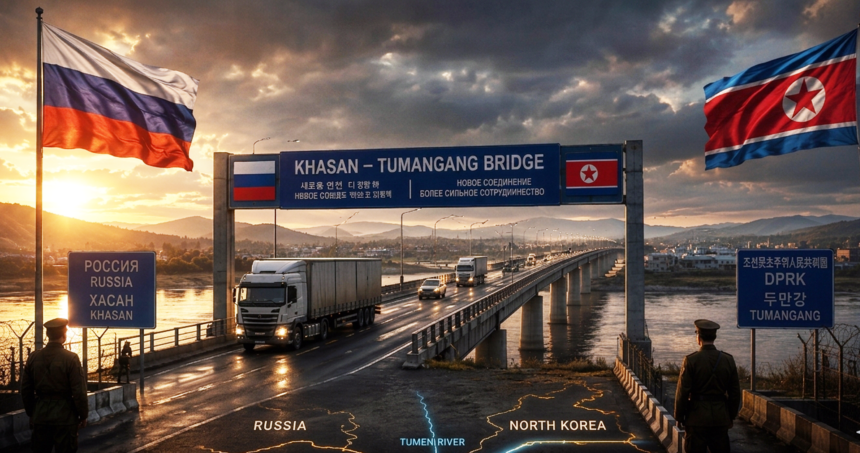
Russia and North Korea are preparing to open the first-ever road bridge linking the two countries, marking a significant new phase in the rapidly deepening relationship between Moscow and Pyongyang. The bridge, being built across the Tumen River at the countries’ small shared border, is expected to become operational in the summer of 2026 after construction work accelerated over the past year. Officials from both nations have described the project as a “landmark” achievement that will expand trade, tourism, transportation, and strategic cooperation between the longtime allies.
The new crossing, known as the Khasan–Tumangang Bridge, connects the Russian town of Khasan with the North Korean border area of Tumangang. It stretches over the Tumen River, the narrow waterway that forms the natural frontier between the two countries. Russia and North Korea share only a short land border of roughly 17 kilometers, making this crossing strategically important despite its relatively remote location in the Russian Far East.
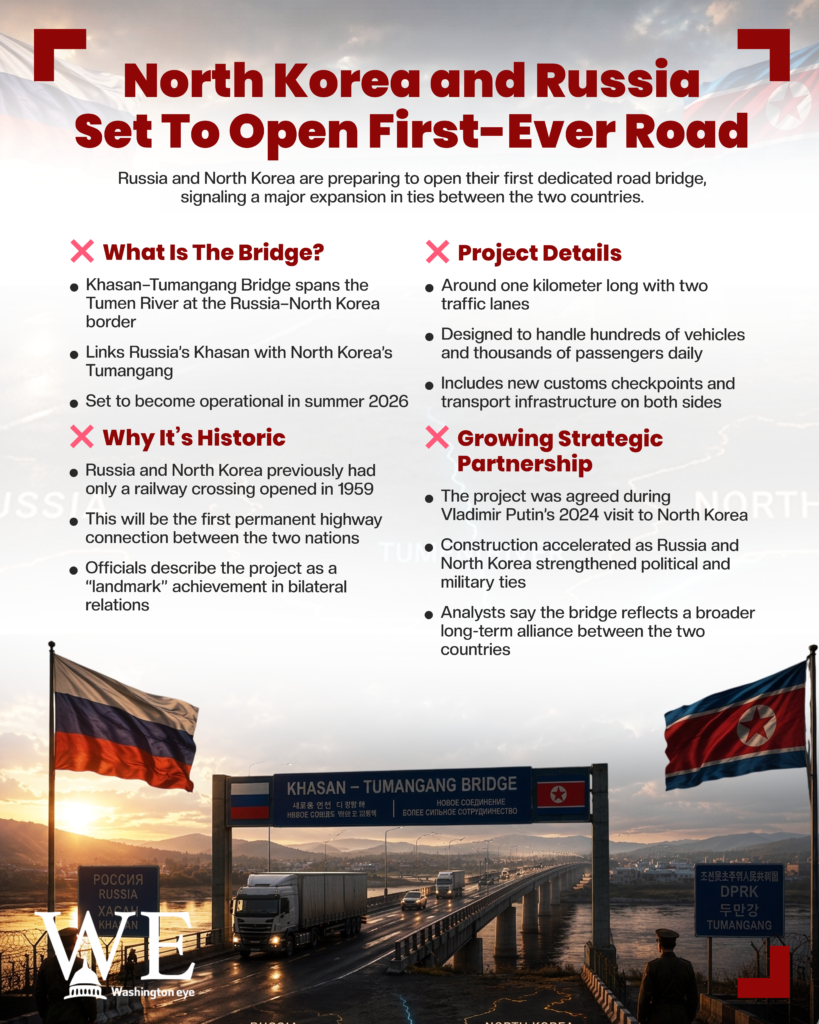
The project was first agreed during Russian President Vladimir Putin’s visit to North Korea in 2024, a trip that symbolized growing cooperation between the two heavily sanctioned states. Construction officially began in April 2025 and advanced quickly despite harsh winter conditions in the region. In April 2026, officials from both countries held a ceremony celebrating the joining of the bridge spans in the middle of the river, signaling that the project had reached its final phase. Russian authorities said the bridge could open fully by June 19, 2026.

The bridge is approximately one kilometer long and includes two traffic lanes capable of handling around 300 vehicles and thousands of passengers daily. Reports estimate the project cost at nearly 9 billion rubles, or more than $100 million. The crossing is also linked to new access roads, customs checkpoints, and supporting infrastructure being built on both sides of the border.

Until now, Russia and North Korea had only one direct crossing point: the Korea–Russia Friendship Bridge, a railway bridge opened in 1959 after the Korean War. While limited road traffic could occasionally pass over the railway bridge through special arrangements, there was never a dedicated highway connection between the two nations. The new bridge is therefore considered historically significant because it creates the first permanent road link in modern history between Moscow and Pyongyang.
Russian Prime Minister Mikhail Mishustin has said the bridge will reduce transportation costs, facilitate trade, and strengthen tourism cooperation. Officials in Russia’s Primorsky region believe the route will shorten travel distances between Vladivostok and North Korea’s northeastern city of Rason, making movement of goods and people easier than before. North Korean state media has similarly described the bridge as an “important business” project intended to deepen bilateral economic cooperation.
The timing of the project has drawn international attention because of the increasingly close political and military partnership between Russia and North Korea since the war in Ukraine began. Western governments and analysts have accused Pyongyang of supplying weapons and even troops to support Russia’s military campaign, while Moscow has reportedly provided fuel, food, economic support, and diplomatic backing in return. Experts say the bridge symbolizes how the relationship is moving beyond temporary wartime cooperation into a broader long-term strategic alliance.
Analysts also believe the road link could help North Korea reduce some of its economic isolation caused by international sanctions. Increased road transport may improve access to Russian goods, fuel, construction materials, and agricultural supplies. For Russia, the bridge offers another transport corridor in Asia as Moscow seeks stronger economic partners outside the Western sphere.
Despite the economic promises, some observers remain cautious. Security experts warn that the bridge could potentially be used for military logistics or sanctioned trade, especially as relations between Moscow and Pyongyang deepen. Others view the project as a geopolitical signal aimed at demonstrating that both countries are willing to strengthen cooperation despite international pressure and isolation.
The bridge’s opening is expected to become one of the most symbolic infrastructure events in Northeast Asia this year, reflecting shifting alliances and changing power dynamics in the region. As construction nears completion, the once quiet border between Russia and North Korea is rapidly transforming into a more active corridor of trade, diplomacy, and strategic cooperation.