
Japan has announced a historic shift in its defense and foreign policy, loosening its long-standing ban on lethal arms exports in a move that signals a departure from decades of post-World War II pacifism. The decision was formally approved on April 21, 2026, in Tokyo by the cabinet of Prime Minister Sanae Takaichi, alongside the country’s National Security Council. The reform allows Japanese companies to export a wide range of military equipment, including missiles, warships, fighter jets, and drones, to selected partner nations, marking one of the most significant policy transformations in Japan’s modern history.
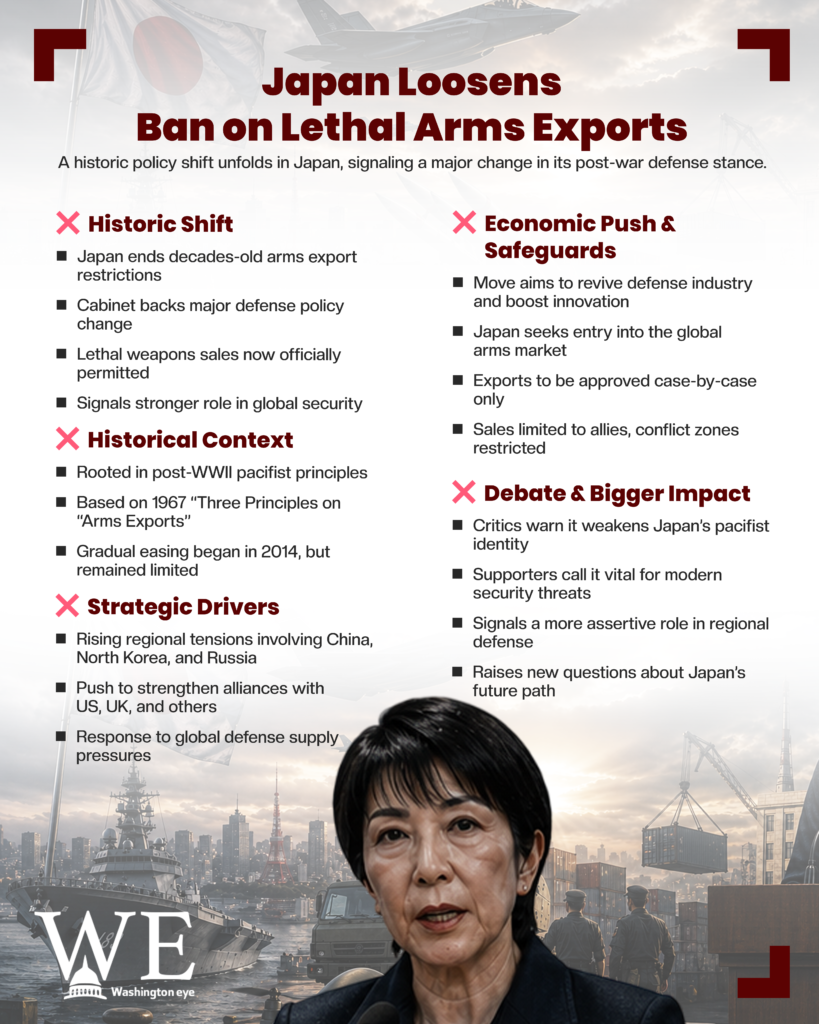
The move represents a fundamental break from Japan’s postwar security framework, which was rooted in its pacifist constitution and strict controls on arms exports. These controls were originally shaped by the “Three Principles on Arms Exports,” introduced in 1967, which effectively prohibited the transfer of military equipment to countries involved in conflict or under international sanctions. Over time, the restrictions were gradually eased, most notably in 2014, but exports remained largely limited to non-lethal or defensive equipment such as surveillance systems or rescue gear.
Under the new policy, Japan has removed key restrictions that previously confined exports to non-combat uses. The revised guidelines abolish earlier categories that limited transfers and now allow, in principle, the export of weapons with lethal capabilities. However, the government has emphasized that strict controls remain in place: exports must be approved on a case-by-case basis, recipients must be trusted allies with defense agreements, and shipments to countries actively engaged in conflict are generally prohibited unless justified by national security considerations.
Officials in Tokyo argue that the shift is driven by a rapidly changing security environment in East Asia and beyond. Rising military tensions involving China, North Korea, and Russia have prompted Japan to rethink its defense posture and deepen cooperation with allies such as the United States, the United Kingdom, Australia, and Southeast Asian partners. The policy is also seen as a response to global pressures on arms supply chains, particularly as Western defense industries face increased demand due to conflicts in Ukraine and the Middle East.

Another major motivation is economic. Japan’s defense industry has long struggled due to decades of export restrictions and limited domestic demand. By opening access to international markets, the government aims to strengthen its industrial base, encourage innovation, and make defense manufacturing a viable growth sector. Japanese firms, including major manufacturers, are expected to benefit from new opportunities such as joint fighter jet development projects and naval contracts with allied countries.
Despite these strategic and economic arguments, the policy has sparked significant domestic and international debate. Critics within Japan warn that the move undermines the country’s pacifist identity and risks entangling it in global conflicts. Opposition politicians and civil society groups have described the change as a “major reversal” of postwar principles. Meanwhile, China and some regional observers have expressed concern that the shift could accelerate militarization in Asia and contribute to an arms race.
Supporters, however, view the policy as a necessary adaptation to modern realities. They argue that Japan can no longer rely solely on its defensive posture and must play a more active role in collective security. The government maintains that the new framework still aligns with international law and Japan’s commitment to peace, as exports will be limited to responsible partners and governed by strict oversight mechanisms.

The development also reflects a broader trend in Japan’s gradual shift away from strict pacifism over the past decade. Defense spending has increased steadily, and Tokyo has expanded military cooperation with allies through joint exercises, technology sharing, and equipment transfers. Analysts say the latest decision is not an isolated step but part of a long-term strategy to reposition Japan as a more assertive security actor in the Indo-Pacific region.
As the new policy takes effect, its impact will likely be closely watched both domestically and internationally. While it opens new economic and strategic opportunities for Japan, it also raises fundamental questions about the country’s identity, regional stability, and the future of its pacifist legacy.