The much-anticipated second round of peace talks between the United States and Iran has faltered amid deep mistrust, last-minute cancellations, and competing diplomatic agendas, despite intense global efforts, particularly by Pakistan, to revive negotiations. The proposed talks were expected to take place in Islamabad in late April 2026, following an earlier round held in the Pakistani capital earlier in April that ended without a breakthrough after marathon discussions.
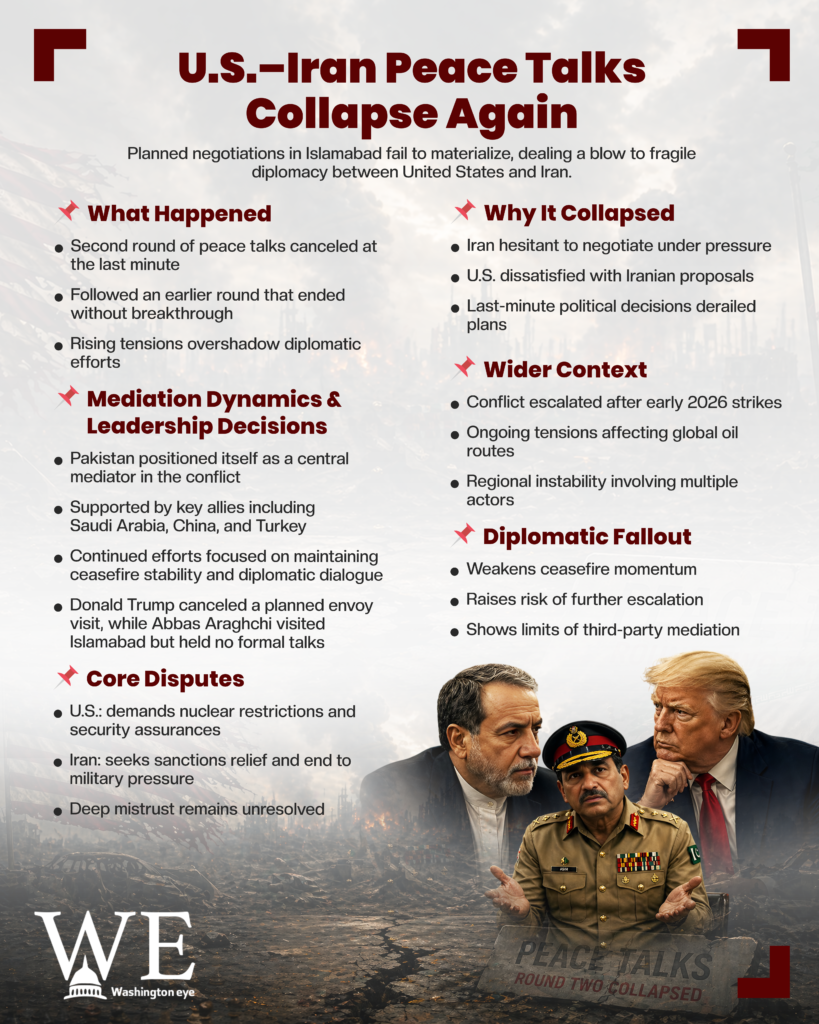
The renewed push for “Round Two” emerged against the backdrop of a fragile ceasefire in a conflict that began in late February 2026 after U.S.-Israeli strikes on Iran, escalating regional instability and disrupting global markets, particularly oil supply routes. The first round of talks failed largely due to disagreements over nuclear restrictions, regional proxy conflicts, and economic sanctions, with both sides accusing each other of inflexibility.
Pakistan positioned itself as a central mediator, leveraging diplomatic ties with both Washington and Tehran. Islamabad hosted delegations and coordinated with global stakeholders including Saudi Arabia, China, Turkey, and Egypt, aiming to build consensus and sustain the ceasefire. Pakistani Prime Minister Shehbaz Sharif and military leadership engaged directly with Iranian Foreign Minister Abbas Araghchi, while backchannel diplomacy continued even as public talks stalled.
However, momentum toward the second round weakened significantly in the days leading up to the expected meeting. Iran signaled hesitation, stating it had “no decision yet” on participation and emphasizing distrust toward Washington, particularly amid continued U.S. military pressure and maritime restrictions. Tehran also insisted that negotiations should not occur “under duress,” demanding relief from blockades and guarantees regarding its nuclear program.

On the U.S. side, President Donald Trump initially suggested that talks could resume quickly and even praised Pakistan’s mediation efforts, describing them as “fantastic.” Yet, in a dramatic turn, Trump abruptly canceled the planned visit of U.S. envoys to Pakistan, effectively derailing the second round.
In his public statements, Trump cited dissatisfaction with Iran’s proposals, describing them as insufficient and pointing to what he called “disarray” within Iran’s leadership. He also indicated that negotiations could resume only if Iran made more substantial concessions, including on nuclear commitments. Reports further suggested Trump dismissed the necessity of travel for talks and emphasized that Iran could initiate direct contact if serious about a deal.
Meanwhile, Iran’s delegation, led by Foreign Minister Abbas Araghchi, did travel to Islamabad but left without engaging in direct talks with U.S. officials, underscoring the collapse of the anticipated round. Iranian officials clarified that their visit was focused on consultations with Pakistan rather than trilateral negotiations, further highlighting the diplomatic disconnect.
The failure of Round Two reflects deeper structural challenges. At the core lies a clash of priorities: the U.S. seeks strict nuclear limitations and regional security assurances, while Iran demands sanctions relief, recognition of its strategic autonomy, and an end to external military pressure. This mismatch has repeatedly stalled negotiations despite temporary ceasefires.
Critically, Pakistan’s mediation, while widely praised, has exposed both its growing diplomatic relevance and the limits of third-party facilitation in high-stakes geopolitical conflicts. Islamabad successfully brought both sides to the table in Round One and maintained communication channels, but it could not overcome entrenched distrust or shifting political calculations in Washington and Tehran.
The broader international community continues to watch closely. Regional actors such as Oman and Russia are now being considered as alternative venues or partners for future negotiations, while China and Gulf states remain supportive of diplomatic efforts. However, escalating tensions in the Middle East, including conflicts involving Israel and Hezbollah, continue to complicate the diplomatic landscape.
In conclusion, while the idea of a second round of peace talks signaled cautious optimism, its collapse underscores the fragility of current diplomacy. Without mutual trust, clear concessions, and sustained international coordination, prospects for a comprehensive peace agreement remain uncertain. Yet, ongoing backchannel efforts suggest that dialogue, however delayed, has not been entirely abandoned.