
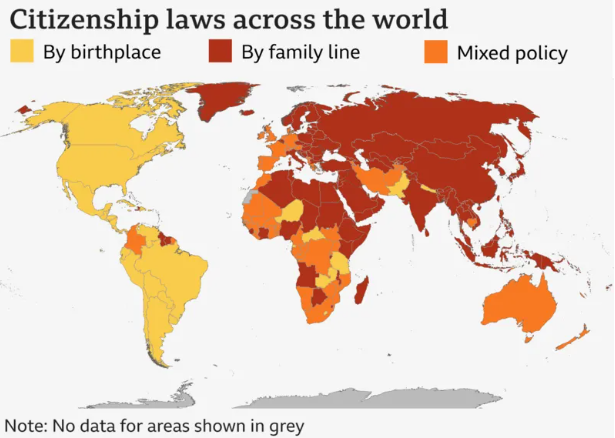
Birthright citizenship, legally known as jus soli (right of the soil), remains one of the most debated immigration policies worldwide, as governments revisit nationality laws in response to migration trends, demographic pressures, and political shifts. As of 2026, only a limited number of countries continue to grant automatic citizenship to individuals born on their territory, while many others have restricted or abolished the practice over the past few decades.
Historically, birthright citizenship emerged as a legal principle to ensure inclusion and prevent statelessness, particularly in countries shaped by immigration. The concept is most strongly associated with the Americas, where colonial histories and population-building policies encouraged automatic citizenship for those born within national borders. The most prominent example remains the United States, where the 14th Amendment guarantees citizenship to nearly all individuals born on U.S. soil, regardless of their parents’ nationality or immigration status. This policy has been central to American identity but continues to spark political debate over immigration control and national security.
Similarly, countries such as Canada and Mexico maintain unrestricted birthright citizenship, granting automatic nationality to anyone born within their territories. In Latin America, the practice is even more widespread, with nations like Brazil, Argentina, and Chile continuing to uphold jus soli as a foundational legal principle. These countries often view the policy as a tool for social inclusion and demographic growth.

In contrast, most European nations have moved away from unconditional birthright citizenship. Countries such as Germany, France, and the United Kingdom now apply a conditional jus soli system. Under these frameworks, a child born in the country may only acquire citizenship if at least one parent is a legal resident, citizen, or has lived in the country for a specified number of years. This shift, implemented largely in the late 20th and early 21st centuries, reflects efforts to balance integration with immigration control.

The tightening of birthright citizenship laws has also been observed in countries like Australia and New Zealand, which ended automatic citizenship for all births in 1986 and 2006 respectively. Today, these countries require at least one parent to hold citizenship or permanent residency status. Similarly, in Asia, unconditional jus soli is rare. Nations such as India have significantly restricted the policy, requiring parental citizenship or legal status, particularly after legislative changes aimed at addressing undocumented migration.
A few exceptions remain outside the Americas. Some Caribbean nations, including Jamaica and Barbados, continue to offer relatively broad birthright citizenship, although certain conditions may apply. Meanwhile, African countries largely follow descent-based citizenship (jus sanguinis), though limited forms of jus soli may exist to prevent statelessness.
The process of obtaining citizenship through birthright is typically automatic in countries with unrestricted jus soli. A birth certificate issued by local authorities serves as proof of citizenship, allowing individuals to apply for passports and access rights such as education, healthcare, and voting (upon reaching legal age). In conditional systems, however, additional documentation is required to prove parental residency or citizenship status, often making the process more complex.

Critics of birthright citizenship argue that it can incentivize “birth tourism,” where individuals travel to certain countries specifically to give birth and secure citizenship for their child. Supporters, however, maintain that the policy promotes equality, reduces discrimination, and prevents the emergence of stateless populations. International organizations have also emphasized its role in safeguarding children’s rights, particularly in regions with large migrant communities.
The global trend indicates a gradual decline in unrestricted birthright citizenship, with most countries favoring hybrid or conditional systems. However, the Americas remain a stronghold of the policy, reflecting historical and cultural commitments to immigration and inclusion. As debates continue in political arenas, from Washington to European capitals, the future of birthright citizenship remains uncertain, shaped by competing priorities of national sovereignty, human rights, and demographic change.