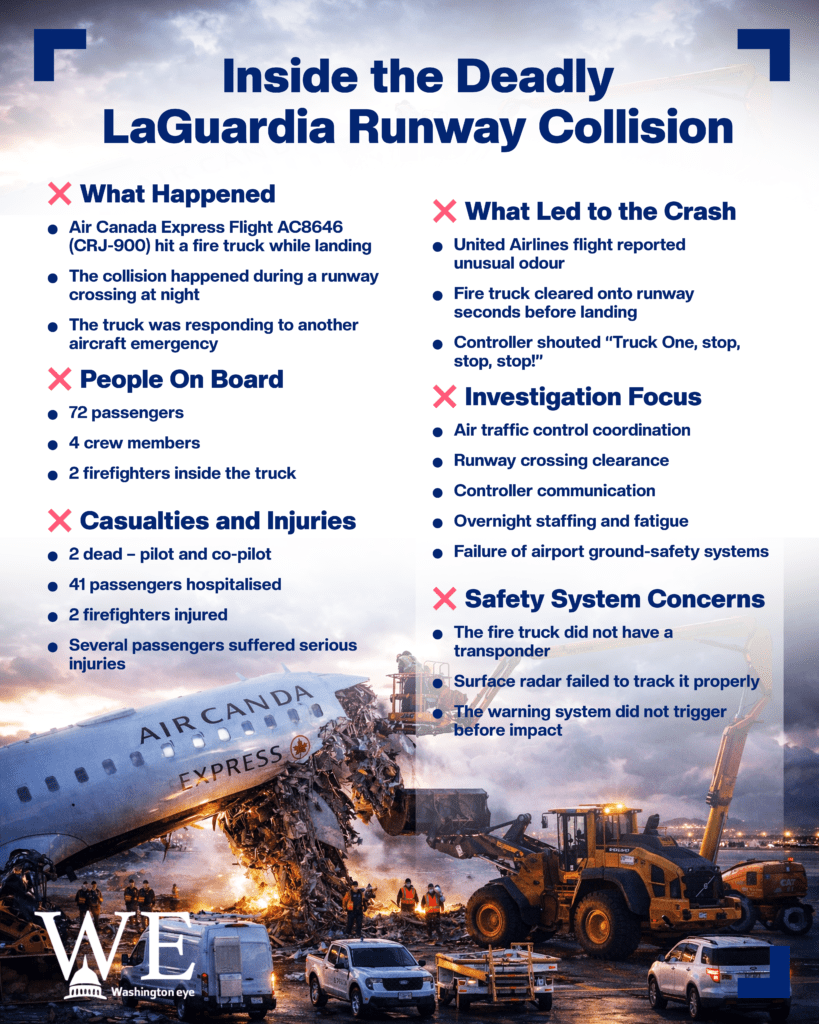

A deadly runway collision at LaGuardia Airport in New York has raised urgent questions about air traffic control coordination, overnight staffing and the reliability of airport ground-safety systems after an Air Canada Express jet struck a fire truck while landing. The crash killed both pilots and left dozens injured, turning one of the busiest airports in the United States into the centre of a major aviation safety investigation.
The aircraft, a CRJ-900 operated by Jazz Aviation as Air Canada Flight AC8646 from Montreal, was carrying 72 passengers and four crew members when it collided with a Port Authority fire truck late Sunday night. The truck had been responding to a separate emergency involving a United Airlines flight that had reported an unusual odour on board. According to investigators, the truck had been cleared to cross the runway moments before the Air Canada aircraft touched down.
Early evidence suggests the focus of the investigation is now on runway coordination and communication inside the control tower. The National Transportation Safety Board (NTSB) said one of only two controllers on duty had cleared the truck to cross just 12 seconds before touchdown, leaving almost no margin for recovery. Audio recordings captured the controller urgently shouting, “Truck One, stop, stop, stop!” in the final seconds before impact. Roughly 20 minutes later, the same controller appeared to blame himself, saying, “I messed up.”
Investigators are also examining why the airport’s safety systems failed to prevent the crash. The NTSB said the fire truck was not equipped with a transponder, meaning it could not be properly tracked by ASDE-X, the airport’s surface detection system. The system also did not generate an alert before the collision because it could not create a high-confidence track as vehicles merged and separated near the runway. Those findings have raised wider concerns about whether current technology and procedures are enough to protect aircraft and emergency vehicles moving in high-pressure airfield environments.
The crash happened at an airport already known for congestion and tightly coordinated movements. LaGuardia, located in Queens, handled more than 16.7 million departing passengers in 2024, according to FAA data released in 2025. While former FAA officials have said LaGuardia is not typically plagued by chronic staffing shortages, the overnight shift and the pressure of handling an earlier emergency are likely to come under close scrutiny. Investigators are expected to examine workload, fatigue, overtime and whether system-level gaps contributed to the tragedy.