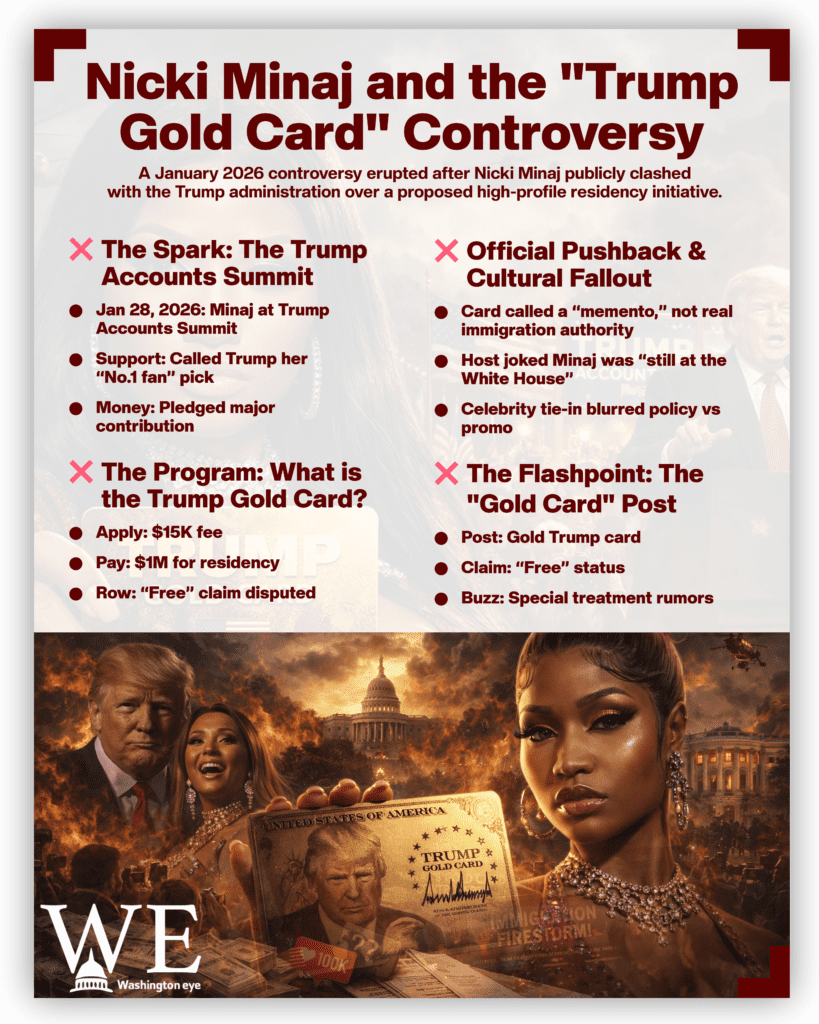
Nicki Minaj has triggered a fresh round of controversy after posting what she called a “Trump Gold Card” and tying it to her U.S. citizenship paperwork, a claim that immediately set off debate over immigration, celebrity influence, and the price-tag politics of President Donald Trump’s newest residency initiative. The episode unfolded in late January 2026 and spilled into the Grammys stage days later, turning a policy-branded card into a full-blown cultural flashpoint.
The spark came from Washington, D.C., where Minaj appeared on January 28 at the Trump Accounts Summit, an event promoting the administration’s proposed “Trump Accounts” concept, and delivered a short, highly supportive on-stage message. In remarks reported by multiple outlets, Minaj called herself Trump’s “No. 1 fan,” argued that criticism only motivates her support further, and framed Trump as a target of “bullying,” adding a religious note that “God is protecting him.” She also signaled she would contribute a substantial amount of money to the “Trump accounts,” placing her not just as a celebrity endorser but as a donor-aligned participant in the initiative’s rollout.
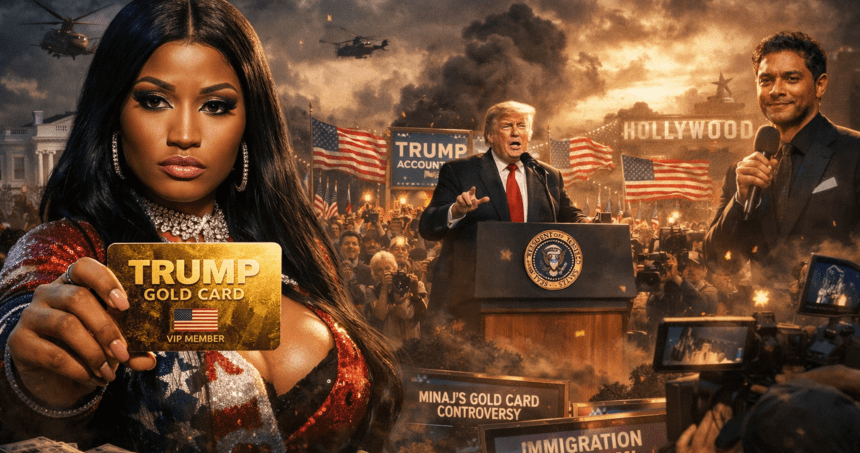
Within about a day, the moment escalated online. Minaj posted an image of a “Gold Trump card” and wrote that her citizenship paperwork was being finalized, describing the card as “free of charge.” Her post was widely shared and interpreted by many users as proof that she had received special treatment, either through the administration or through some fast-track mechanism tied to Trump’s new immigration pitch.

That interpretation collided with the basics of what the “Trump Gold Card” is marketed to be. A U.S. government-branded website describing the program states that applicants pay a $15,000 processing fee and, after background approval, make a $1 million contribution in exchange for expedited U.S. residency. In other words, the card is presented as a premium pathway that explicitly costs money, a framing that makes the idea of a celebrity receiving it “free” instantly polarizing.
As backlash grew, reporting indicated the White House disputed the idea that Minaj’s card carried immigration authority, with at least one account describing it as a “memento” rather than a valid visa or immigration document. That pushback fueled a second wave of arguments online: supporters said the outrage was overblown and rooted in “celebrity hate,” while critics argued the whole episode illustrated how easily branding and proximity to power can blur public understanding of immigration processes.
The controversy didn’t stay confined to social media. It bled into pop culture’s biggest night when Grammys host Trevor Noah joked about Minaj’s absence from the 2026 ceremony, quipping that she was “still at the White House” with Trump and performing an impersonation that drew a loud audience reaction. The gag effectively sealed the story’s crossover from politics into entertainment: Minaj’s “Gold Card” became a shorthand punchline for celebrity access and political alignment, and a reminder of how quickly policy messaging turns into meme currency when stars are involved.
Underneath the noise, the “price” angle has remained central. The Gold Card’s advertised costs, and the broader idea of monetizing fast-track residency, have been cited by critics as emblematic of a pay-to-play immigration philosophy, while supporters argue it’s a transparent, revenue-generating filter that attracts wealthy applicants and investment. Minaj’s case amplified that argument because her framing (“free of charge”) collided directly with a program built around explicit fees, raising questions about what was symbolic, what was procedural, and what was promotional theater.
For Minaj, the incident also lands in a familiar dynamic: an artist with an intensely loyal fanbase, a long history of online battles, and a proven ability to drive attention, now colliding with the country’s most attention-driven political figure. Whether the card was symbolic or substantive, the larger impact is already clear: a single post turned a niche policy brand into a global trend, reframing an immigration debate through celebrity identity, fandom tribalism, and America’s ongoing obsession with who gets access, and how.