
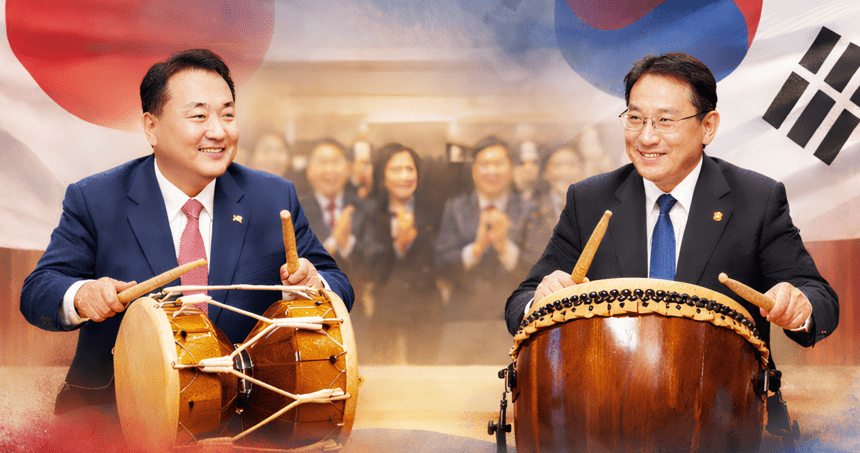
In a striking display of cultural diplomacy, the leaders of Japan and South Korea stepped away from formal negotiations to share a lighter, symbolic moment: performing traditional drum rhythms together during an official bilateral meeting. The brief but widely shared performance, held on the sidelines of high-level talks in Tokyo on 13 January, 2026, quickly captured public attention across both countries and beyond, highlighting how soft power and shared heritage continue to shape Northeast Asian diplomacy.
The moment took place during President Yoon Suk Yeol’s official visit to Japan, where he met with Prime Minister Fumio Kishida as part of ongoing efforts to stabilize and strengthen relations between the two neighboring nations. At a cultural showcase arranged alongside the summit, the two leaders were invited to try their hands at traditional percussion instruments, Japan’s taiko drum and Korea’s janggu, a double-headed drum central to Korean folk and court music.
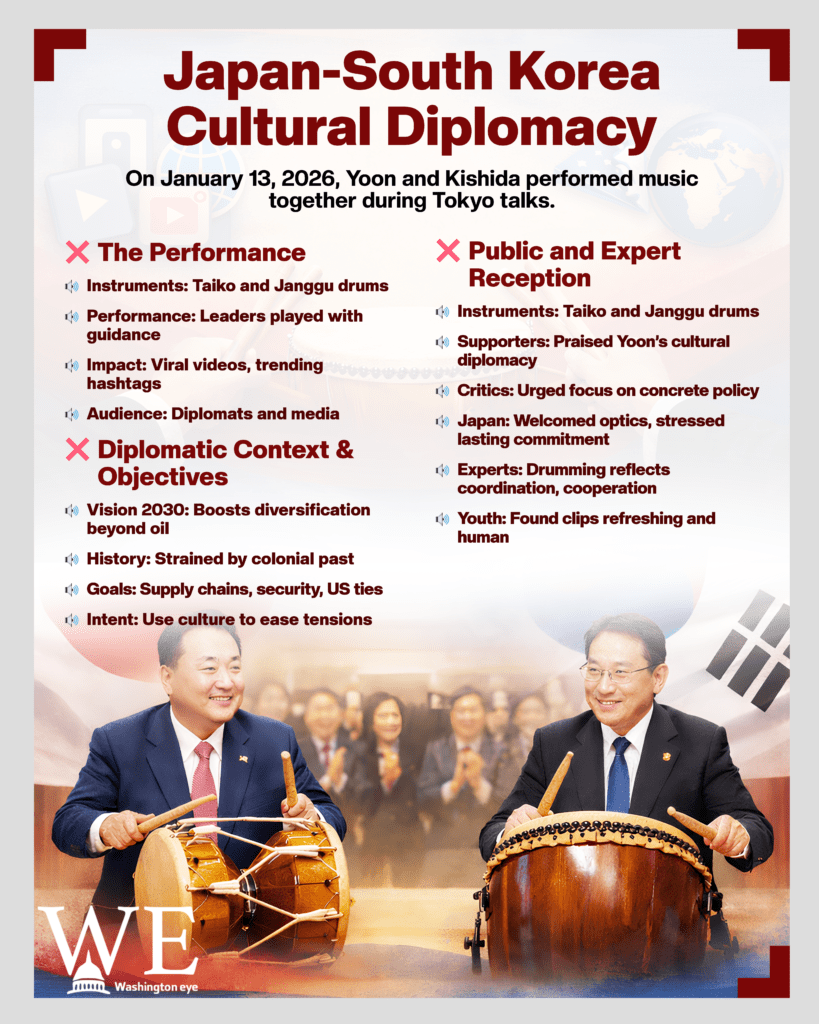
What might have been a brief ceremonial gesture soon became a headline moment. Videos released by official channels and circulated widely on social media showed both leaders smiling, slightly tentative at first, before settling into rhythmic beats guided by professional musicians. The audience, composed of diplomats, cultural figures, and media representatives, responded with applause, while commentators quickly framed the scene as a deliberate signal of goodwill.
The drumming display came at a time when Japan–South Korea relations, long strained by historical grievances stemming from Japan’s colonial rule of the Korean Peninsula (1910–1945), have been undergoing cautious repair. Recent years have seen renewed dialogue on security cooperation, economic resilience, and regional stability, particularly amid shared concerns over North Korea’s weapons programs and broader geopolitical shifts in East Asia.
Officials from both sides emphasized that the cultural segment was not accidental. According to diplomatic sources, the inclusion of traditional music was intended to underscore mutual respect and shared regional identity, without diminishing the seriousness of political discussions. “Culture allows leaders to communicate beyond policy language,” one senior Japanese official noted, adding that such gestures can “soften public perceptions and build trust.”
The broader meeting agenda covered issues ranging from trade and technology cooperation to trilateral coordination with the United States. Both governments have been seeking to stabilize supply chains, deepen security ties, and present a united front on regional challenges. Against this backdrop, the drumming moment served as a visual counterpoint to the often technical and tense nature of diplomatic negotiations.
In South Korea, reactions were mixed but largely positive. Supporters praised President Yoon for engaging in cultural diplomacy and projecting confidence on the international stage. Critics, however, cautioned against over-symbolism, arguing that unresolved historical and legal disputes require concrete policy outcomes rather than gestures. Similar debates unfolded in Japan, where commentators welcomed the friendly optics but stressed the importance of sustained political commitment.

Cultural experts highlighted the deeper resonance of the scene. Drumming traditions in both countries emphasize rhythm, coordination, and collective effort, qualities often invoked in discussions of regional cooperation. “When leaders participate in each other’s cultural practices, it sends a message of recognition and respect,” said a Tokyo-based cultural historian. “It does not erase the past, but it suggests a willingness to move forward.”
The images also resonated with younger audiences, many of whom encountered the moment first through short video clips online. Hashtags related to the performance trended briefly in both countries, with users describing the scene as “unexpected,” “human,” and “refreshing.” For governments increasingly aware of public diplomacy in the digital age, such viral moments carry strategic value.
While no one is suggesting that a drum performance can resolve decades of diplomatic tension, the episode illustrates how symbolism continues to play a role in international relations. As Japan and South Korea navigate a complex mix of historical memory, domestic politics, and regional security pressures, moments like these can help create a more favorable environment for dialogue.
As the Tokyo meetings concluded, both leaders reiterated their commitment to continued engagement and practical cooperation. The sound of drums, echoing briefly through a formal diplomatic setting, may not change policy overnight, but it has added a memorable beat to the evolving rhythm of Japan–South Korea relations.