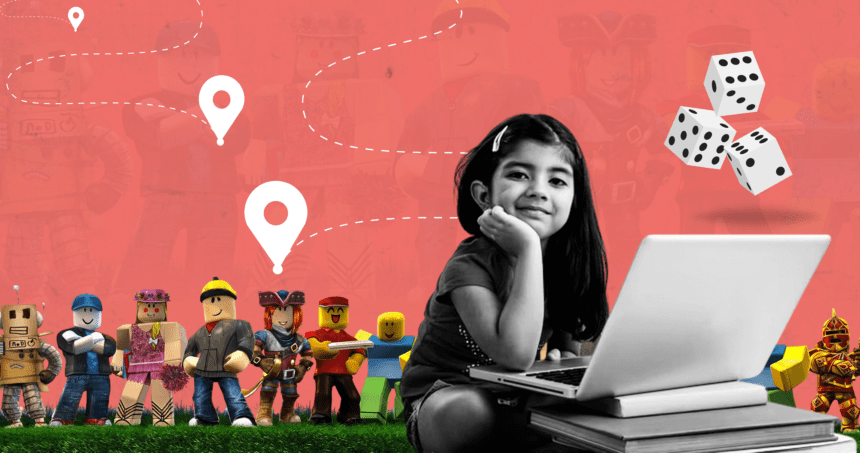
Roblox, one of the world’s most widely used gaming platforms among children and teenagers, is facing renewed global scrutiny as concerns grow over child safety, mental health impacts, and the platform’s exposure to vulgar or hidden sexual content. Launched in 2006 in the United States, Roblox allows players to join millions of user-created games and experiences, attracting a massive youth audience. Around 40% of its users are under the age of 13, and the platform has long been marketed as a safe, creative playground. However, investigations and parental reports now suggest that Roblox contains darker corners that younger players can access within minutes of logging in.
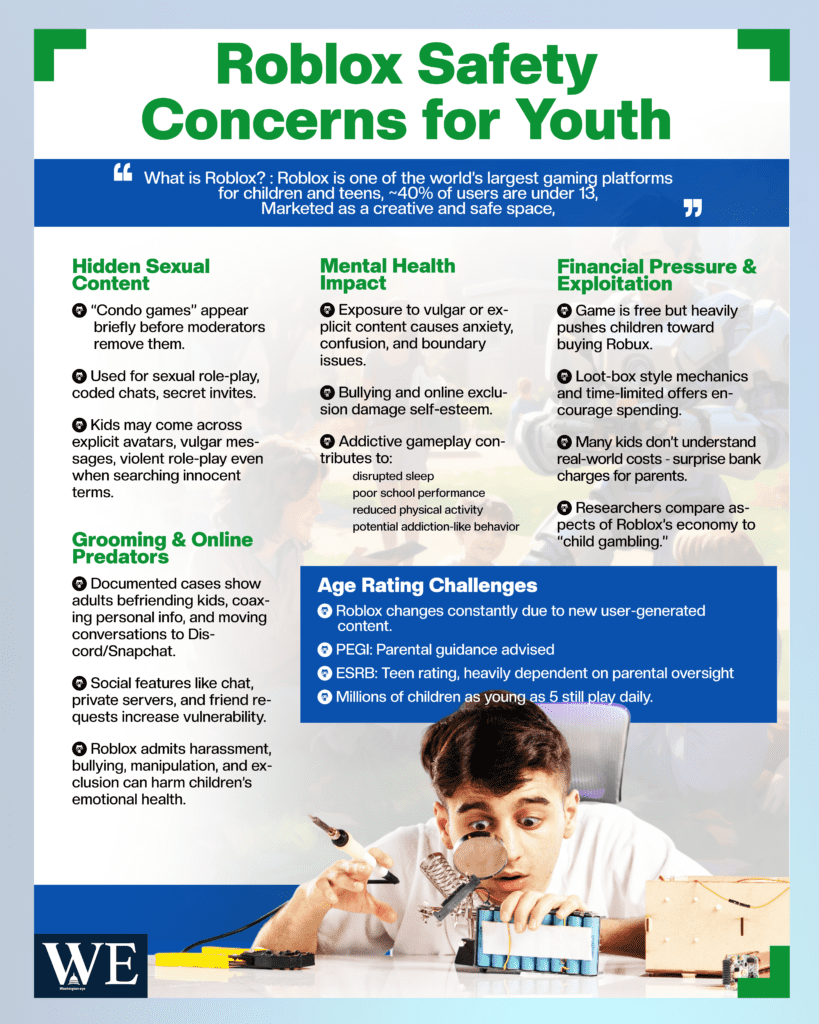
Safety experts warn that user-generated content makes the platform difficult to regulate. Hidden “condo games,” which appear briefly before being shut down by moderators, are often used for sexual role-play, disguised behind coded language and private chat invitations. Children may encounter inappropriate messages, suggestive avatars, explicit conversations or violent role-play scenarios even when they search for seemingly harmless content.
Mental-health specialists say such encounters can damage a child’s sense of safety, trigger anxiety, or distort their understanding of relationships and boundaries. The platform’s social features also create risks of grooming, with several documented cases showing predators befriending children in-game, extracting personal information and attempting contact outside Roblox through apps like Discord or Snapchat. Roblox itself acknowledges that online harassment, exclusion, bullying and manipulation can erode self-confidence and contribute to emotional stress among young players.

Another rising concern is financial pressure inside the game. Although Roblox is free to download, children often feel compelled to purchase the virtual currency Robux to access popular game features, buy character outfits, or participate in online trends. Researchers have criticized Roblox’s in-game economy as overly complex and potentially exploitative, comparing some mechanisms to “child gambling” due to time-limited offers, loot-box–style incentives and unclear real-world value. Many parents report surprise bank charges after children make repeated purchases through app stores, often without fully understanding the cost.

Age-rating agencies have also struggled to categorize Roblox because the platform constantly changes as players upload new content. Europe’s PEGI system now advises parental guidance, while the U.S. ESRB recommends the game for teens, noting that its safety depends heavily on parental oversight. Still, millions of younger children, some as young as five, regularly spend hours on the platform, raising concerns among pediatricians about poor sleep, reduced physical activity and potential addiction-like behaviors that interfere with school and family routines.
Governments worldwide are responding differently to Roblox’s growing influence. Several countries, including Turkey, Qatar, Kuwait, Iraq and Palestine, have enacted bans or severe restrictions, citing child exploitation, extremist content or moral concerns. On December 3, 2025, Russia’s Roskomnadzor also blocked Roblox, accusing it of spreading extremist material and content harmful to minors. In the United States, the company is facing multiple lawsuits from parents who say Roblox failed to protect children from sexual exploitation, manipulation and deceptive monetization schemes.
In response, Roblox Corporation has expanded its parental-control offerings, allowing parents to restrict chat, block spending, filter content by maturity level, set time limits and review activity logs. The company is also rolling out age verification and age-segmented chat environments to prevent younger players from interacting with adults, although critics remain uncertain whether these measures are strong enough to stop determined offenders.

Child-safety advocates emphasize that technology alone cannot solve the problem; parents must treat Roblox not merely as a game but as a social platform where real risks exist. They encourage families to play together, discuss online safety openly, set firm screen-time boundaries, and monitor communication platforms linked to gaming.
Despite the controversies, Roblox still offers positive spaces where children learn coding, build games, and socialize creatively. The debate now centers on whether the platform, regulators, and parents can strike the right balance between freedom, creativity, and essential child protection as online environments increasingly blur the boundary between play and danger.