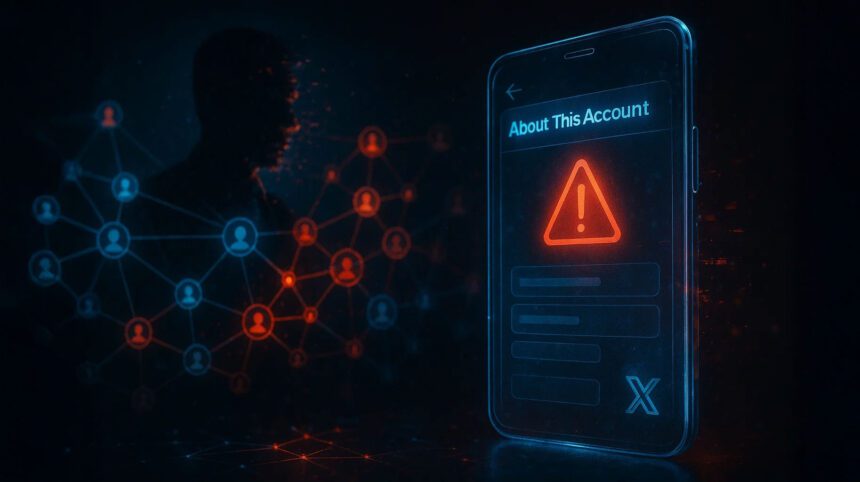
Elon Musk’s social platform X faced a wave of scrutiny this week after a newly introduced “About This Account” feature revealed that several high-profile political accounts projecting themselves as hardcore American conservatives, were actually being operated from outside the United States. The discovery reinforced long-standing warnings from intelligence agencies and cybersecurity experts about how foreign-run accounts can infiltrate political discourse, shape narratives, and amplify disinformation. It also sparked new questions about whether some of these users were motivated less by ideology and more by X’s revenue-sharing program, which pays creators with large followings.
Among the most striking revelations was a pro-Trump account with more than 50,000 followers, branded heavily with American symbols and slogans about “the Trump movement,” which turned out to be linked to the Nigeria App Store. Another account simply named @American was shown to be based in Pakistan. Digital investigator Benjamin Strick identified entire clusters of accounts claiming to be Trump-supporting women bios filled with hashtags like #MAGA and #Patriots that were actually operating from Thailand. Many of those accounts were quickly taken down after the revelations spread.
The feature also exposed less overt but equally misleading profiles, including an account promising insider updates about former ICE official Tom Homan that appeared to originate in Eastern Europe, and another devoted to Ivanka Trump that was linked once again to Nigeria. While the tool includes disclaimers that the displayed location may be affected by travel or temporary relocation, experts say the patterns point clearly to large-scale inauthentic activity.
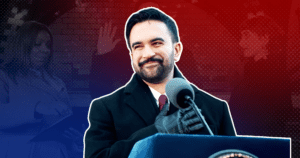
The rollout of this transparency tool was announced in October by X’s head of product, Nikita Bier, as part of a broader push for users to verify the authenticity of accounts and content. Bier described the feature as a first step toward protecting “the integrity of the global town square.” He noted that privacy settings were added for users in countries with restricted speech. However, the launch was bumpy: registration location data briefly disappeared, and Bier warned that the system was “not 100%” accurate for older accounts.
Even legitimate institutions became entangled in the confusion. False screenshots circulated widely claiming the U.S. Department of Homeland Security’s X account was based in Israel, forcing DHS to publicly reject the claim and warn that manipulated images can easily mislead. The controversy underscored a larger challenge: as AI-generated disinformation accelerates, it is becoming harder than ever for users to distinguish genuine voices from foreign influence operations.

The incident ultimately highlighted a fundamental truth of the modern information ecosystem: even small platform updates can expose vast networks of deception hiding in plain sight.