U.S. border officials are moving toward requiring visa-free tourists to disclose up to five years of social media history as part of an expanded pre-travel screening proposal that would significantly widen the amount of personal data collected before visitors board a plane to the United States. The plan, outlined this week in a federal notice and reported by multiple outlets, would apply to travelers entering under the Visa Waiver Program (VWP), citizens of 42 countries (including Germany, the UK, France, Japan, Australia, South Korea and others) who typically do not need a visa for short stays but must obtain approval through the Electronic System for Travel Authorization (ESTA).
The proposed change surfaced publicly around December 10–11, 2025, after U.S. Customs and Border Protection (CBP), part of the Department of Homeland Security (DHS), published details of an overhaul to the ESTA process. According to reporting, CBP is also considering a broader “data expansion” package tied to travel screening: 10 years of email addresses, five years of phone numbers, and additional family information (such as contact details and residences), alongside the social media requirement. In Australia, the proposal triggered fresh advisories and a new wave of debate about how much of a person’s online identity should be examined as a condition of entry.
Officials frame the proposal as a national security and public safety measure, arguing that more robust identity and risk checks can help flag threats earlier, before someone arrives at a U.S. airport. CBS reports that DHS linked the push to an executive order issued earlier in 2025 focused on denying entry to individuals deemed security or safety risks. ABC notes CBP characterized the notice as an early step to discuss new policy options “to keep the American people safe,” while also pointing to increased border searches and “media searches” as part of broader enforcement trends this year.
In practical terms, the proposal would shift what has been optional into something closer to mandatory for visa-exempt tourists. ABC reports that listing social media usernames has been optional on ESTA since 2016, but would become compulsory under the new plan. Separately, and importantly for context, the U.S. has already required many visa applicants to list social media identifiers used in the last five years on State Department forms since 2019, meaning the new proposal would extend a similar concept more deeply into visa-free travel.

Supporters of tougher screening argue that digital footprints can help investigators confirm identity, detect fraud networks, and identify security-relevant affiliations, especially when combined with other travel and biographic data. Critics, however, warn the shift could normalize mass “pre-crime” style profiling, chill lawful speech, and create uncertainty over what kinds of posts, political commentary, satire, or criticism of U.S. policy, could trigger delays or denials. Civil liberties advocates have long raised concerns about error-prone interpretation of online content, language barriers, and context collapse (for example, jokes or reposts being treated as intent). ABC also highlighted expert warnings that people who are politically outspoken online may feel particularly exposed.
There is also a tourism and diplomacy dimension. CBS notes critics fear the added disclosures could discourage visitors, especially as the U.S. heads toward a high-profile travel year with major events like the 2026 FIFA World Cup hosted across North America. Travel industry stakeholders typically argue that heavier friction in entry systems can push travelers toward alternative destinations, while also increasing compliance costs and processing burdens. Even for travelers who have nothing to hide, the requirement to remember and accurately list years of handles, platforms, and accounts can become a paperwork risk where mistakes are treated as misrepresentation.
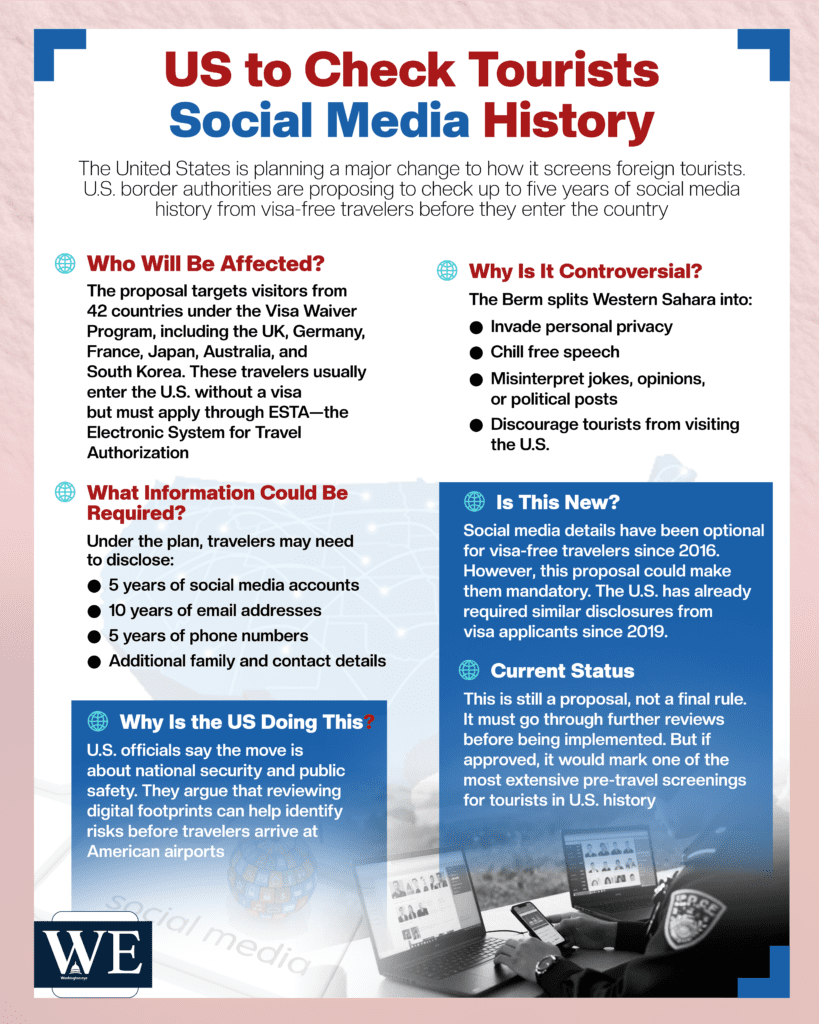
For now, the policy remains a proposal, not a finalized rule. Reporting indicates the changes would still require further government review, including budget/oversight processes, before becoming operational. In the meantime, the debate is likely to intensify over where the boundary should sit between legitimate screening and invasive surveillance, especially for ordinary tourists whose travel is short-term and low-risk.