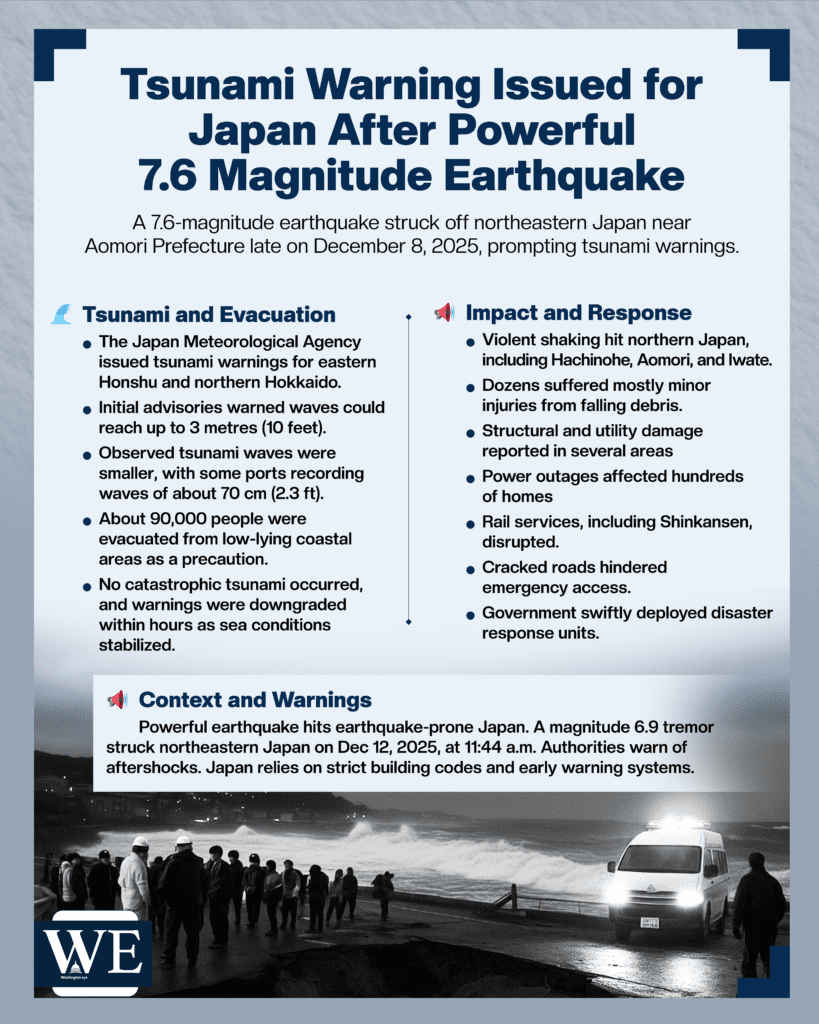
A major earthquake with a magnitude of 7.6 struck off the northeastern coast of Japan late on Monday, December 8, 2025, sending shockwaves across the Pacific coast and prompting emergency authorities to issue tsunami warnings and evacuation orders for tens of thousands of residents. The quake occurred around 11:15 p.m. local time, with its epicenter located approximately 80 kilometers (about 50 miles) offshore of Aomori Prefecture in the northern part of Honshu, Japan’s largest island, at a depth of roughly 50 kilometers beneath the seabed.
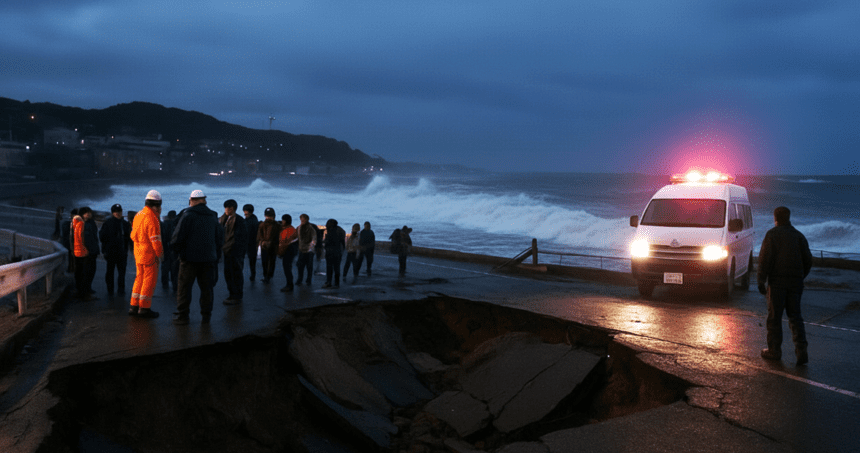
The Japan Meteorological Agency (JMA) immediately issued tsunami warnings for parts of the eastern coast of Honshu and northern Hokkaido, advising that waves could reach heights of up to 3 metres (10 feet) in some areas. Initial fears raised concerns of significant coastal inundation, but the observed tsunami waves were smaller, with some ports reporting waves of up to about 70 centimetres (2.3 feet).
The violent shaking was widely felt across northern Japan, including in cities such as Hachinohe, Aomori and parts of Iwate Prefecture, where buildings swayed and alarms blared, throwing residents into the streets. Authorities ordered the evacuation of roughly 90,000 people from low-lying coastal areas as a precautionary measure, emphasizing the unpredictability of tsunami wave patterns and the possibility of delayed secondary surges.

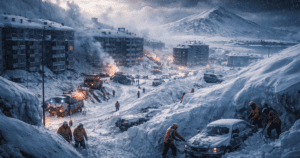
In the hours following the quake, reports began to emerge of structural and utility damage. Dozens of people sustained injuries, most of whom suffered minor harm from falling objects and debris, as rescue teams scrambled to assess conditions. Some communities reported power outages affecting hundreds of homes, disruptions to rail services including Shinkansen bullet train operations, and cracked road surfaces that impeded immediate access for emergency responders.

Despite the intensity of the quake and the tsunami warnings that followed, no catastrophic tsunami impact was recorded, and authorities were able to downgrade the warnings to advisories within hours as sea readings stabilised. Subsequent monitoring showed smaller wave activity along coastal sectors of northern Honshu and Hokkaido, reducing immediate coastal inundation concerns.
Japan’s government has rapidly mobilised disaster response units to support affected communities. Emergency task forces have been established to coordinate search-and-rescue operations, inspect infrastructure integrity, and restore essential services. The prime minister’s office emphasised that while there is no sign of major nuclear facility damage or radiation leaks, all critical infrastructure systems are being thoroughly examined as a precaution.
This powerful earthquake is the latest in a series of seismic activities that have struck Japan in recent days. On Friday, December 12, 2025, a separate magnitude 6.9 earthquake shook the same northeastern region around 11:44 a.m. local time, initially sparking another tsunami advisory that was later lifted after only minor wave activity was observed. Authorities have warned residents to remain on high alert for aftershocks and further seismic events, noting that earthquake sequences can trigger significant tremors within short intervals.

Japan’s location along the Pacific Ring of Fire, an arc of tectonic plate boundaries around the Pacific Ocean, makes it one of the most earthquake-prone regions on Earth. The movement of multiple tectonic plates, particularly where the Pacific Plate subducts beneath the North American and Eurasian Plates, generates frequent seismic activity. Japan’s comprehensive disaster readiness systems, developed from decades of experience and in response to historic events such as the 2011 Tōhoku earthquake and tsunami, are designed to mitigate loss of life and property. These systems include rigorous building codes, early warning networks and regular public evacuation drills.
While full damage assessments and casualty reports continue to be compiled, local governments have urged residents to remain vigilant, follow evacuation orders when issued, and review emergency plans and supplies. Officials also reminded people that the risk of powerful aftershocks and additional seismic activity remains through the coming days, encouraging ongoing adherence to safety guidance issued by disaster management agencies.