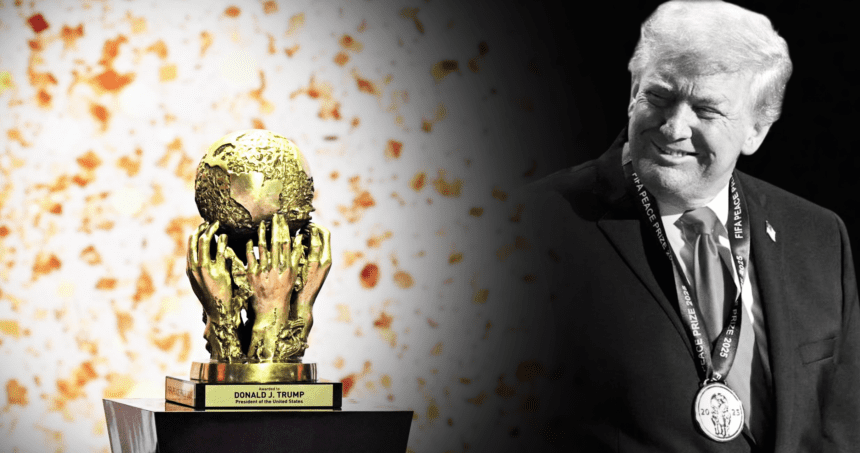
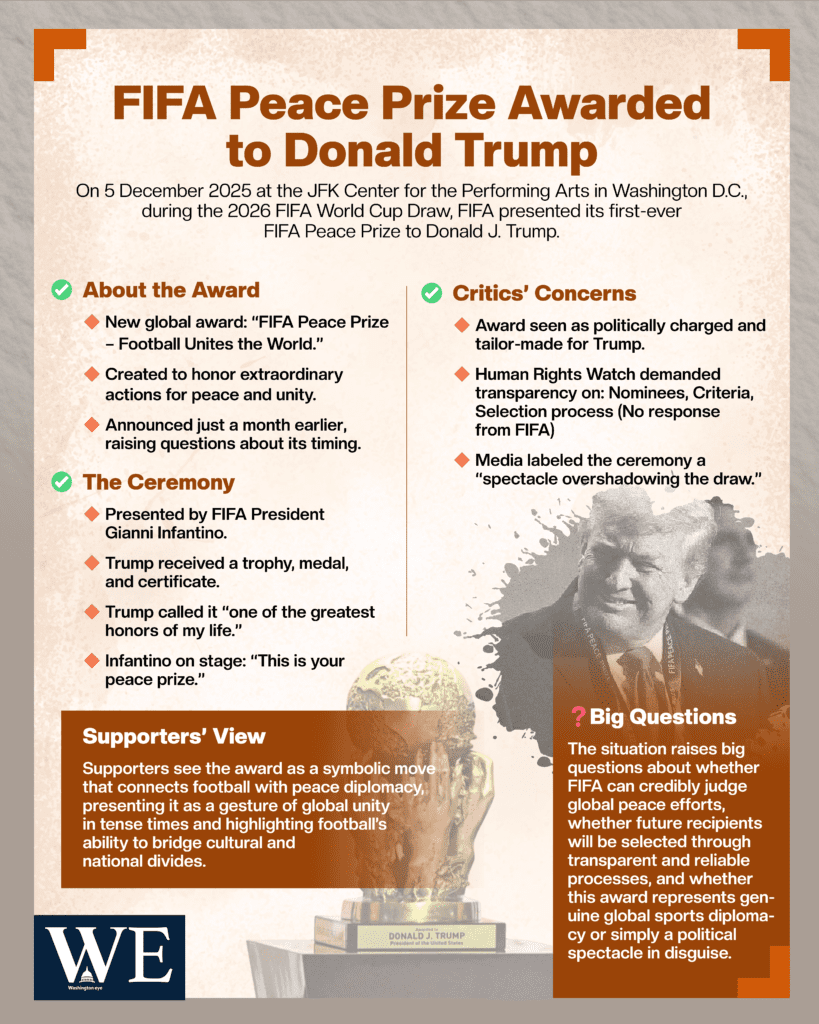
On 5 December 2025, during the draw for the 2026 World Cup at the John F. Kennedy Center for the Performing Arts in Washington, D.C., the global governing body of football, FIFA, presented its newly established peace award, the FIFA Peace Prize, to former U.S. President Donald J. Trump. The Peace Prize, officially named “FIFA Peace Prize, Football Unites the World,” was announced just a month earlier and described as an annual award to honor “individuals who have taken exceptional and extraordinary actions for peace and by doing so have united people across the world.”
During a ceremony filled with pageantry, part of the high-profile World Cup draw event, FIFA president Gianni Infantino personally handed Trump a trophy, a commemorative medal, and a certificate honoring his purported contributions to global peace and unity. As Infantino put it on stage, “This is your prize, this is your peace prize.” Trump, visibly moved, called the award “one of the greatest honors of my life,” claiming it recognized efforts he said had “saved millions and millions of lives.”
Supporters and critics responded almost immediately. On one hand, the move was praised by some as a bold gesture bridging sport and diplomacy, a symbolic nod to unity and cooperation at a time of global tensions. According to FIFA, the Peace Prize aims to reinforce football’s message that the sport can unite people across national, cultural, and political divides.
More Read

On the other hand, the awarding of the prize to Trump sparked sharp criticism. Many observers described the ceremony as a politically charged spectacle rather than a genuine peace-recognition event. Critics pointed to the fact that the Peace Prize was announced only recently, shortly after Trump failed to secure the 2025 Nobel Peace Prize, and suspected that the new award was effectively tailored for him.

Further concern came from human-rights organisations. Human Rights Watch (HRW) publicly criticised the lack of transparency around the prize: it has reportedly written to FIFA requesting details on who was nominated, who decided the winner, what criteria were used, and has not received a response. Many saw the award as incompatible with some of Trump’s recent policies and rhetoric, including tough immigration stances, aggressive law-and-order measures, and controversial foreign-policy actions.
Some media described the scene as a farce, suggesting the draw had been turned into a political spectacle with glitz overshadowing sport. According to one assessment, the Peace Prize segment “eclipsed” the actual World Cup draw itself, turning what should have been a routine sports event into an overt display of political alignment and self-promotion. Meanwhile, supporters argue that awarding such a prize during a global sporting event highlights football’s potential as a unifier beyond borders, suggesting a role in diplomacy, global engagement, and sport as a bridge between cultures.
Whether the Peace Prize will gain long-term credibility remains uncertain. The lack of a transparent nomination or evaluation process, the apparent timing shortly after Trump’s failed Nobel bid, and the close personal and political ties between Infantino and Trump have all fueled skepticism. Yet, for now, Trump stands as the first-ever recipient, and FIFA has signaled its willingness to make the Peace Prize a permanent annual award.
In Washington and beyond, the moment raised fundamental questions: Can a football organisation credibly evaluate global politics and peace efforts? Or does this mark a troubling fusion of sport, diplomacy, and partisanship? The eyes of the world are now on FIFA, and on whether future Peace Prize recipients will be chosen with greater independence and transparency, or whether the award remains, in critics’ words, a politically convenient spectacle.