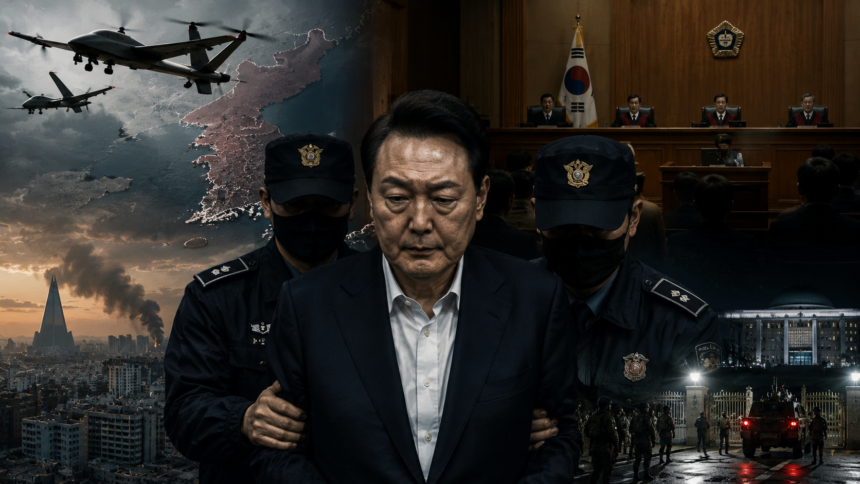
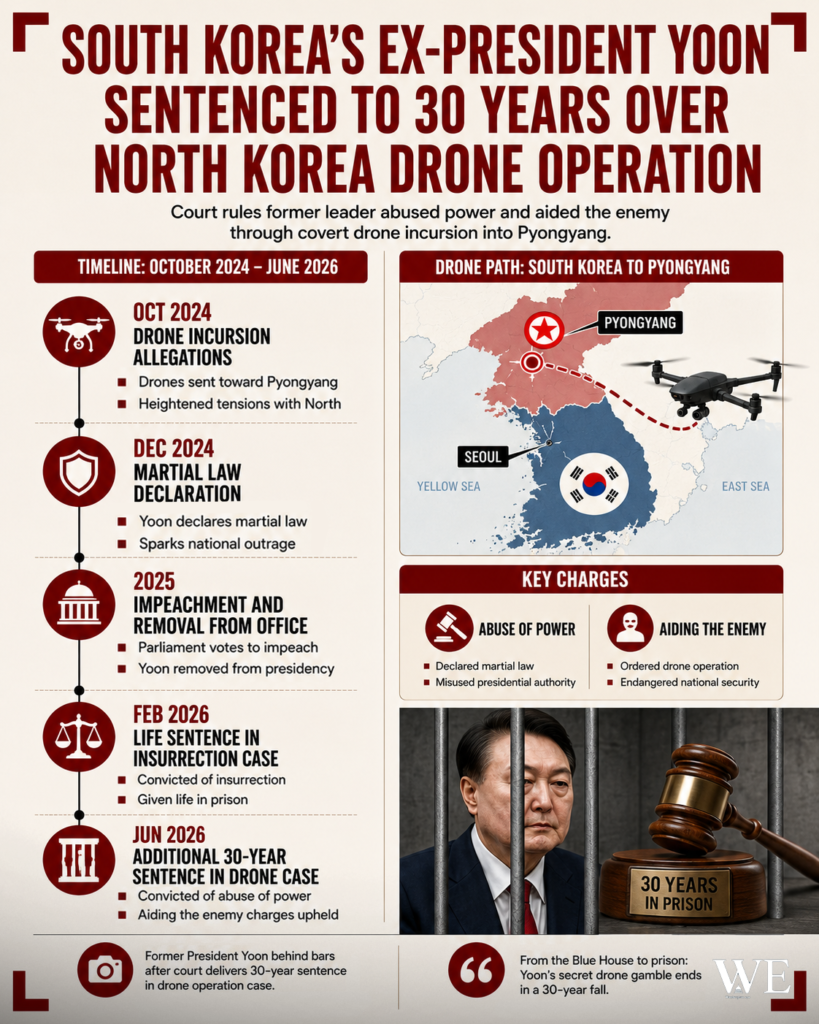
Former South Korean president Yoon Suk Yeol has been sentenced to 30 years in prison after a Seoul court found him guilty of involvement in a controversial military drone operation that flew into North Korean airspace in 2024. The ruling, delivered by the Seoul Central District Court on June 12, 2026, marks another dramatic chapter in one of the biggest political scandals in South Korea’s modern democratic history and further deepens the legal troubles facing the former conservative leader.
According to prosecutors, Yoon played a central role in authorizing and coordinating military drone incursions over Pyongyang in October 2024. The court concluded that the operation was not merely a defensive military action but part of a broader plan intended to heighten tensions with North Korea and create conditions that could later justify the declaration of martial law inside South Korea. Prosecutors argued that the drone flights deliberately increased security risks on the Korean Peninsula and endangered national interests.
The court found Yoon guilty of abuse of power and aiding the enemy, a serious offense under South Korean law. Judges stated that evidence showed the former president had been involved in planning the operation from its inception and that the drone mission contributed to escalating inter-Korean tensions at a particularly sensitive moment. The ruling accepted prosecutors’ argument that the operation was politically motivated and linked to events that unfolded later in 2024.

The case revolves around allegations that South Korean military drones crossed into North Korean airspace and operated over Pyongyang in October 2024. At the time, North Korea accused Seoul of violating its sovereignty and claimed the drones were carrying propaganda materials. The incident triggered angry reactions from Pyongyang and heightened fears of military confrontation between the two rivals. Although Seoul did not publicly confirm all details surrounding the operation, the controversy remained a major source of political debate.
Yoon has consistently denied any wrongdoing. His lawyers argued throughout the trial that he neither ordered nor approved the drone operation and insisted that the flights were unrelated to the political turmoil that later engulfed his administration. The defense maintained that any military activities near the border were legitimate responses to North Korean provocations, including repeated launches of trash-filled balloons across the demilitarized zone. They also rejected accusations that the operation was designed to manufacture a national security crisis.
The drone case is only one of several legal proceedings involving the former president. Earlier this year, Yoon was sentenced to life imprisonment after being convicted of leading an insurrection connected to his controversial declaration of martial law in December 2024. That declaration, which lasted only a few hours before lawmakers moved to overturn it, triggered widespread protests, political chaos and a constitutional crisis. The Constitutional Court later upheld his impeachment, removing him from office and paving the way for a snap presidential election.
The collapse of Yoon’s presidency has led to a series of prosecutions involving former senior officials. Several members of his administration, including former ministers and military leaders, have also received lengthy prison sentences for their roles in the martial law crisis and related events. South Korean prosecutors have described the cases as necessary to defend democratic institutions and ensure accountability for abuses of power.

Political analysts say the latest sentence highlights the severity with which South Korean courts have viewed the actions of Yoon and his associates. The country has a history of prosecuting former presidents, but the scale of the penalties imposed in the current cases is among the most significant in recent decades. The judgments reflect concerns that democratic norms and constitutional safeguards were threatened during the final months of Yoon’s presidency.
Despite the ruling, the legal battle is not over. Yoon remains in custody and is expected to continue appealing both the drone conviction and the earlier life sentence related to the martial law case. His supporters argue that the prosecutions are politically motivated, while critics contend that the convictions demonstrate the strength of South Korea’s democratic and judicial institutions. The appeals process could take months or even years before final decisions are reached.
The verdict comes at a time when South Korea is seeking to move beyond one of the most turbulent periods in its recent political history. Under President Lee Jae-myung, the government has pledged to restore public trust and strengthen democratic governance. Nevertheless, the shadow of the Yoon era, and the extraordinary allegations surrounding the drone operation and martial law crisis, continues to shape political debate across the country.