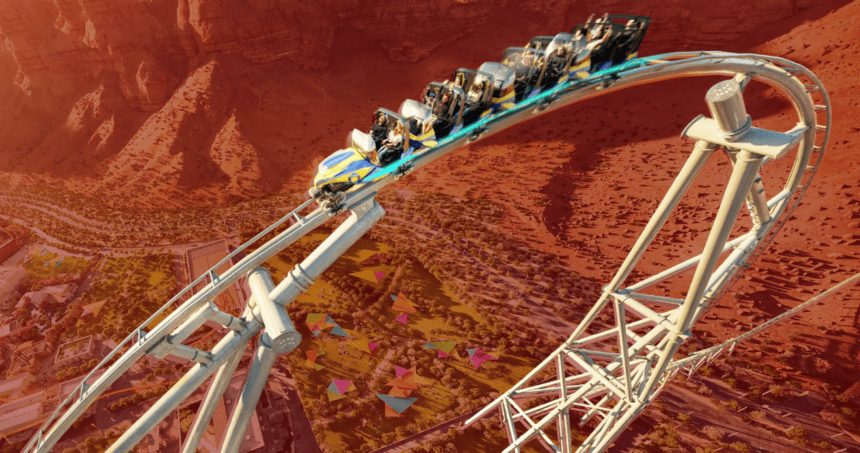
Saudi Arabia is preparing to add a new headline-grabbing landmark to its fast-expanding entertainment portfolio: a record-setting roller coaster billed as the world’s tallest and fastest, set to anchor the upcoming Six Flags Qiddiya City theme park on the outskirts of the capital. The coaster, called Falcon’s Flight, is being built in Qiddiya City, a major leisure development near Riyadh, and is designed to eclipse existing global benchmarks for height, speed and track length.
According to Six Flags Qiddiya City’s official ride description, Falcon’s Flight is planned as the world’s longest, tallest and fastest roller coaster, accelerating to roughly 240 km/h in 4.9 seconds. The scale is intended to be as dramatic as the setting: concept visuals and industry coverage show the track racing across the site and climbing toward a towering peak before plunging back down, positioning the ride as a signature attraction for thrill-seekers and international tourism marketing.
The coaster is part of Six Flags Qiddiya City, which Six Flags has described as its first theme park outside North America. The park is now publicly tied to a year-end launch window: multiple outlets report an opening date of December 31, 2025, as Qiddiya’s first major asset comes online within the wider Qiddiya City megaproject.

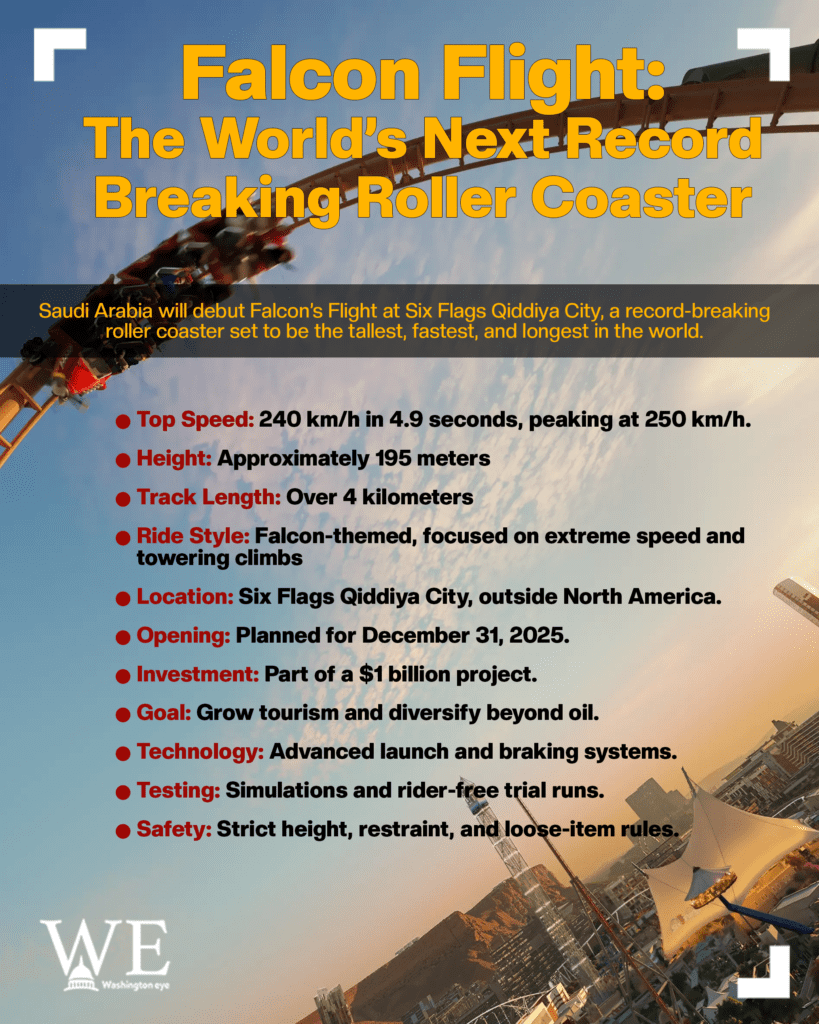
While Six Flags’ official page highlights the acceleration figure, broader published specifications for Falcon’s Flight have consistently pointed to extreme “record book” numbers, including a peak height around 195 meters and a top speed around 250 km/h (often framed as “projected” or “expected” records), alongside a track length exceeding four kilometers. Those metrics, if delivered as advertised, would surpass today’s best-known record holders elsewhere in the world and strengthen Saudi Arabia’s push to become a regional hub for big-ticket attractions.

The business logic is straightforward: Saudi Arabia has been investing heavily in leisure, sport and culture to broaden the economy beyond oil and to keep domestic tourism spending at home while attracting visitors from abroad. Six Flags Qiddiya City is part of that strategy, and has been widely described as a major investment, including reports of a $1 billion project in partnership with Qiddiya Investment Company, with a ride lineup designed to deliver multiple “world record” claims beyond Falcon’s Flight.
Safety is also central to the conversation whenever a coaster is marketed around extreme speed and height. Operators typically emphasize a layered approach: intensive engineering review, computer simulation, component testing, commissioning runs without riders, and ongoing daily inspections once operational. Falcon’s Flight is being developed with established industry involvement, including well-known coaster engineering and manufacturing expertise referenced in trade and enthusiast reporting, and its launch technology and braking systems will be designed to manage energy at very high speeds. Even after opening, theme parks generally require riders to meet height restrictions, follow secure restraint checks, and comply with loose-article rules that reduce risk during high-G runs.
What visitors can expect, promoters say, is a “thrill narrative” built around the falcon, a cultural symbol in the region, with a layout that blends brute acceleration, towering climbs and long-distance traversal rather than a short, compact circuit. For Saudi Arabia’s tourism pitch, Falcon’s Flight functions as more than a ride: it is a statement piece meant to put Qiddiya on global bucket lists alongside destination parks in the United States, Europe and East Asia.

With the December 2025 target now in the public domain, attention will likely turn to construction milestones, test-running timelines, and final confirmed ride statistics. If the project opens on schedule and the coaster performs to its advertised numbers, Saudi Arabia will be able to claim a new world-leading attraction and a potent symbol of how quickly the kingdom’s entertainment sector is scaling up.