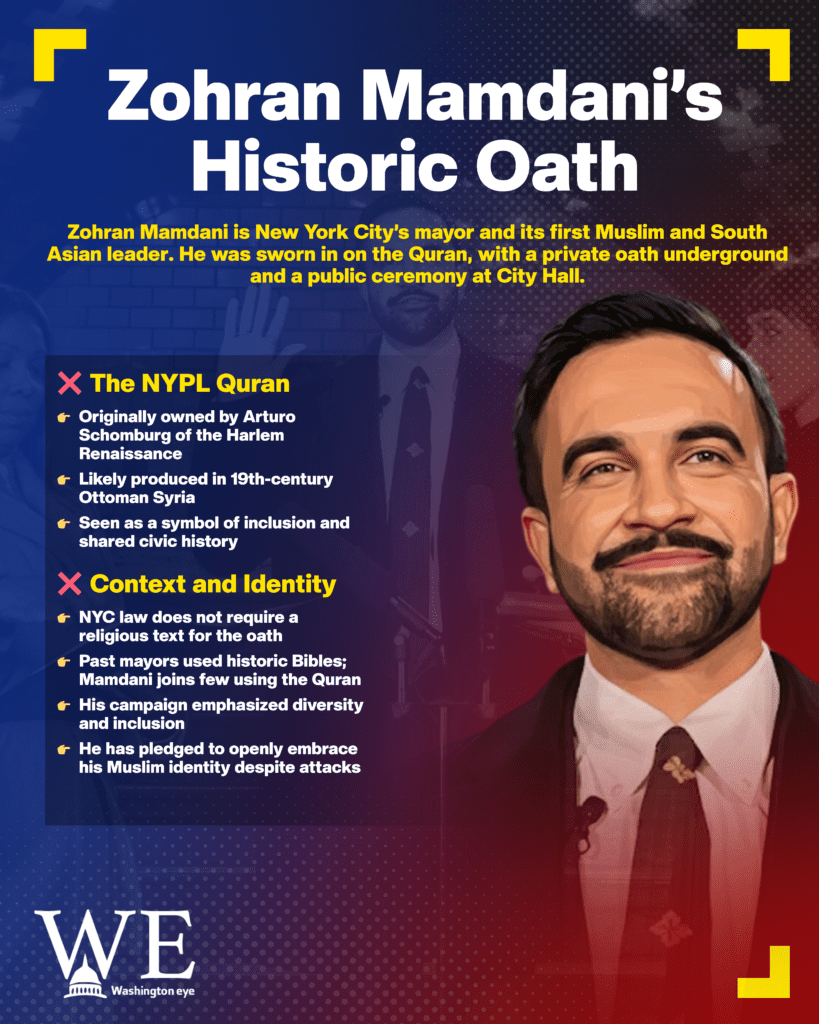
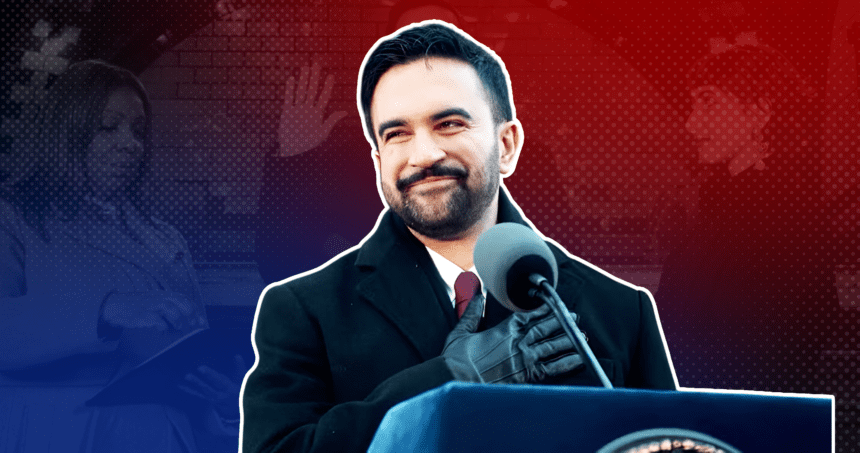
Zohran Mamdani on Thursday became the first mayor of New York City to be sworn into office using a Quran, marking a historic moment for the United States’ largest city. Mamdani, the first Muslim and first South Asian mayor of New York, took his private oath at a disused subway station beneath Times Square, using his grandfather’s Quran alongside a 200-year-old copy on loan from the New York Public Library (NYPL).
The ceremony reflected both personal heritage and public symbolism, underscoring Mamdani’s emphasis on faith, family and inclusion throughout his political rise.
A Quran Rooted in New York’s Cultural History
The historic Quran borrowed from the NYPL once belonged to Arturo Schomburg, a pioneering Black historian and intellectual whose vast collection of books formed the foundation of the Schomburg Center for Research in Black Culture. Schomburg, born in Puerto Rico in the late 19th century, became a central figure of the Harlem Renaissance, shaping the intellectual life of Black America in the early 20th century.
Library officials praised Mamdani’s decision to use Schomburg’s Quran, noting its deep ties to New York’s cultural and scholarly history. Experts believe the small, simply crafted Quran was produced in Ottoman Syria in the 19th century and designed for everyday use rather than ceremony.
Symbolism of Inclusion and Representation
NYPL leaders described the Quran as a symbol of civic-mindedness and inclusion. Curators noted that its modest design reflects accessibility and connection to everyday people. For Mamdani, the choice represented a bridge between communities, histories and faith traditions in a city defined by diversity.
For his public swearing-in at City Hall on Friday, Mamdani plans to use two additional Quran that belonged to his grandfather and grandmother, further reinforcing the personal nature of the milestone.
A Break From Tradition, Not the Law
New York City does not require mayors to swear their oath on a religious text. However, many of Mamdani’s predecessors chose historic Bibles, including Michael Bloomberg, Bill de Blasio and Eric Adams. Mamdani joins a small group of US politicians who have taken their oath on the Quran, reflecting the growing religious diversity of American political leadership.
Faith, Identity and Politics
Mamdani’s campaign openly embraced his Muslim faith and background as a Ugandan-born American of South Asian descent. He frequently addressed the rise of Islamophobia following the September 11 attacks and highlighted the lived experiences of Muslim and immigrant New Yorkers.
A vocal critic of Israel’s policies toward Palestinians and the war in Gaza, Mamdani has faced fierce criticism from conservative opponents. Some have targeted his faith and democratic socialist politics with inflammatory rhetoric. Mamdani has consistently rejected such attacks, vowing not to hide his identity.
“I will not change who I am,” he said during his campaign. “I will find myself in the light.”