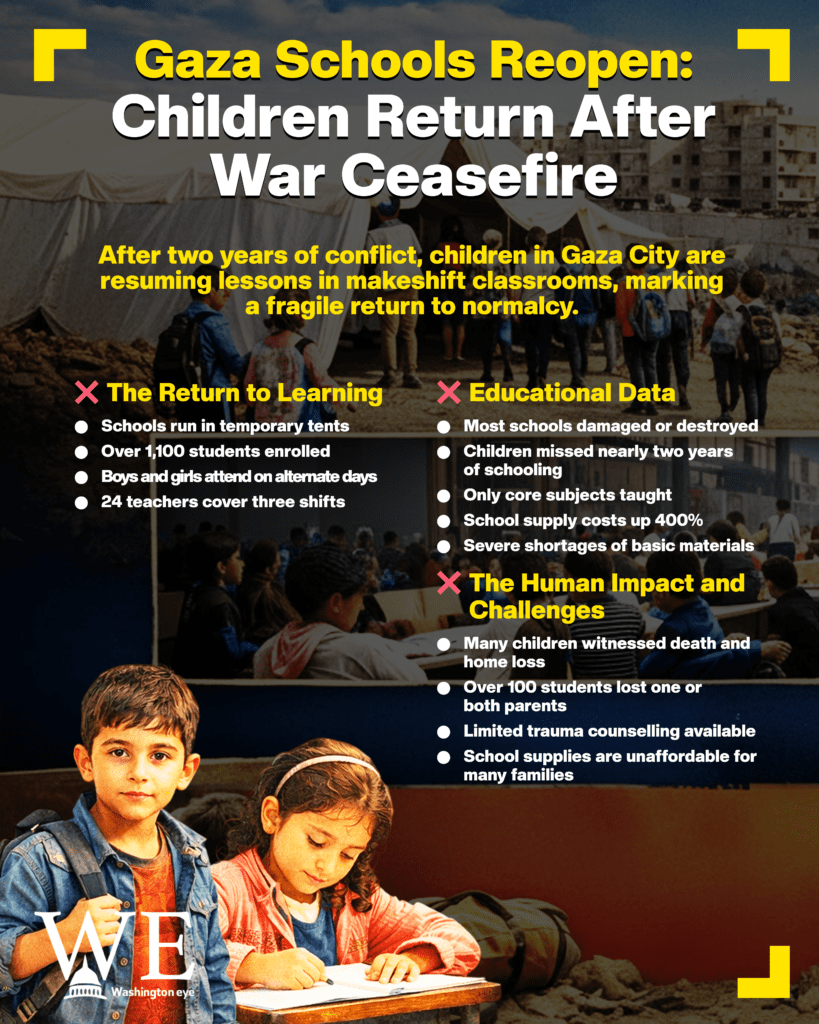

In the rubble of Gaza City, children are once again hearing the hum of lessons. Temporary classrooms have been set up in tents where the Lulwa Abdel Wahab al-Qatami School once stood, destroyed in January 2024. After two years of war, the ceasefire between Israel and Hamas in October has allowed children to return to something that was once too normal in the city.All the tiny children head into classrooms with smiles, marking their first real return to education since the conflict began. The tents are crowded, noisy, and far from the fully equipped classrooms that existed before the war, but they represent hope for over 1,100 students.
Challenges Amid Hope
The makeshift school, run by Unicef, teaches basic subjects including Arabic, English, mathematics, and science. With only 24 teachers for three shifts per day, the school is operating at capacity, yet demand far exceeds resources. Over 97% of schools in Gaza were damaged or destroyed during the war, leaving many children without any formal education for nearly two years.
Supplies like notebooks, pens, and mental health kits remain scarce due to restrictions on aid entering Gaza, worsening the challenges for teachers and families. Students such as 14-year-old Naeem al-Asmaar, who lost his mother in an airstrike, and ninth-grader Rital Alaa Harb, displaced for months, are trying to reclaim some sense of childhood and continuity despite trauma and limited resources.
Education as a Lifeline
School is not just about learning. It is a refuge for children who have witnessed death, displacement, and hunger. Psychological support sessions have been introduced to help children cope with trauma, though the need far surpasses capacity. For parents, schooling is both a relief and a worry; basic supplies have become unaffordable, and many children are years behind in their studies. Teachers emphasize that education remains a vital investment. Kholoud Habib, a schoolteacher, stresses, “We lose homes. We lose money. We lose everything. But knowledge, the one investment we can still give our children remains.” Amid daily challenges and ongoing instability, the reopening of schools provides Gaza’s children with a fragile but crucial step toward normalcy, learning, and hope.