
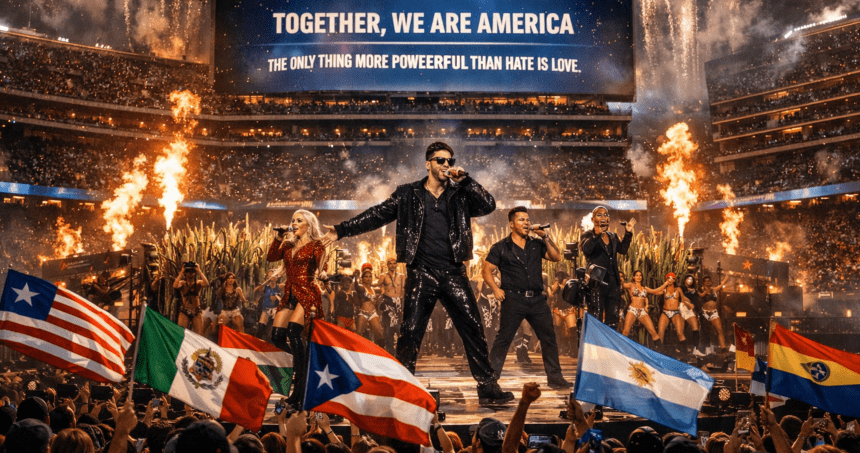
Puerto Rican music superstar Bad Bunny delivered a landmark and electrifying performance at the Super Bowl LX halftime show on Sunday night (8 February, 2026) at Levi’s Stadium, turning one of the world’s biggest broadcast stages into a cultural celebration that reverberated far beyond the gridiron.
Bad Bunny, born Benito Antonio Martínez Ocasio, was selected as this year’s headliner months ago, making history as one of the first Latino artists to take center stage in a Super Bowl halftime show, and the first to perform an entire set primarily in Spanish. The 31-year-old multi-Grammy winner, whose global influence spans reggaeton, Latin trap, and mainstream pop, brought a vibrant medley of hits to an audience of tens of millions worldwide, showcasing his signature mix of rhythm, storytelling, and cultural pride.
The performance was a carefully crafted showcase of Latino music, narrative, and spectacle. Opening with high-energy anthems like “Tití Me Preguntó” and “Yo Perreo Sola,” Bad Bunny’s set weaved through classic reggaeton beats and contemporary favorites, incorporating elaborate stage designs, including a sugar cane field motif that paid homage to his Puerto Rican roots, and dynamic choreography that captivated fans both in the stadium and at home.
A standout moment came when Lady Gaga, a frequent collaborator and pop legend in her own right, joined Bad Bunny on stage for a salsa-infused performance of “Die with a Smile,” a duet that blended cross-genre styles and electrified the crowd. Global icon Ricky Martin also made a surprise appearance during “Lo Que Le Pasó a Hawaii,” adding another layer of Latin musical heritage to the show.

Beyond the music, Bad Bunny’s halftime performance carried a broader message of unity and cultural inclusion. While some viewers and commentators expected overt political commentary, particularly on immigration issues after Bad Bunny’s recent Grammy speech calling for compassion and systemic change, the artist chose instead to emphasize togetherness. Near the show’s close, backup dancers paraded flags representing nations from across the Americas, and the stadium’s jumbotron displayed phrases like “The only thing more powerful than hate is love” and “Together, we are America.”
Reactions to the halftime show poured in immediately after the performance. On social media platforms, fans celebrated what many called one of the most memorable and unifying halftime shows in recent memory. Clips of the performance sparked enthusiasm, pride, and a surge of supportive commentary from fans across diverse communities, both in the U.S. and internationally. Some highlighted the emotional resonance of seeing Latino culture celebrated on one of the biggest entertainment stages of the year, while others noted the show’s production value, musical versatility, and sheer entertainment energy.
However, not all feedback was positive. Former U.S. President Donald Trump and his supporters criticized the performance, with Trump posting on Truth Social shortly after the show decrying it as “one of the worst ever” and characterizing it as “an affront to the greatness of America,” citing its Spanish-language dominance and stylistic choices. Trump also reiterated his past objections to Bad Bunny’s selection, reflecting a broader cultural and political debate that had surrounded the halftime announcement since late 2025.
The halftime controversy had begun months earlier, when Trump had publicly derided the NFL’s decision to choose Bad Bunny as the halftime headliner, claiming he was an unlikely choice and insisting he’d “never heard of him.” Despite that backlash, the league stood by its selection, emphasizing the artist’s global appeal and the importance of cultural representation for an increasingly diverse audience.
In an unusual twist this year, political advocacy groups also inserted their own spin into the event. Prior to kickoff, activists distributed “Bad Bunny-themed, anti-ICE” towels to thousands of fans entering Levi’s Stadium, attempting to tie the halftime narrative to ongoing debates over immigration enforcement, a reflection of how pop culture and politics have intersected around the performance.
Despite pre-game controversies and polarized commentary, Bad Bunny’s performance will likely be remembered for its high energy, cultural celebration, and emphasis on unity. The show culminated with fireworks, crowd-pleasing choreography, and a powerful visual reminder that the Super Bowl halftime stage has evolved into a platform that reflects global music trends and social currents as much as it does athletic spectacle.
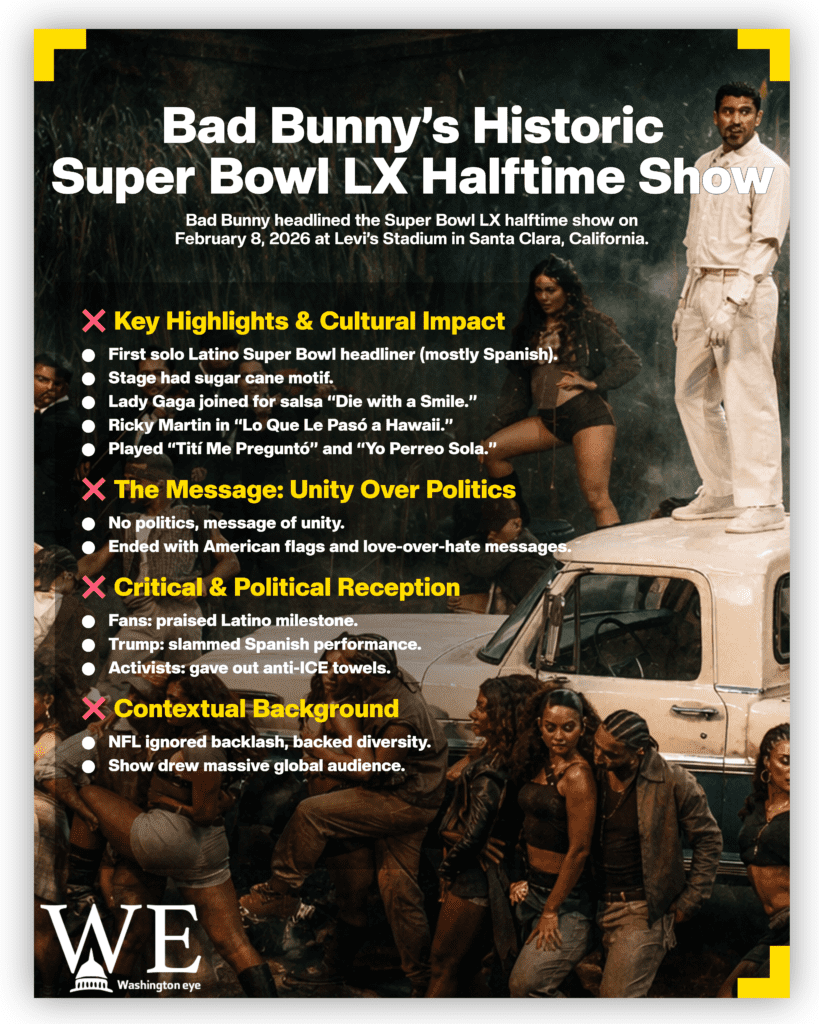
As the echoes of Sunday night’s show continue to reverberate online and in pop culture discourse, Bad Bunny’s Super Bowl halftime performance stands as a milestone moment, one that expanded the boundaries of entertainment, representation, and artistic expression on one of the world’s most-watched stages.