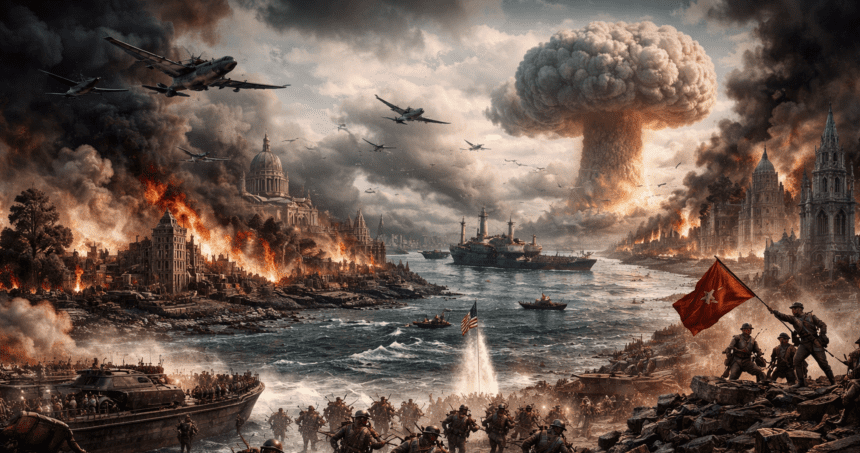
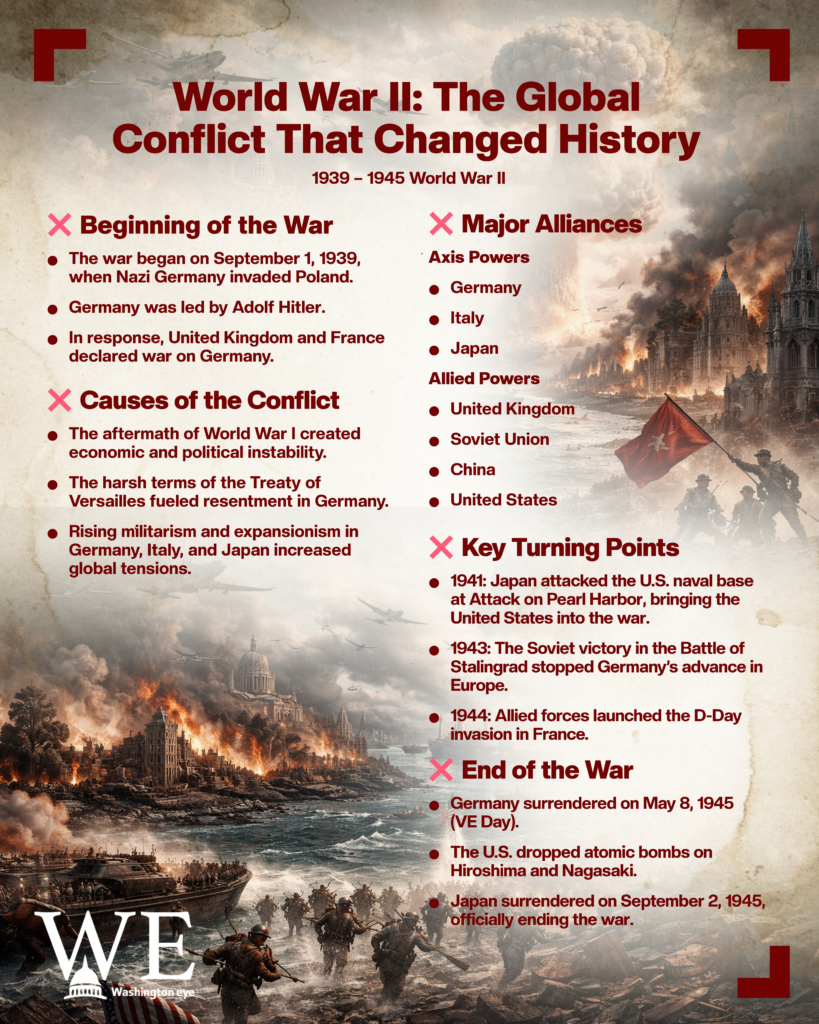
World War II remains one of the most devastating and transformative events in modern history, leaving an indelible mark on global politics, economies, and societies. Fought between 1939 to 1945, the war involved dozens of countries across Europe, Asia, Africa, and the Pacific, ultimately reshaping the international order. The conflict began on September 1, 1939, when Nazi Germany, under the leadership of Adolf Hitler, invaded Poland. This aggressive move prompted Britain and France to declare war on Germany two days later, marking the official start of the Second World War.
The roots of the war can be traced back to the aftermath of World War I (1914–1918), particularly the harsh terms imposed on Germany by the Treaty of Versailles in 1919. Economic hardship, political instability, and rising nationalism created fertile ground for extremist ideologies. Hitler and the Nazi Party capitalized on these conditions, promising to restore Germany’s power and reclaim territories lost after World War I. Meanwhile, expansionist ambitions in other parts of the world also contributed to tensions. Imperial Japan sought to expand its influence across East Asia, while Fascist Italy, led by Benito Mussolini, pursued territorial expansion in Africa and the Mediterranean.
The war soon expanded into a truly global conflict involving two major alliances: the Axis Powers and the Allied Powers. The Axis alliance was led by Germany, Italy, and Japan, while the Allies included major powers such as Britain, the Soviet Union, China, and later the United States. In the early years, Axis forces made rapid gains across Europe and Asia. Germany captured much of Western Europe, including France, while Japan expanded its control over large parts of China and Southeast Asia.
A turning point came on December 7, 1941, when Japan attacked the U.S. naval base at Pearl Harbor in Hawaii. The surprise attack prompted the United States to enter the war on the side of the Allies, dramatically shifting the balance of power. Over the following years, major battles on multiple fronts began to weaken Axis forces. In Europe, the Soviet Union halted Germany’s advance at the Battle of Stalingrad in 1943, one of the bloodiest battles in history. In the Pacific, the United States gradually pushed back Japanese forces through a series of island campaigns.

By 1944, Allied forces launched a massive invasion of Nazi-occupied France known as D-Day, landing on the beaches of Normandy. This operation opened a western front against Germany and accelerated the collapse of Nazi control in Europe. On May 8, 1945, Germany officially surrendered, marking Victory in Europe Day (VE Day). However, the war in the Pacific continued until August 1945, when the United States dropped atomic bombs on the Japanese cities of Hiroshima and Nagasaki. The unprecedented destruction forced Japan to surrender on September 2, 1945, bringing World War II to an end.
The human cost of the war was staggering. Historians estimate that between 70 and 85 million people died during World War II, making it the deadliest conflict in human history. These deaths included both military personnel and civilians. The war also witnessed horrific atrocities, including the Holocaust, in which Nazi Germany systematically murdered six million Jews and millions of other victims. Cities across Europe and Asia were destroyed, economies collapsed, and millions of people were displaced.
The impact of World War II extended far beyond the battlefield. The war fundamentally altered global power structures. The United States and the Soviet Union emerged as the world’s two superpowers, setting the stage for the Cold War, a decades-long period of political tension and rivalry. In addition, the devastation of the war prompted the creation of international institutions aimed at preventing future conflicts. The United Nations was established in 1945 to promote peace, cooperation, and diplomacy among nations.
World War II also accelerated technological and social changes. Advances in aviation, medicine, nuclear technology, and industrial production reshaped modern societies. Women entered the workforce in large numbers during the war, contributing to long-term shifts in gender roles. Meanwhile, many colonies in Asia and Africa began pushing for independence, leading to the wave of decolonization that reshaped the global political landscape in the decades that followed.
Today, the memory of World War II serves as both a warning and a lesson for future generations. The war demonstrated the devastating consequences of unchecked aggression, nationalism, and authoritarianism. At the same time, it highlighted the importance of international cooperation and diplomacy in maintaining global peace. As historians and leaders continue to reflect on the conflict, the legacy of World War II remains a powerful reminder of the cost of war and the need to preserve peace in an increasingly interconnected world.