A new lawsuit by former Meta executive Sarah Wynn Williams over her memoir “Careless People” has turned a private arbitration battle into a public test of how far technology companies can go in controlling critical insider narratives. The case now sits at the intersection of contract law, whistleblower protections and the democratic need for scrutiny of powerful platforms.
A Legal Fight Over Silence, Not Just a Book
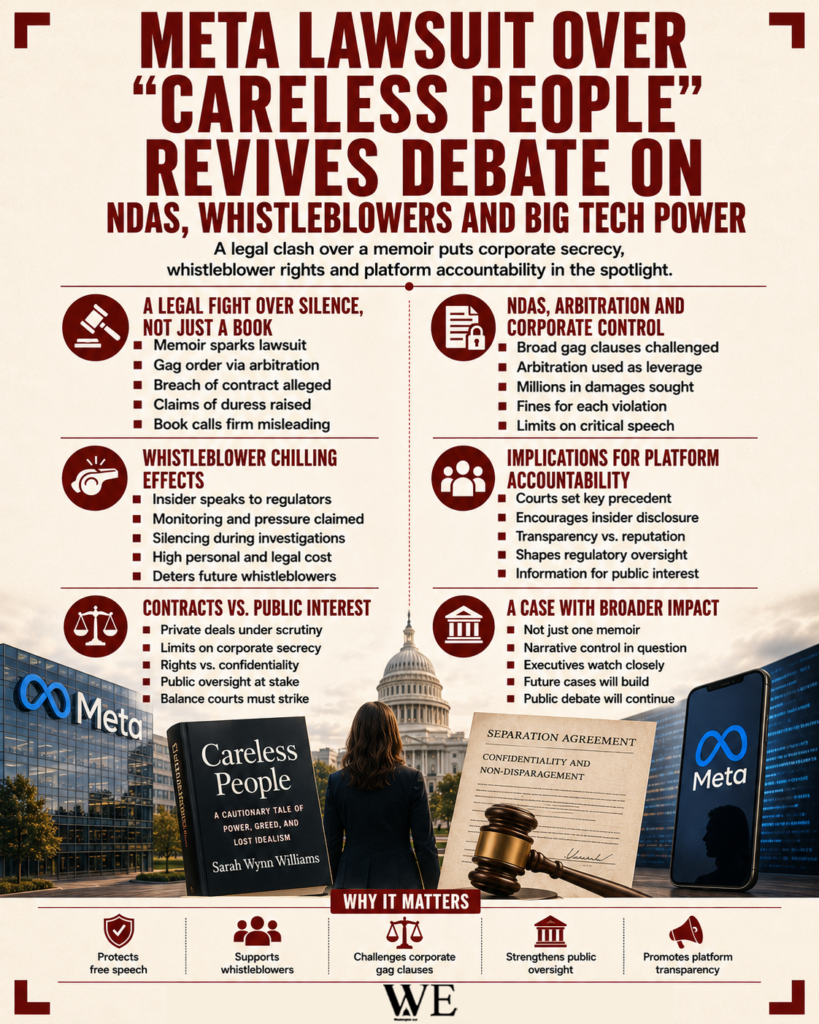
Sarah Wynn Williams, a former director of global public policy at Facebook, now Meta, worked at the company from 2011 to 2017 and later published “Careless People”, a memoir that portrays what she describes as a culture of power, greed and lost idealism at the social media giant. The book, released in 2025, quickly became a bestseller even as Meta publicly characterized it as misleading and defamatory.
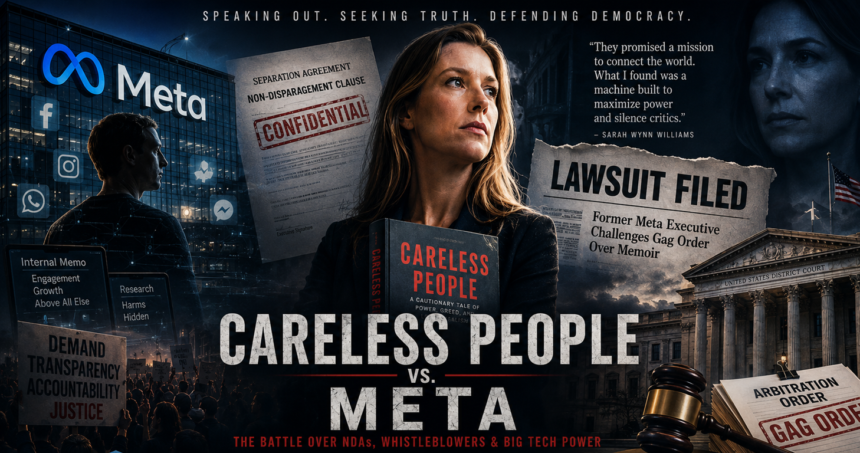
Meta previously obtained an emergency arbitration ruling in the United States that ordered Wynn Williams to stop promoting the memoir and, to the extent she could, to halt further publication, arguing that she had breached a non-disparagement clause in her separation agreement. Her new lawsuit in federal court in Northern California contends that this private gag order and the underlying severance agreement are invalid, claiming they were imposed under duress and used to punish her for speaking to regulators, lawmakers and the public.
NDAs, Arbitration and the Boundaries of Corporate Control
At the core of the dispute is whether confidentiality and non-disparagement clauses can legitimately be used to prevent a former executive from sharing critical accounts that may be relevant to public oversight. Meta maintains that it is simply enforcing contractual obligations, insisting that the memoir violates agreed terms and contains false and defamatory claims, while critics argue that mandatory arbitration and broad gag clauses function in practice as tools to deter whistleblowing.
Wynn Williams alleges that Meta has used arbitration not merely to resolve a contract dispute, but to threaten her with substantial financial penalties, including demands for millions of dollars in damages and potential fines of fifty thousand dollars per violation of the order in related UK proceedings. If courts accept her argument that such mechanisms were deployed in a retaliatory way after she raised concerns with US authorities and Congress, the case could narrow the safe space corporations currently enjoy when they bundle NDAs and arbitration into executive exits.
Whistleblower Chilling Effects in the Platform Era
The lawsuit also speaks to a broader pattern in which insiders who expose alleged misconduct at technology companies face intensive legal and reputational pushback. Wynn Williams claims that Meta subjected her to sustained monitoring of her public appearances and tried to keep her “silenced” even as legislators were seeking testimony on issues she had raised, including platform governance and workplace practices.
From a governance perspective, the question is not only whether the claims in “Careless People” are accurate, but whether others inside large platforms will conclude that the personal cost of speaking is too high. Persistent use of sweeping non disparagement terms and aggressive arbitration strategies can send a signal that corporate loyalty extends far beyond employment, potentially limiting the flow of information to regulators, researchers and the public about how these companies operate internally.
Implications for Platform Accountability and Public Debate
The outcome of Wynn Williams’s case could influence how much deference courts continue to grant to private dispute resolution in contexts that affect public interest. If the federal court narrows Meta’s ability to enforce its gag order, executives at other firms may feel more secure in publishing critical accounts or cooperating with investigations even when they have signed restrictive severance deals.
For Meta, the litigation underscores the tension between protecting corporate reputation and honoring commitments to transparency and openness that the company has advertised in response to past controversies. For regulators and lawmakers already scrutinizing Big Tech, the case offers a concrete example of how contractual instruments such as NDAs and arbitration clauses can shape what information about platform governance reaches the public sphere.
A Final Note
In the end, the dispute over “Careless People” is less about one memoir than about who controls the narrative around a platform that shapes global communication, and how far private agreements can legitimately go in constraining that conversation. Its resolution will provide an important signal to future insiders weighing whether to stay quiet or to speak out about life inside technology’s most powerful firms.