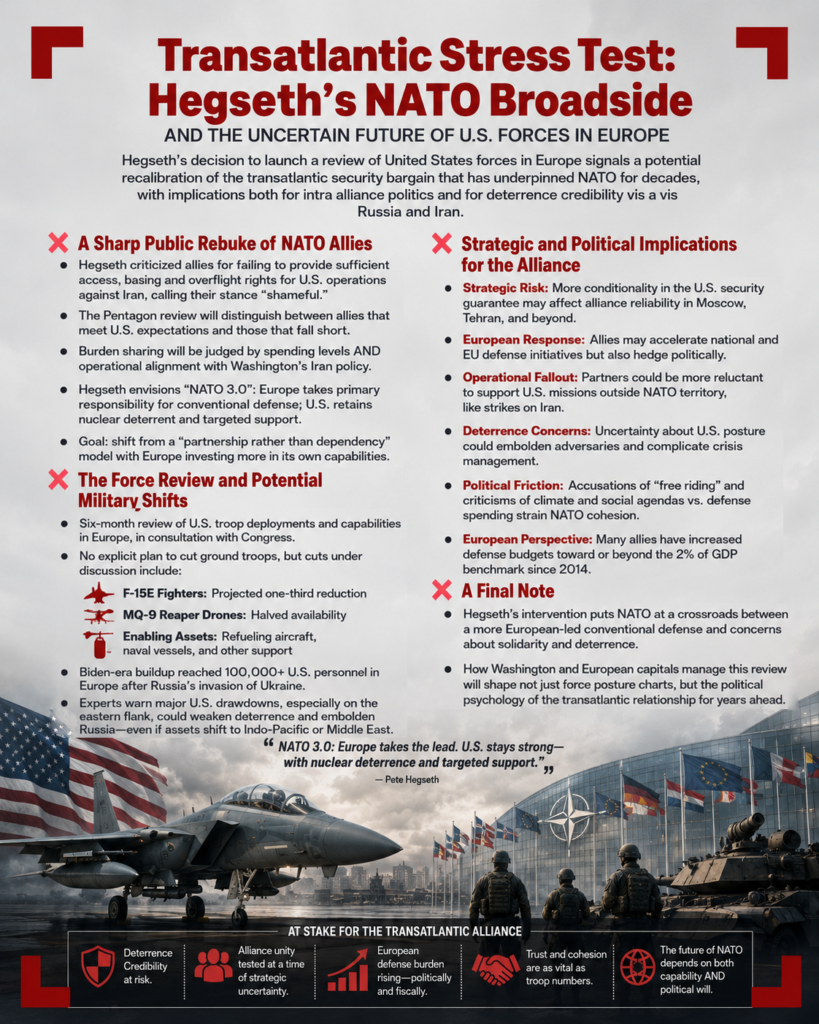
Hegseth’s decision to launch a review of United States forces in Europe signals a potential recalibration of the transatlantic security bargain that has underpinned NATO for decades, with implications both for intra alliance politics and for deterrence credibility vis a vis Russia and Iran. While framed as an effort to push Europeans to “take the lead” in their own defence, the tone and timing of his criticism risk deepening political rifts at a moment of heightened strategic uncertainty.
A Sharp Public Rebuke of NATO Allies
Speaking to NATO defence ministers in Brussels, Defence Secretary Pete Hegseth sharply criticized several European allies for, in his view, failing to provide sufficient access, basing and overflight rights for United States operations against Iran, describing their stance as “shameful.” He coupled this rebuke with a warning that the forthcoming Pentagon review would distinguish between allies that meet United States expectations and those that fall short, signalling that burden sharing will be judged not only by spending levels but also by operational alignment with Washington’s approach to Iran.
Hegseth has articulated a vision of “NATO 3.0” in which Europe assumes primary responsibility for its conventional defence while the United States retains its extended nuclear deterrent and more targeted conventional support. This framing aligns with broader thinking in Washington policy circles that NATO should transition from what one senior Pentagon official previously described as a “partnership rather than dependency” model, with Europeans investing more heavily in their own capabilities.
The Force Review and Potential Military Shifts
The announced six month review will examine United States troop deployments and associated capabilities in Europe, in consultation with a Congress that has legislated a minimum force presence on the continent. While Hegseth has not explicitly committed to reducing ground troop numbers, reporting indicates that recent and planned adjustments include cuts to enabling assets such as refuelling aircraft, fighter jets, drones and naval vessels assigned to NATO, including a projected one third reduction in F 15E fighters and a halving of MQ 9 Reaper drones available for alliance missions.
These discussions unfold against a longer trajectory of fluctuating United States posture in Europe. During the Biden administration, Washington expanded its presence to over one hundred thousand personnel in response to Russia’s invasion of Ukraine and reinforced the eastern flank with additional air and ground assets. Analyses by institutions such as the Center for Strategic and International Studies have cautioned that significant downsizing of United States forces, particularly on NATO’s eastern front, could weaken deterrence and embolden a revisionist Russia, even if some assets are reallocated to address challenges in the Indo Pacific and Middle East.
Strategic and Political Implications for the Alliance
Strategically, a force review tied to allies’ behaviour introduces greater conditionality into the United States security guarantee, potentially affecting perceptions of alliance reliability in Moscow, Tehran and other capitals. If European partners interpret the review as a prelude to retrenchment rather than restructuring, they may accelerate national and European Union level defence initiatives but also hedge politically, becoming more cautious about aligning with United States operations beyond NATO territory, such as airstrikes on Iran.
Politically, Hegseth’s public accusations of “free riding” and his critique that some allies prioritise issues such as climate policy and social agendas over defence spending are likely to resonate with domestic audiences in the United States but could strain cohesion within NATO councils. European governments facing fiscal pressures and domestic debate over continued support to Ukraine may view Washington’s rhetoric as undervaluing existing contributions, even as several have increased defence budgets toward or beyond the two percent of GDP benchmark since 2014.
A Final Note
Hegseth’s intervention places NATO at a crossroads between a more European led conventional defence and persistent concerns about alliance solidarity and deterrence signalling. How both Washington and European capitals manage this review period will shape not only force posture charts but also the political psychology of the transatlantic relationship in the years ahead.