
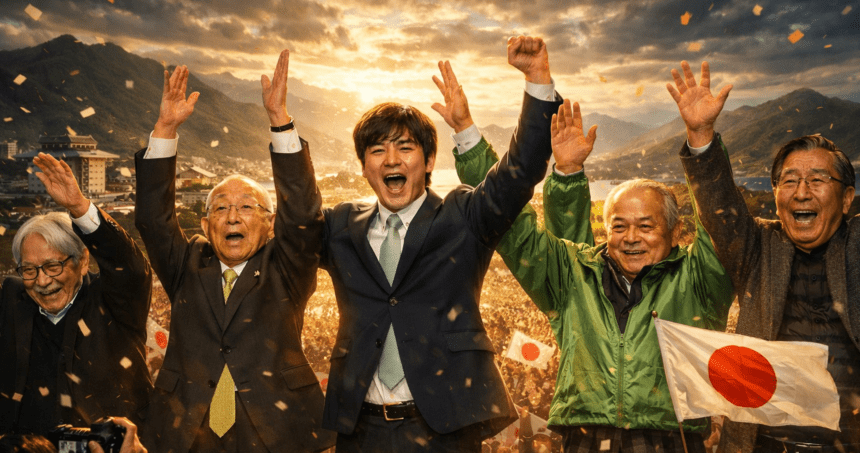
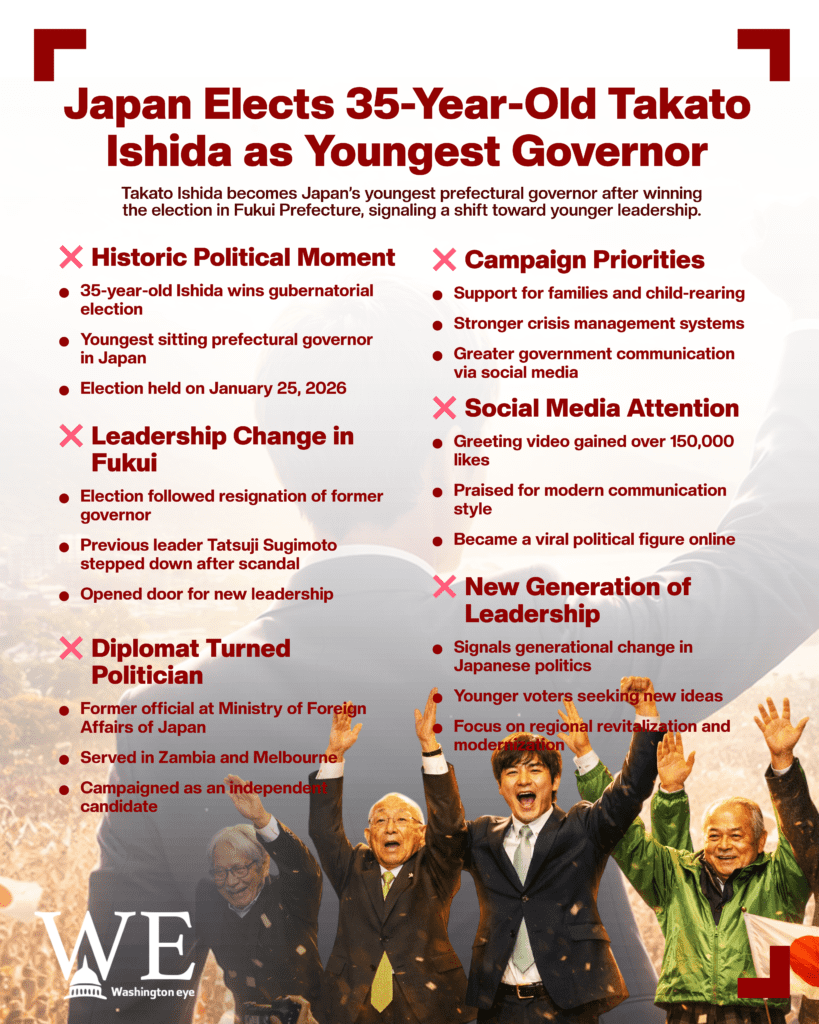
Japan has witnessed a historic moment in its regional politics after 35-year-old Takato Ishida was elected governor of Fukui Prefecture, becoming the youngest sitting prefectural governor in the country. The election took place on January 25, 2026, marking a shift toward younger leadership in a political system traditionally dominated by older politicians. Ishida officially assumed office on January 28, 2026, drawing national attention not only because of his age but also because of his background as a former diplomat and his promise to bring fresh ideas into local governance.
Fukui Prefecture, located on Japan’s western coast along the Sea of Japan, held the gubernatorial election following the resignation of its previous governor, Tatsuji Sugimoto, who stepped down after a sexual harassment scandal involving prefectural government employees. The unexpected resignation triggered the election and opened the door for new leadership. Ishida entered the race as an independent candidate, competing against experienced rivals including Kenichi Yamada, a 67-year-old former mayor of Echizen City, and Yukie Kanemoto, a candidate backed by the Japanese Communist Party. Despite his youth and relative political inexperience, Ishida secured victory and became the youngest governor currently serving in Japan.
Born on February 5, 1990, in Fukui City, Ishida built an unusual political profile before entering regional politics. He studied internationally and later joined Japan’s Ministry of Foreign Affairs in 2015. During his diplomatic career he served overseas, including postings in Zambia and Melbourne, Australia, where he worked on international cooperation and energy security issues. His international exposure and diplomatic experience helped shape his campaign message that Fukui should become more globally connected and forward-looking.

Ishida announced his candidacy in December 2025, shortly after the previous governor’s resignation. He resigned from the foreign ministry to run in the election, campaigning on policies that emphasized support for families and child-rearing, improved crisis management, and stronger communication between government and citizens through social media platforms. His campaign also highlighted the importance of economic revitalization in regional areas and greater transparency in local administration.

The election result surprised many observers because Japanese politics, especially at the prefectural level, tends to favor experienced senior candidates. Ishida’s victory signaled a growing appetite among voters for younger leaders who can connect with modern social and economic challenges. Analysts say his success reflects changing political attitudes among younger voters and residents who want innovative approaches to issues such as population decline, digital governance, and economic modernization in regional Japan.
The new governor quickly became a sensation on social media after taking office. Photos and videos of Ishida attending prefectural assembly sessions and interacting with residents spread widely online. Many Japanese social media users commented on his youthful appearance and modern communication style, with some describing him as unusually “handsome” for a politician. One greeting video he posted on Instagram gained more than 150,000 likes, highlighting the level of public curiosity surrounding the young leader.
However, the attention has not been limited to admiration. Ishida has also faced scrutiny over remarks and policies since entering office. In March 2026, he issued an apology after making comments describing Japan as an “ethnically homogeneous” country, acknowledging that the statement was inappropriate and clarifying that his international experiences had broadened his understanding of diversity. The incident underscored the pressures that come with holding high political office at a young age.

Political observers say Ishida’s rise reflects a broader trend in Japan toward generational change in leadership. While the country’s political landscape has long been dominated by veteran lawmakers, younger politicians have gradually begun gaining visibility at local and national levels. Ishida’s election may encourage more young professionals to consider entering public service, particularly in regional governments that are seeking new ideas to address demographic decline and economic transformation.
As governor, Ishida now faces the challenge of translating his youthful popularity into effective governance. Fukui Prefecture, known for its nuclear power plants, manufacturing sector, and scenic coastline, must navigate issues ranging from economic development and energy policy to aging populations and regional revitalization. If successful, Ishida could become a model for a new generation of leaders shaping Japan’s political future.