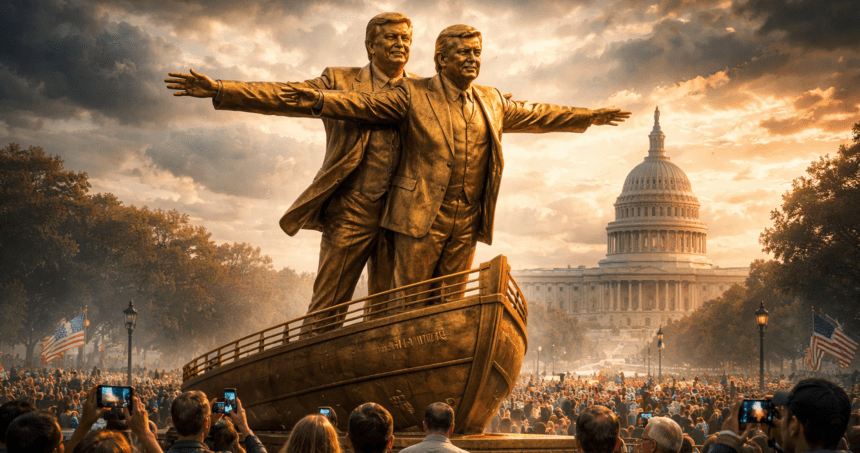
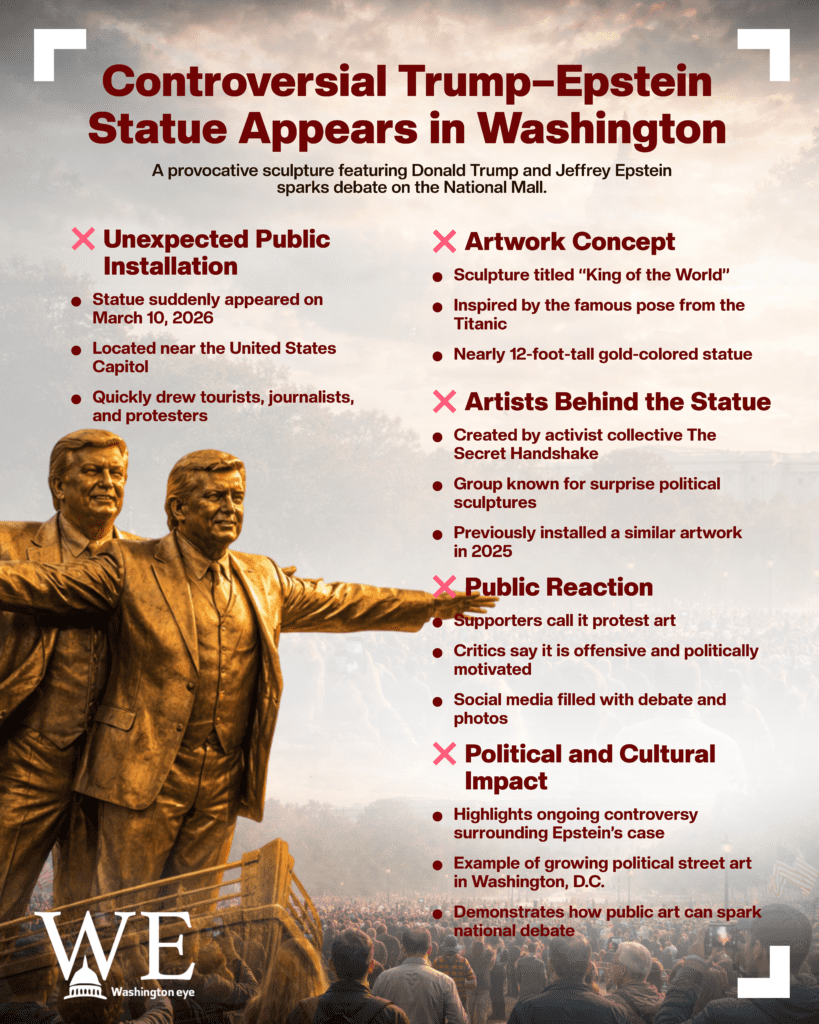
A controversial statue depicting the former U.S. President Donald Trump and disgraced financier Jeffrey Epstein suddenly appeared on the National Mall in Washington, D.C., triggering intense debate across the United States about politics, protest art, and the legacy of Epstein’s criminal case. The artwork was installed on March 10, 2026, near the U.S. Capitol and quickly drew crowds of tourists, journalists, and critics who gathered to photograph and discuss the provocative sculpture.
The statue, titled “King of the World,” is nearly 12 feet tall and portrays Trump and Epstein reenacting the iconic “Titanic” scene made famous by the 1997 film. In the sculpture, Trump stands behind Epstein with arms outstretched as if standing on the bow of a ship, echoing the famous pose of Jack and Rose from the movie. The gold-colored statue includes a plaque suggesting parallels between the fictional love story and the real-life relationship between the two men, referencing luxury travel, lavish parties, and controversy.
The installation was created by a mysterious activist art collective known as “The Secret Handshake.” The group has previously installed satirical sculptures and protest artworks in Washington, D.C., targeting political figures and controversial events. Members of the collective remain anonymous, but their work often appears suddenly in public places to spark debate about politics and accountability.
According to reports, this is not the first time the group has used sculpture to comment on Trump and Epstein’s relationship. In 2025, the same artists installed another statue titled “Best Friends Forever,” showing the two men holding hands. That earlier sculpture was also placed on the National Mall and generated widespread media coverage before being removed by authorities.

The latest statue immediately became a focal point of political and social discussion. Supporters of the artwork say it is a form of protest art designed to highlight unanswered questions surrounding Epstein’s network and alleged connections with powerful figures. Many visitors argued that art has historically been used to challenge political leaders and encourage public reflection on controversial issues.
However, critics described the sculpture as offensive and politically motivated. Some observers said the artwork crossed ethical lines by using satire involving Epstein, who was convicted of sex crimes involving minors and died in a New York jail in 2019 while awaiting trial on federal trafficking charges. Others criticized the statue for what they called “distasteful symbolism” that trivializes a serious criminal case.
The White House and Trump supporters quickly rejected the message of the statue. Officials dismissed the installation as partisan propaganda and questioned why similar attention had not been directed toward other political figures who had contact with Epstein in the past. Trump himself has long denied wrongdoing and has stated that he cut ties with Epstein years before the financier’s arrest.

Despite the controversy, the statue succeeded in attracting public attention. Visitors lined up to take photos and videos beside the sculpture, while social media platforms were flooded with reactions ranging from laughter to outrage. For many observers, the artwork reflects how political satire and street art have become powerful tools in modern political discourse.
Experts say Washington, D.C., has increasingly become a stage for guerrilla-style political art installations. Over the past decade, artists have placed statues referencing events such as the January 6 Capitol attack, political scandals, and election controversies. These artworks often appear temporarily but generate international headlines before being removed.
Whether viewed as protest, satire, or provocation, the Trump–Epstein statue has once again highlighted the enduring controversy surrounding Epstein’s case and the complex intersection of politics, art, and public debate in the United States. As visitors continue to gather around the sculpture, the installation underscores how symbolic imagery can ignite conversations far beyond the streets where it appears.