
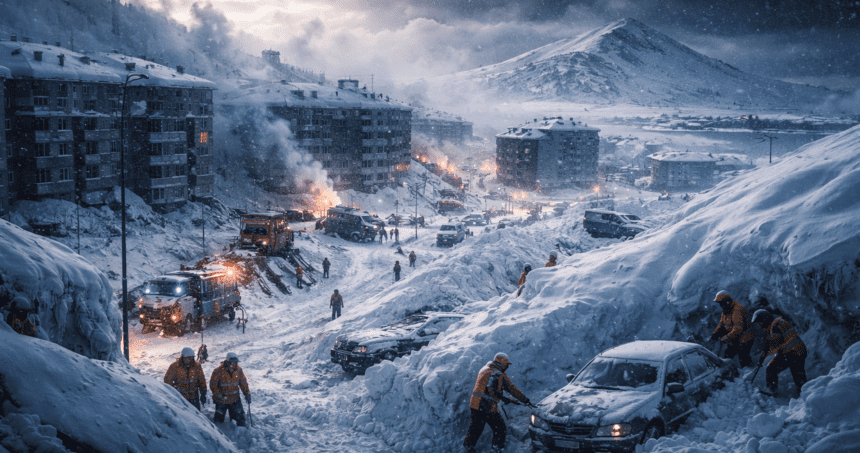
Russia’s Far Eastern Kamchatka Peninsula is grappling with the heaviest snowfall in 60 years, a historic winter storm that has buried towns, halted transportation, and left residents digging out from monumental drifts of snow. The extraordinary weather event, striking in early to mid-January 2026, has drawn comparisons with rare climatic extremes and exposed vulnerabilities in infrastructure and emergency response systems across the region.
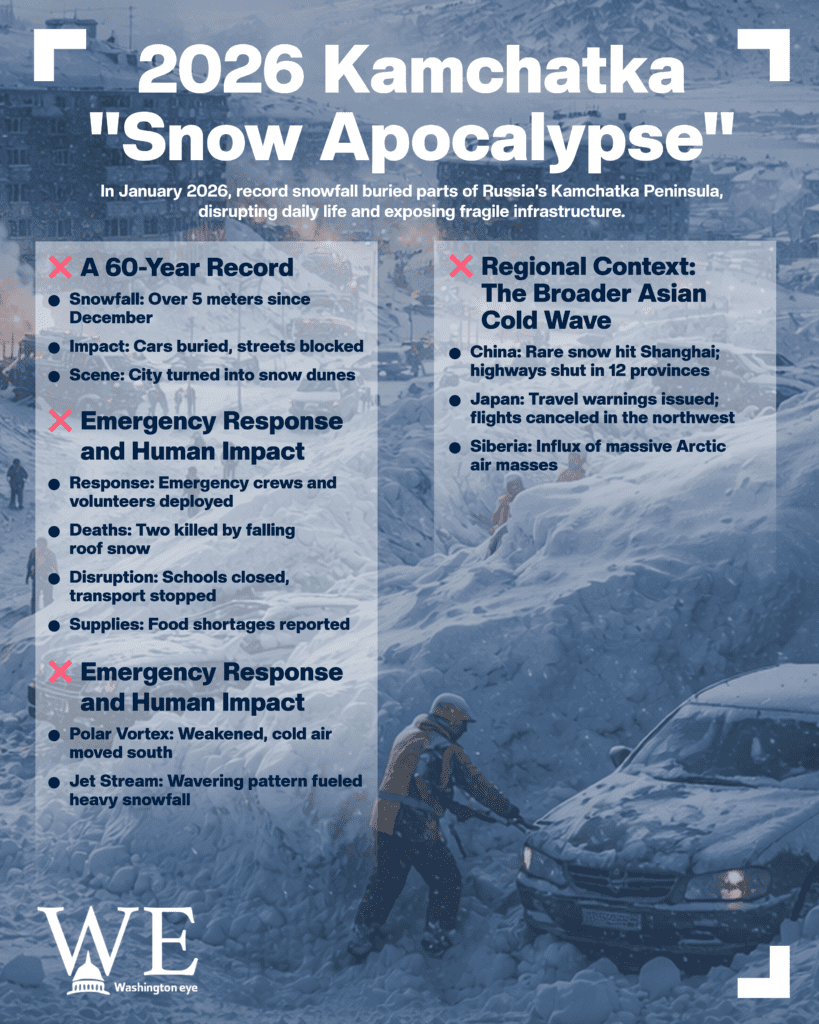
In Petropavlovsk-Kamchatsky, the peninsula’s largest city and administrative capital, vast snowdrifts tower several meters high, blocking entrances to residential blocks and submerging vehicles parked on urban streets. Snow depths in parts of Kamchatka have exceeded two meters in early January, on top of 3.7 meters recorded in December, according to weather observations, amounts rarely seen in modern meteorological records.
Residents and local media have described the conditions as a “snow apocalypse,” capturing videos of snow-covered homes and people resorting to digging narrow paths to reach doors or climbing atop drifts just to navigate their neighborhoods. Some have even taken to what one local described as a surreal “sand-dune-like” landscape of white peaks where once there were streets.

The storm’s immediate impact on daily life has been severe. Local authorities declared a state of emergency, mobilizing emergency crews, including students, soldiers and civilian volunteers, to clear snow-blocked roads, restore access to homes and assist vulnerable residents trapped by the drifts. Municipal services have struggled as intense cold, heavy snow and strong winds compound each other, creating hazardous conditions and slowing clearance efforts.

Tragically, the extreme snowfall has also led to fatalities. At least two people in Kamchatka have died after being struck by large snow masses that fell from building roofs, underscoring the danger posed not just by accumulation but by secondary effects of the heavy storm.
The storm has brought daily life in the region to an abrupt halt. Schools closed, public transportation ground to a halt, and many businesses shifted to remote operations as streets turned into rigid corridors of packed snow. Supply chains have also been disrupted; residents report intermittent shortages of basic food items in local shops as deliveries struggle to traverse snow-choked routes.
While Kamchatka has long been accustomed to harsh winters, climatologists say the magnitude of this snowfall is unusual. Scientists point to atmospheric anomalies such as a weakened Arctic polar vortex and a more “wavering” jet stream as contributing factors that allowed surges of frigid Arctic air laden with moisture to plunge deep into the Far East. These conditions, tied to broader shifts in global weather patterns, can amplify winter storms, creating intense precipitation events in regions that typically see heavy snow but not at this scale.

The polar vortex usually circulates cold air around the Arctic, limiting how far frigid air can plunge southward. But when it weakens, as it has this season, the jet stream, the fast-moving air current high above Earth, becomes more sinuous. This can draw Arctic air masses into Siberia and the Pacific Rim, where they collide with moist air systems, producing intense snowfall.
The current snowfall event is part of a larger cold wave affecting parts of Asia. It has not only slammed Russia’s east but also swept into China and Japan, bringing rare snow to cities such as Shanghai and disrupting travel in Japan’s northwest with cancelled flights and hazardous surface conditions. Officials in China closed sections of major highways across at least a dozen provinces as icy conditions spread, while the Japan Meteorological Agency warned of continued heavy snow and urged residents to avoid non-essential travel.
For residents in and around Petropavlovsk-Kamchatsky, the immediate challenges are stark: clear the snow, restore basic services and ensure safety amid continuing winter blasts. Local government and emergency services are working around the clock to reopen main roads and critical infrastructure, yet the enormity of the task, clearing metres of snow from streets and public spaces, means that full recovery could take days or even weeks.
As Russia and its neighbors contend with these extreme winter conditions, the event serves as a reminder of the growing need for resilience in the face of climatic volatility, whether through improved forecasting, reinforced infrastructure, or community preparedness. For now, Kamchatka’s residents dig deep, both literally and figuratively, to rise above one of the most intense snowstorms in recent memory.