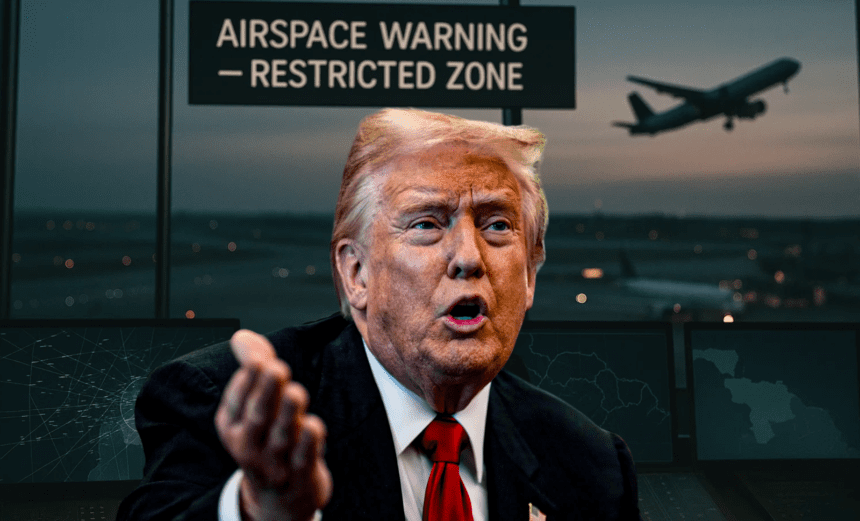
Former U.S. President Donald Trump triggered a diplomatic storm on 29 November 2025, at 3:15 p.m. EST, when he declared during a campaign rally in Miami, Florida, that he would “shut down Venezuela’s airspace completely” if President Nicolás Maduro continued what he called dangerous “military provocations” in the Caribbean.
Trump claimed that the Venezuelan government had intensified aerial maneuvers close to international aviation corridors, tracked foreign aircraft with advanced radar, and allowed Russian and Iranian military planes to operate from its bases. His remarks, delivered to a cheering crowd, immediately raised alarms across Latin America, aviation bodies, and diplomatic circles, with many questioning the legality of such a move and whether it signaled the beginning of a new phase of U.S.-Venezuela confrontation.
Trump justified his threat by arguing that Venezuela’s military activity near shared regional flight zones could jeopardize the safety of American commercial pilots and was part of a broader pattern of “regional destabilization.” He accused Maduro of cooperating with America’s adversaries and claimed that Venezuela’s alleged intelligence-tracking operations represented a direct threat to U.S. interests.
Trump further framed the issue within his campaign narrative, linking the tension to surging migration from Venezuela and asserting that the Maduro government was contributing to insecurity across the hemisphere. While Trump’s rhetoric was forceful, experts noted that closing another sovereign country’s airspace is not standard international practice and cannot be executed unilaterally by the United States without major legal and logistical repercussions.
The possibility of the crisis escalating into a military conflict remains low, but Trump’s language has stirred concern among analysts who warn that aggressive aviation-related threats can quickly destabilize already fragile regional relationships. Restricting Venezuelan airspace could disrupt South American and Caribbean airline routes, increase travel costs, and trigger retaliatory measures by Caracas, which might close its skies to U.S. aircraft or strengthen military cooperation with Russia and Iran. Aviation experts stressed that such a dramatic move would require broad multinational coordination, including alignment with the International Civil Aviation Organization (ICAO), which typically governs airspace and safety regulations. Any unilateral pressure tactic, they noted, would be unprecedented.
Venezuela responded defiantly. Foreign Minister Yván Gil condemned Trump’s comments as “illegal, imperialist, and dangerous,” accusing the former president of attempting to influence Venezuela’s 2026 election environment. President Nicolás Maduro later addressed the nation in a televised speech from Caracas, dismissing Trump’s threats as “election theatrics” designed to energize U.S. voters. Maduro insisted that Venezuela would defend its sovereignty “in the skies, on land, and at sea” and announced that air-defense cooperation with “friendly partner nations”, widely interpreted as Russia, Iran, and China, would be strengthened.
Governments across Latin America reacted cautiously but with visible concern. Colombia called for restraint and urged both sides to avoid actions that could destabilize regional security. Brazil emphasized that any decisions regarding airspace must follow international aviation law and warned against politicizing regional skies. Mexico criticized Trump’s statement as “unprecedented” and highlighted the potential economic damage that airspace disruptions could cause for regional tourism and trade. The European Union also expressed alarm, urging Washington and Caracas to avoid further escalation and reaffirming support for diplomatic engagement.
In Washington, the Biden administration distanced itself from Trump’s remarks, noting that campaign statements do not reflect official U.S. foreign policy. A State Department spokesperson refused to comment directly on Trump’s threat but reiterated America’s commitment to maintaining stability in the Western Hemisphere. Despite this, Trump’s comments have revived old anxieties about the future of U.S.–Latin America relations should he return to the White House, especially regarding sanctions, migration, airspace security, and alliances.
Airlines operating in the Caribbean and South America voiced immediate concern over the uncertainty. Venezuelan airspace remains a major route for travel between North and South America, and any disruption would force airlines to reroute flights, increase fuel costs, and lengthen travel times. The International Air Transport Association (IATA) warned that closing a country’s airspace due to political disputes would be “a profound and deeply destabilizing precedent” that could have global consequences.
As the situation stands, Trump’s threat has no immediate legal effect, but the political shockwaves have already reshaped regional discussions. Observers predict that tensions may intensify in the coming months as both U.S. and Venezuelan elections approach, with aviation, migration, and security poised to become central themes. While war remains unlikely, the rhetoric marks one of the sharpest escalations in U.S.–Venezuela relations since 2019, raising new questions about the future of diplomacy in the Americas.