
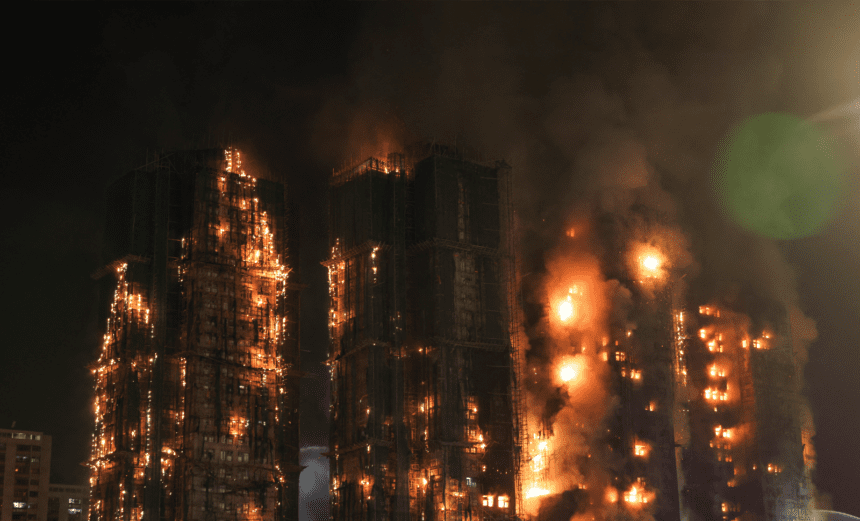
Hong Kong was plunged into grief on Wednesday, 26 November 2025, after a devastating fire tore through a residential high-rise complex in the Tai Po District, leaving at least 146 people dead and scores injured. The blaze erupted at approximately 2:51 pm (HKT) at Wang Fuk Court, a cluster of eight 31-storey towers, and authorities believe the fire began in the bamboo scaffolding covering the building for exterior renovation.
Wrapped in flammable green netting and insulated with polystyrene foam boards, the scaffolding helped the flames spread with alarming speed, engulfing seven towers within minutes. Witnesses described seeing thick black smoke rising hundreds of metres into the air as residents screamed for help from windows and balconies, while others attempted to escape down dark, smoke-filled stairwells.
Firefighters declared a Level-5 alarm, Hong Kong’s highest emergency category, within hours. More than 750 firefighters, dozens of fire engines, and specialized rescue teams struggled against intense heat, collapsing scaffolding, and near-zero visibility. The fire raged for nearly 43 hours before being fully extinguished by the morning of Friday, 28 November. Among the injured were at least 12 firefighters, and one firefighter tragically lost his life in the operation.

Authorities reported 79 people injured in total, while nearly 100 residents remained unaccounted for in the days following the tragedy. Many victims were later discovered in corridors, staircases, locked apartments, and even on rooftops where they had attempted to take shelter.

Early investigations suggest a combination of factors contributed to the severity of the incident, including the use of flammable renovation materials, malfunctioning fire alarms, and inadequate emergency exits in the older building design. Residents had previously raised complaints about safety hazards, including the thick bamboo scaffolding that wrapped the complex for months.
But those warnings reportedly went unanswered. In the aftermath, the police arrested several individuals connected to the construction company responsible for the renovation, including its directors and engineering consultants, on suspicion of gross negligence and manslaughter. The government has suspended renovation works at 28 other sites managed by the same contractor pending a full safety audit.
As rescue teams continue to search for missing residents, Hong Kong has entered a period of three days of official mourning, with flags lowered to half-mast and condolence books placed across the city. Thousands of mourners have gathered outside Wang Fuk Court, laying flowers and candles in quiet tribute. Many families fear the worst, as officials warn that the final death toll may rise. The tragedy has sparked widespread outrage, with citizens demanding accountability and a complete overhaul of fire-safety regulations, especially for aging high-rise estates undergoing renovation. Questions are also being raised about oversight failures, building inspection procedures, and the widespread use of flammable scaffolding materials.

The Hong Kong government has promised swift action, including a city-wide review of building safety systems, temporary housing for displaced families, counselling support, and an independent inquiry to determine the chain of negligence that led to the disaster. Urban safety experts are calling the event “a wake-up call” for cities dependent on dense high-rise housing, emphasising the need for stricter building codes, transparent regulation, and stronger tenant protection. As the city mourns its dead, Hong Kong faces not just a moment of sorrow, but a critical test of its ability to reform, rebuild trust, and ensure such a tragedy never happens again.