
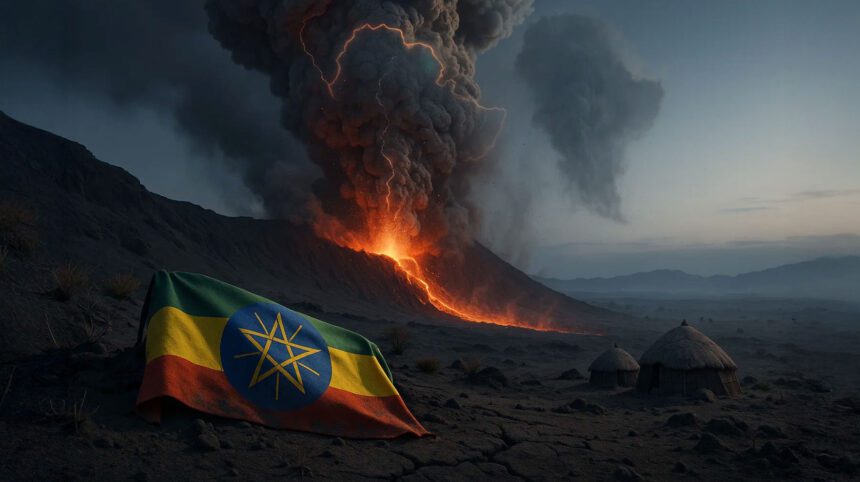
Ethiopia’s long-dormant Hayli Gubbi volcano erupted this week for the first time in roughly 10,000 years, unleashing towering plumes of ash that drifted across the Red Sea and disrupted aviation as far away as India and Pakistan. The eruption, which occurred on Sunday in the Afar region, sent smoke rising nearly 9 miles (14km) into the sky and continued for several hours before subsiding.
Local officials confirmed there were no casualties, but concerns quickly shifted to the economic impact on the region’s livestock-herding communities. Mohammed Seid, a local administrator, said many villages had been blanketed in ash, leaving grazing lands severely damaged. “No human lives or animals were lost, but the ash has covered vast areas. Their livestock now have little to eat,” he said, noting that no prior eruption of Hayli Gubbi had ever been recorded in local history.
Residents reported hearing an explosive blast at the moment the eruption began. “It felt like a sudden bomb had been thrown,” said Ahmed Abdela, who also described a powerful shock wave sweeping through nearby settlements. Satellite imagery captured the dramatic plume, with NASA showing ash clouds billowing westward and then sweeping across Yemen and Oman before drifting into northern Pakistan and India.
By Monday night, Pakistan’s Meteorological Department issued warnings as ash entered its upper airspace. In India, Air India cancelled a number of domestic and international flights to conduct precautionary inspections on aircraft that had flown over affected regions. Delhi, already struggling with hazardous air pollution, was not expected to be significantly affected, with the Indian Meteorological Department confirming that volcanic ash remained at high altitudes and would continue moving eastward.
Hayli Gubbi, located roughly 500 miles northeast of Addis Ababa near the Eritrean border, forms the southernmost peak of the Erta Ale volcanic range. The volcano rises about 500 meters and sits at the meeting point of two tectonic plates within the geologically active Rift Valley—one of the few places on Earth where a new continental boundary is forming.

Although the eruption has now subsided, experts warned that lingering ash could continue to affect livestock and air travel for several days. For communities in the Afar region, the long-silent volcano’s awakening has become an unexpected test of resilience—one they had not faced in thousands of years.