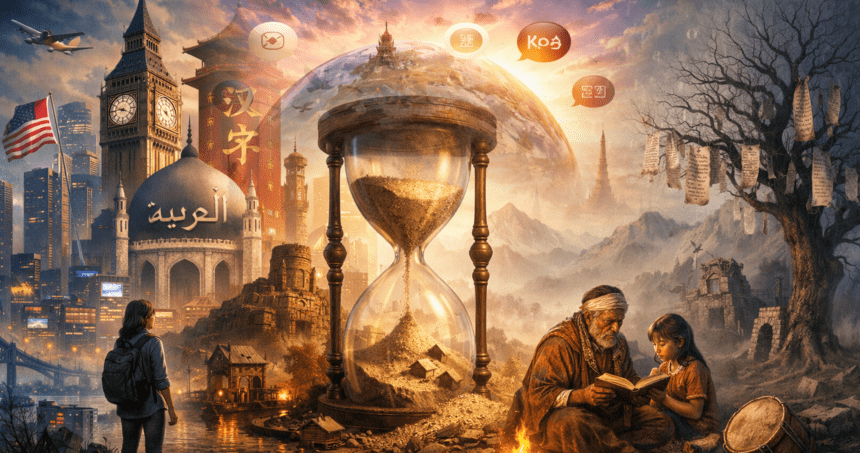
As UNESCO marked International Mother Language Day this week at its Paris headquarters under the 2026 theme “Youth voices on multilingual education,” linguists say the world is living through a linguistic paradox: a handful of “mega-languages” are expanding across borders through migration, trade, education and the internet, while a large share of the planet’s roughly 7,159 living languages struggle to survive.
The scale of global multilingualism is enormous, but uneven. Ethnologue, one of the most widely used reference sources for language statistics, counts 7,159 living languages worldwide (its 28th edition, released in 2025). Yet the everyday linguistic marketplace is concentrated: the top 10 languages by total speakers are led by English and Mandarin Chinese, followed by Hindi, Spanish, Standard Arabic, French, Bengali, Portuguese, Russian and Indonesian, reflecting the combined impact of population size, colonial histories, state systems and global media ecosystems.
English remains a special case because its dominance is powered less by native speakers than by second-language use in business, science, aviation, technology and popular culture. Ethnologue’s 2025 estimates place English at roughly 1.5 billion total speakers when first- and second-language speakers are combined. Mandarin Chinese remains the world’s largest language by native speakers, with its global footprint closely tied to China’s population and diaspora communities.

Geography explains much of the ranking. Spanish is spoken widely across Latin America and is deeply embedded in the United States; French has a broad multi-continental presence tied to historical empires and modern regional organizations; Arabic spans North Africa and the Middle East through shared written standards alongside diverse spoken varieties. Hindi and Bengali draw strength from South Asia’s demographic weight, while Portuguese’s scale is heavily driven by Brazil. Russian remains influential across parts of Eastern Europe, the Caucasus and Central Asia, and Indonesian reflects a large national population plus the role of Bahasa Indonesia as a unifying national language.

But languages are not only spoken, they are taught, written, and increasingly “platformed.” A striking dividing line is literacy infrastructure. Ethnologue estimates that out of the 7,159 living languages it lists, about 4,153 have a developed writing system, meaning a majority still rely primarily on oral transmission, community knowledge and informal use rather than standardized schooling and publishing. That makes them particularly vulnerable when families shift to a dominant language for education, employment, or social mobility.
UNESCO warns that this vulnerability is widespread. The agency says at least 40% of the world’s roughly 7,000 languages are endangered, and that, on average, a language disappears about every two weeks, erasing not only words but cultural memory, oral literature, identity, and local knowledge about ecosystems and medicine. The “endangered” label covers a spectrum, from languages that children still speak but only at home, to those with no young speakers at all. UNESCO’s endangered-language mapping work has listed 2,473 endangered languages in its Atlas project, underscoring how many communities are fighting language loss at the edge of visibility.
Why does this matter in 2026, beyond heritage? Policymakers increasingly treat language as infrastructure: it shapes access to education, health services, justice systems, and digital opportunities. UNESCO’s International Mother Language Day programming this year put young people at the center of multilingual education debates, reflecting a growing consensus that language survival depends on whether it is valued in schools, supported in media, and usable in modern life, including online.

At the same time, technology is changing the stakes. Real-time translation, AI-powered subtitling and voice tools can lower barriers for major languages and sometimes help smaller ones through documentation and learning apps. Yet digital dominance can also accelerate language shift: when the internet, entertainment, and job markets overwhelmingly reward a few languages, families may abandon a minority language within a generation.
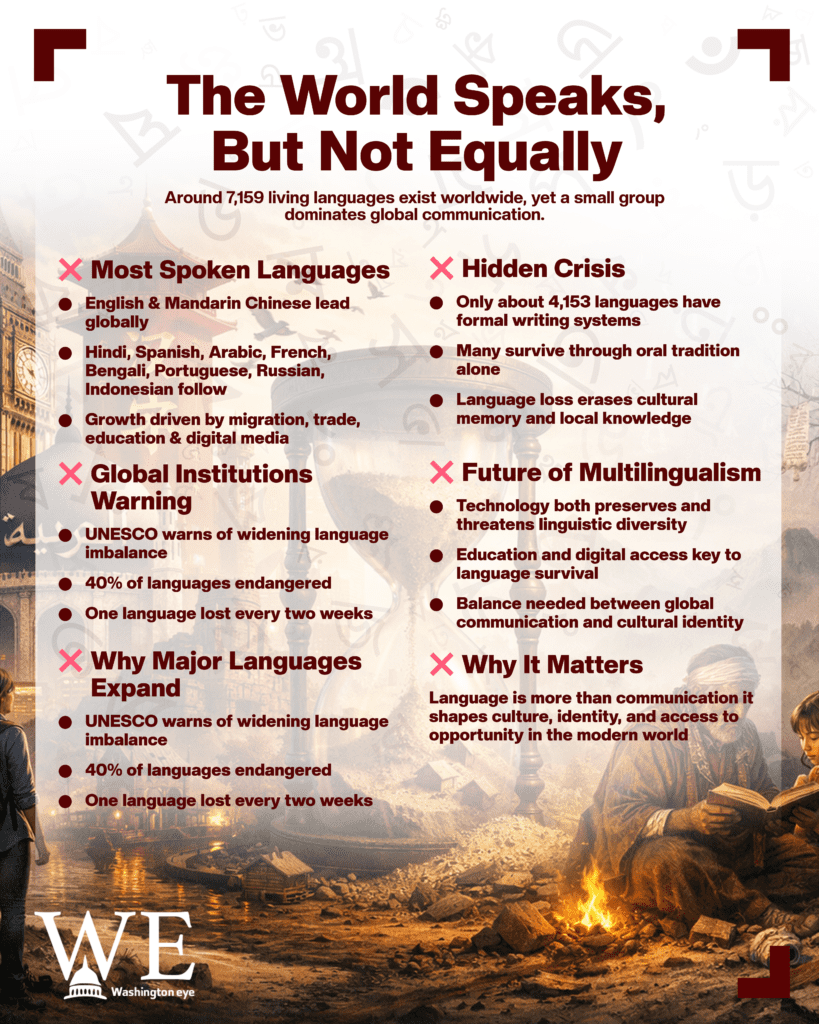
For linguists and educators, the message is not “one language versus another,” but balance: supporting global lingua francas for mobility while keeping mother tongues alive through schooling, community media, local publishing, and credible public recognition. In a world where the most spoken languages grow louder each year, the quiet fight is ensuring the smallest ones are still heard.