

The United States sustained an estimated $3.97 billion in aircraft losses during its military campaign against Iran, according to recent congressional and defense assessments, highlighting the enormous financial and strategic cost of one of the most intense conflicts involving American forces in recent years. The figures emerge as lawmakers, defense analysts, and military officials continue to assess the long-term impact of the war, known as Operation Epic Fury, which began in late February 2026 and lasted roughly 40 days.
The reported losses include a combination of aircraft destroyed, severely damaged, or rendered inoperable during combat operations. Congressional documents indicate that at least 42 American aircraft were either lost or damaged throughout the campaign, ranging from advanced fighter jets and surveillance aircraft to helicopters, transport planes, and unmanned aerial vehicles. While earlier estimates placed the value of these losses between $2.6 billion and $3 billion, newer assessments factoring in replacement costs have pushed the figure closer to $3.97 billion. Some analysts argue the eventual replacement bill could exceed $7 billion when training, logistics, and procurement delays are considered.
Among the most significant losses were several F-15E Strike Eagle fighter aircraft, an F-35A Lightning II stealth fighter, surveillance platforms, refueling aircraft, and multiple MQ-9 Reaper drones. Reports also point to damage sustained by an E-3 Sentry airborne warning and control aircraft, one of the most valuable assets in the U.S. Air Force inventory. In several cases, aircraft were reportedly destroyed by Iranian missile and drone attacks, while others were lost in accidents, friendly-fire incidents, or deliberately destroyed by U.S. forces to prevent capture behind enemy lines.
The war itself was marked by extensive air operations across Iranian territory and the wider Gulf region. U.S. and allied forces conducted thousands of sorties aimed at degrading Iran’s military infrastructure, missile capabilities, and command-and-control networks. However, Iran responded with a sustained campaign of ballistic missile strikes, drone attacks, and air-defense operations that inflicted notable damage on American assets despite Washington’s claims of air superiority. Defense experts say the losses reveal the growing effectiveness of modern integrated air-defense systems and the challenges posed by large numbers of relatively inexpensive drones.

The financial impact extends beyond aircraft alone. Pentagon officials estimate that the broader war has cost approximately $29 billion when operational expenditures, munitions, repairs, and equipment replacement are included. Aircraft losses represent only one component of that overall bill, but they remain among the most visible indicators of the conflict’s intensity. Lawmakers have demanded greater transparency regarding the true scale of losses, with some congressional reports noting uncertainty over whether the Pentagon has provided a complete accounting of damaged and destroyed aircraft.
Political reactions in Washington have been mixed. Supporters of the military operation argue that the campaign significantly weakened Iran’s military capabilities and reduced threats to regional allies. They contend that losses, while costly, were unavoidable in a high-intensity conflict against a capable adversary. Critics, however, question whether the strategic gains justify the enormous financial burden and loss of advanced military hardware. Several lawmakers have called for formal investigations into procurement readiness, force protection measures, and the circumstances surrounding friendly-fire incidents that reportedly accounted for some of the most expensive losses.
Military analysts note that replacing advanced platforms such as the F-35 and specialized surveillance aircraft will not be easy. Production lines are already operating under heavy demand, and replacement orders could place additional strain on defense budgets. Some experts warn that rebuilding lost capacity may take years, potentially affecting U.S. military readiness in other regions, including the Indo-Pacific and Europe. The war has therefore reignited debates about the sustainability of modern warfare, where even technologically superior militaries can face significant losses against determined adversaries equipped with missiles, drones, and asymmetric tactics.
From a strategic perspective, the conflict has become a case study in the evolving nature of air warfare. The ability of Iran to inflict billions of dollars in aircraft losses despite overwhelming American firepower has prompted renewed discussion about the vulnerability of high-value military assets. Analysts argue that future conflicts may increasingly favor dispersed operations, unmanned systems, and cheaper technologies designed to counter expensive aircraft and platforms.
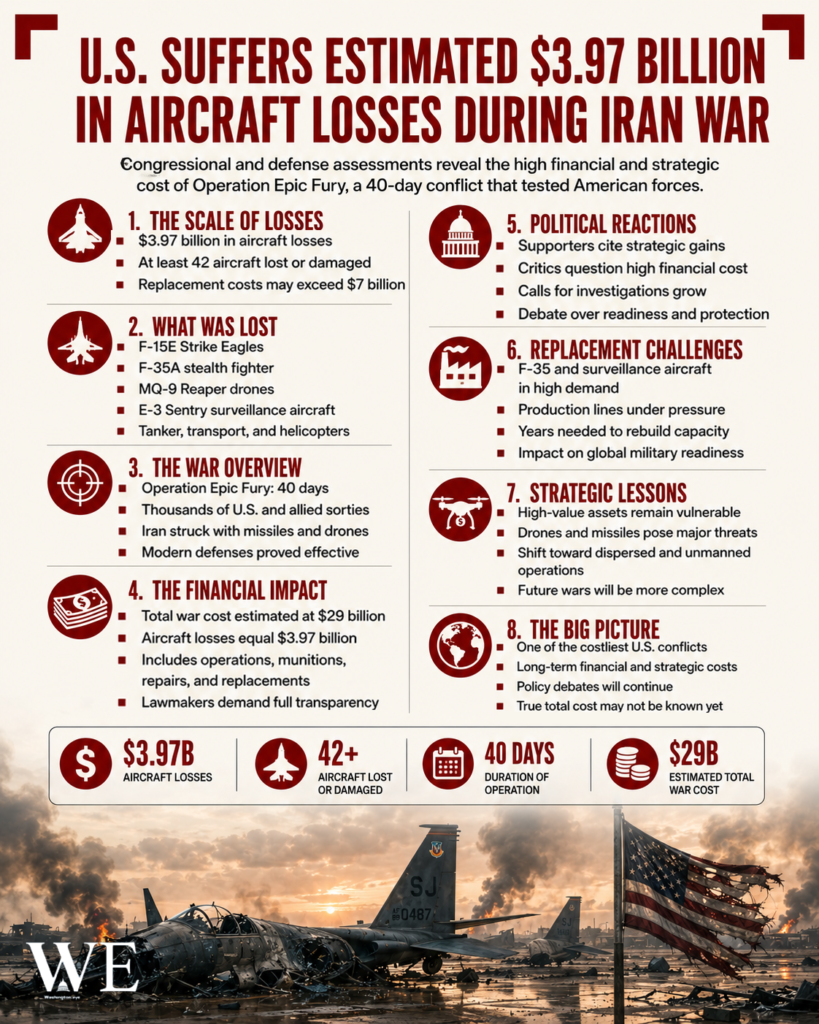
As assessments continue, the final cost of the war remains uncertain. What is already clear, however, is that the Iran conflict has become one of the costliest military engagements for the United States in decades, leaving policymakers to grapple with its financial, strategic, and political consequences long after the fighting has subsided.