
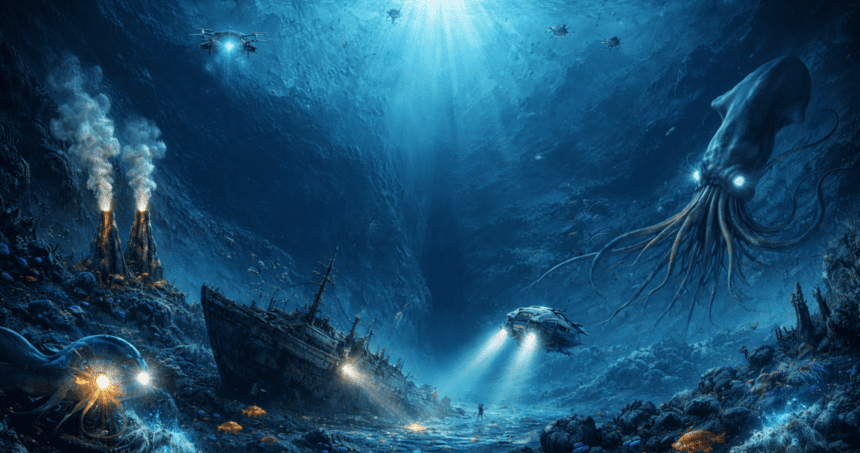
More than 70 percent of the Earth’s surface is covered by water, yet scientists estimate that nearly 80 percent of the world’s oceans remain unexplored. From the crushing depths of the Pacific Ocean’s Mariana Trench to the icy waters beneath Antarctica, underwater mysteries continue to challenge researchers, inspire explorers, and spark global curiosity. As new technologies emerge in 2026, from advanced submersibles to AI-powered deep-sea drones, humanity is gradually uncovering secrets hidden miles beneath the waves, though much remains unknown.
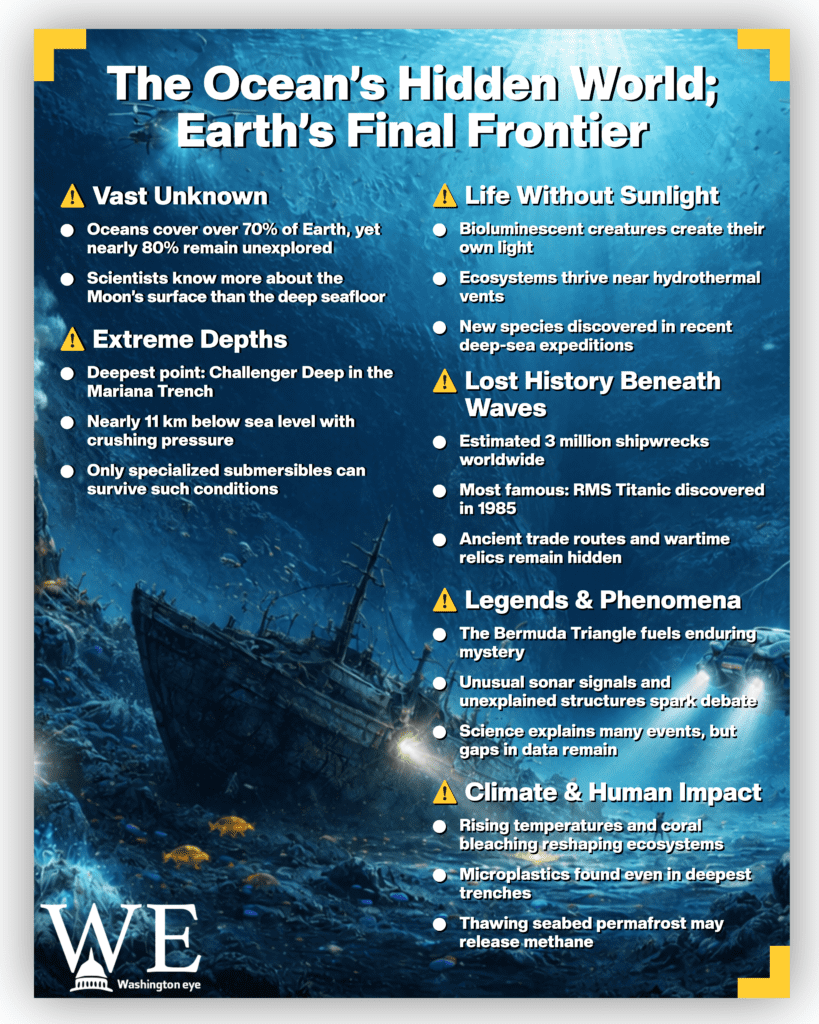
The ocean’s vastness is staggering. It contains about 1.332 billion cubic kilometers of water, regulating global climate, producing over half of the world’s oxygen through marine plants, and sustaining millions of species. Yet, compared to the surface of the Moon or Mars, scientists have mapped far less of the deep ocean floor in high resolution. The deepest known point on Earth, the Challenger Deep in the Mariana Trench in the western Pacific Ocean, plunges nearly 11 kilometers below sea level. At such depths, pressure exceeds 1,000 times that at the surface, conditions so extreme that only specialized submersibles can survive.
Among the greatest underwater mysteries are unusual sea creatures adapted to life in darkness. Bioluminescent organisms, such as anglerfish and comb jellies, produce their own light to attract prey or communicate. Giant squid, rarely seen alive, have fueled maritime legends for centuries. In 2025 and early 2026, deep-sea expeditions in the Indian and Pacific Oceans reported sightings of previously undocumented species, including translucent fish and heat-resistant microbes living near hydrothermal vents. These vents, found along mid-ocean ridges, release mineral-rich, superheated water and support entire ecosystems independent of sunlight.

Despite the wonders, the deep sea is also dangerous and unforgiving. Extreme pressure, near-freezing temperatures, underwater volcanic activity, and unpredictable currents make exploration risky. Several high-profile submersible missions in recent years have underscored both the ambition and the peril of deep-sea tourism and scientific research. Experts warn that while curiosity drives exploration, safety standards and environmental protection must remain priorities.

Another enduring mystery lies in the countless shipwrecks resting on the ocean floor. Historians estimate that more than three million shipwrecks are scattered across the world’s seas, from ancient trading vessels in the Mediterranean to World War II submarines in the Atlantic. Some, like the RMS Titanic, discovered in 1985 nearly 3,800 meters below the North Atlantic, continue to draw international attention. Others remain lost, their cargo and stories buried beneath layers of sediment. In addition to shipwrecks, unexplained phenomena, such as unusual sonar readings, underwater “sound anomalies,” and massive circular structures, have fueled both scientific debate and conspiracy theories.
The so-called “Bermuda Triangle,” located between Miami, Bermuda, and Puerto Rico, remains one of the most famous ocean legends. While scientific investigations attribute disappearances in the region to natural causes such as weather patterns, strong currents, and navigational challenges, public fascination endures. Marine scientists emphasize that most mysteries have rational explanations, but incomplete data from vast oceanic regions leaves room for speculation.
Climate change has added urgency to underwater research. Rising sea temperatures, coral bleaching, and melting polar ice are transforming marine ecosystems. Scientists studying the Arctic Ocean have warned that thawing permafrost beneath the seabed could release trapped methane, a potent greenhouse gas. Meanwhile, plastic pollution has reached even the deepest trenches, with microplastics discovered in organisms living thousands of meters underwater. These findings highlight not only the mystery of the ocean but also humanity’s growing impact on it.

Exploration efforts are expanding globally. Countries including the United States, Japan, China, and European nations have invested in deep-sea research programs. Autonomous underwater vehicles (AUVs) and remotely operated vehicles (ROVs) now capture high-definition footage and collect samples from extreme depths. The United Nations has also emphasized sustainable ocean governance under its Decade of Ocean Science for Sustainable Development (2021–2030), encouraging international cooperation to better understand marine environments.
Yet, for every discovery made, countless questions remain. Scientists still debate how life first originated in the ocean, how deep ecosystems evolved in isolation, and what unknown species may still exist. Some researchers believe that studying extremophiles, organisms that survive in harsh underwater environments, could provide clues about life on other planets, particularly icy moons like Europa, which are believed to harbor subsurface oceans.
As technology pushes the boundaries of exploration, the ocean continues to remind humanity of its scale and power. Beneath the calm surface lies a world of darkness, pressure, beauty, and danger. The mysteries of the deep are not just tales of sea monsters or lost ships, they are scientific frontiers that could reshape understanding of Earth’s climate, biodiversity, and even the origins of life itself. For now, the underwater world remains one of the last great unexplored realms on the planet, a reminder that even in the age of satellites and space travel, some of the greatest discoveries may lie not above us, but below.