

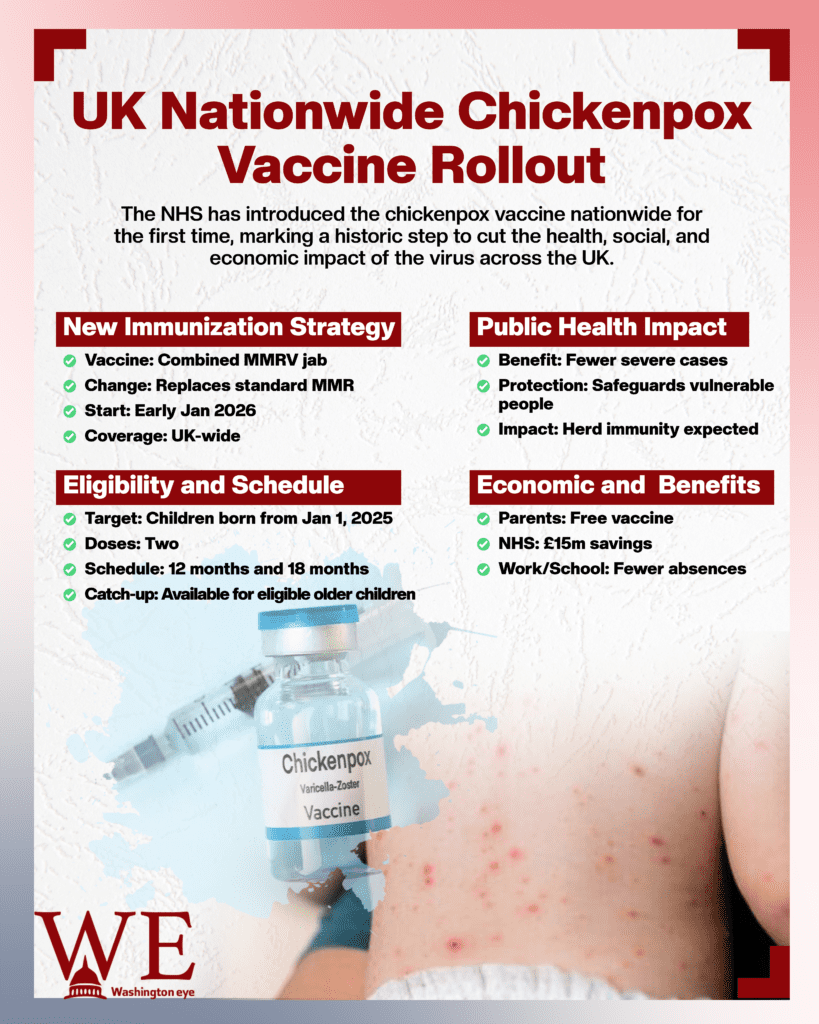
The National Health Service (NHS) has started offering the chickenpox vaccine across the United Kingdom for the first time, marking a major shift in the country’s childhood immunisation schedule. From early January 2026, children are being invited through GP practices to receive a combined measles, mumps, rubella, and varicella vaccine (MMRV), protecting them concurrently against four infectious diseases, including chickenpox.
The rollout, now underway in England, Wales, Scotland and Northern Ireland, comes after decades of debate among public health experts about whether to include varicella (the virus that causes chickenpox) in routine childhood vaccinations. The decision follows a recommendation by the Joint Committee on Vaccination and Immunisation (JCVI) in 2023, which concluded that offering the vaccine to all children could substantially lower the burden of chickenpox illness and its associated complications.
GP practices and community vaccination centres began administering the MMRV vaccine from early January 2026, with most families receiving letters or calls from their GP to schedule appointments. The vaccine will be offered as part of the existing NHS childhood programme, replacing the traditional MMR (measles, mumps and rubella) jab for eligible age groups.

Children born on or after 1 January 2025 are expected to receive two doses of the MMRV vaccine, first at 12 months and then at 18 months of age. Catch-up vaccination schedules have also been established for children born before 2025 but still within eligibility windows set out by NHS guidance.

Chickenpox (varicella) has historically been viewed as a common, generally mild childhood illness. However, health officials emphasise that it can pose serious risks for some children, immunocompromised individuals, pregnant women, and adults who have never been infected. Severe cases can lead to hospitalisation, complications such as chest infections or neurological problems, and in rare cases can be fatal.
Officials also point to the broader social and economic impact of chickenpox. According to NHS estimates, the illness is responsible for millions of missed school days and lost workdays for parents each year, as well as significant healthcare usage. Research suggests that chickenpox contributes to an estimated £24 million in lost income and productivity in the UK annually, with the NHS expecting to save about £15 million per year in treatment and associated care costs due to the vaccine rollout.
Health Secretary Wes Streeting described the launch as a “historic milestone”, saying the decision reflects a long-term commitment to protecting children’s health and easing the burden on families. He noted that many UK parents have previously had to either watch their child suffer through the disease or pay privately for vaccination, which could cost around £150 for a two-dose course when done outside the NHS. With the new programme, that cost is eliminated for eligible children.

The combined MMRV vaccine has been used in countries such as the United States, Germany, Canada, and Australia for years, where routine varicella vaccination has significantly reduced incidence, hospitalisations and disease transmission. Early data indicates that the vaccine provides strong protection against chickenpox, with particularly high effectiveness in young children.
Experts also emphasise that including chickenpox vaccination within the routine NHS schedule simplifies administration and improves uptake, as parents can access it at standard well-child appointments without additional visits.
Public health officials encourage parents to ensure their children receive both doses on schedule, which is critical for maximum protection. The NHS and UK Health Security Agency are running information campaigns to raise awareness and address vaccine hesitancy, stressing the favourable safety profile and long-term benefits of immunisation.
Introducing the varicella vaccine into the NHS childhood programme aligns the UK with many other high-income countries and could pave the way toward herd immunity within the next decade, according to health modelling. High coverage rates in childhood could dramatically reduce the spread of the virus in the broader population and protect vulnerable groups who cannot be vaccinated.
While officials acknowledge that most chickenpox cases are mild, this policy is designed to curb severe outcomes, reduce the social and economic toll of the disease, and bring the UK’s vaccination schedule in line with global best practice. As the programme expands through 2026 and beyond, health authorities will monitor uptake rates, vaccine effectiveness, and population impact, adapting strategies to ensure broad and equitable access.