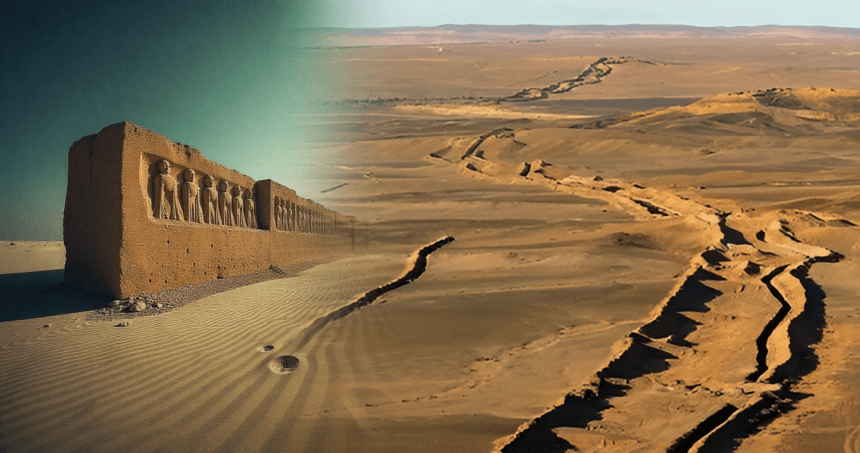
The Secret Wall of the Sahara, known as the Moroccan Berm, is one of the longest yet least visible military structures in the world, stretching silently across the vast deserts of Western Sahara in North Africa. Located between Morocco, Mauritania, and near the Algerian border, this enormous earthen barrier cuts through one of the most remote landscapes on Earth, dividing territories and shaping a conflict that has remained unresolved for nearly five decades. Despite its massive scale and geopolitical significance, the wall remains largely unknown to the global public, earning its reputation as a hidden or “secret” wall of the desert.
The Berm was constructed during the early 1980s, at the height of the Western Sahara conflict that followed Spain’s withdrawal from the territory in 1975. After Spain ended its colonial rule, Morocco moved to assert control over Western Sahara, while the Polisario Front, representing the indigenous Sahrawi people and backed primarily by Algeria, demanded independence. As guerrilla warfare intensified and Polisario fighters launched attacks on key cities and infrastructure, Morocco adopted a defensive military strategy that centered on physically securing the territory it controlled. Between 1980 and 1987, the Berm was built in six successive phases, each extending the barrier further across the desert to protect strategic towns, phosphate mines, and economically vital coastal regions.
Often described as a wall, the Berm is in fact a sand and stone embankment, typically rising 2 to 3 meters (6 to 10 feet) high, but its effectiveness lies in its layered defenses rather than its height. The structure is reinforced with trenches, barbed wire, radar and surveillance systems, military checkpoints, and thousands of observation posts, making it a formidable obstacle. Running for approximately 2,700 kilometers (around 1,700 miles), it ranks among the longest military barriers ever constructed, surpassing more famous structures such as the Berlin Wall or the Israeli West Bank barrier. Alongside the Berm lies one of the world’s largest active landmine zones, making access extremely dangerous and tightly controlled.
Rather than connecting regions, the Berm’s primary function is to divide. It separates Western Sahara into two distinct zones: the western portion, which is administered by Morocco and contains major cities such as Laayoune, Dakhla, and Smara, and the eastern areas controlled by the Polisario Front, often referred to as the Free Zone. For centuries, Sahrawi nomadic tribes moved freely across this desert, following seasonal grazing routes and trade paths. The construction of the Berm disrupted these traditional patterns, separating families, communities, and cultural landscapes, while forcing many Sahrawis into refugee camps in southwestern Algeria, where tens of thousands remain today.

Politically and historically, the Berm has become a powerful symbol of the Western Sahara dispute, which is widely regarded as Africa’s longest unresolved conflict. In 1991, a United Nations, brokered ceasefire halted most large-scale fighting, and the UN established the MINURSO mission to oversee peace and organize a referendum on self-determination for the Sahrawi people. However, disagreements over voter eligibility and political status have stalled the process indefinitely. While the ceasefire reduced open warfare, the Berm solidified a de facto territorial division that continues to shape negotiations, diplomacy, and regional tensions.
Strategically, the wall allowed Morocco to maintain control over areas rich in natural resources, particularly phosphate deposits and valuable fishing zones along the Atlantic coast. This control has strengthened Morocco’s economic position in the region and reinforced its political claims, while critics argue that it has marginalized Sahrawi aspirations for independence. For the Polisario Front and its supporters, the Berm represents occupation and exclusion, a physical manifestation of an unfinished decolonization process.
Despite its scale, the Berm remains largely absent from popular global discourse, partly due to its remote desert location and limited media access. Unlike other famous walls, it is rarely seen up close, with satellite imagery providing one of the few ways to grasp its enormity. Military restrictions, landmines, and harsh terrain contribute to its invisibility, allowing it to exist quietly while continuing to influence lives and politics across generations.


Today, the Secret Wall of the Sahara still stands as both a military structure and a political boundary, shaping daily realities in Western Sahara and serving as a reminder of how modern conflicts can leave enduring marks on geography and history. As diplomatic efforts continue sporadically and tensions occasionally resurface, the Berm remains a silent but powerful symbol of division, resilience, and an unresolved struggle over land, identity, and self-determination.