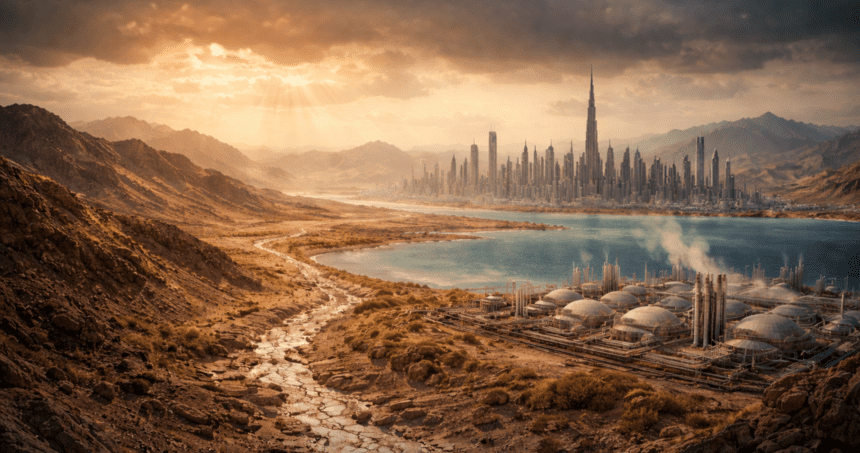
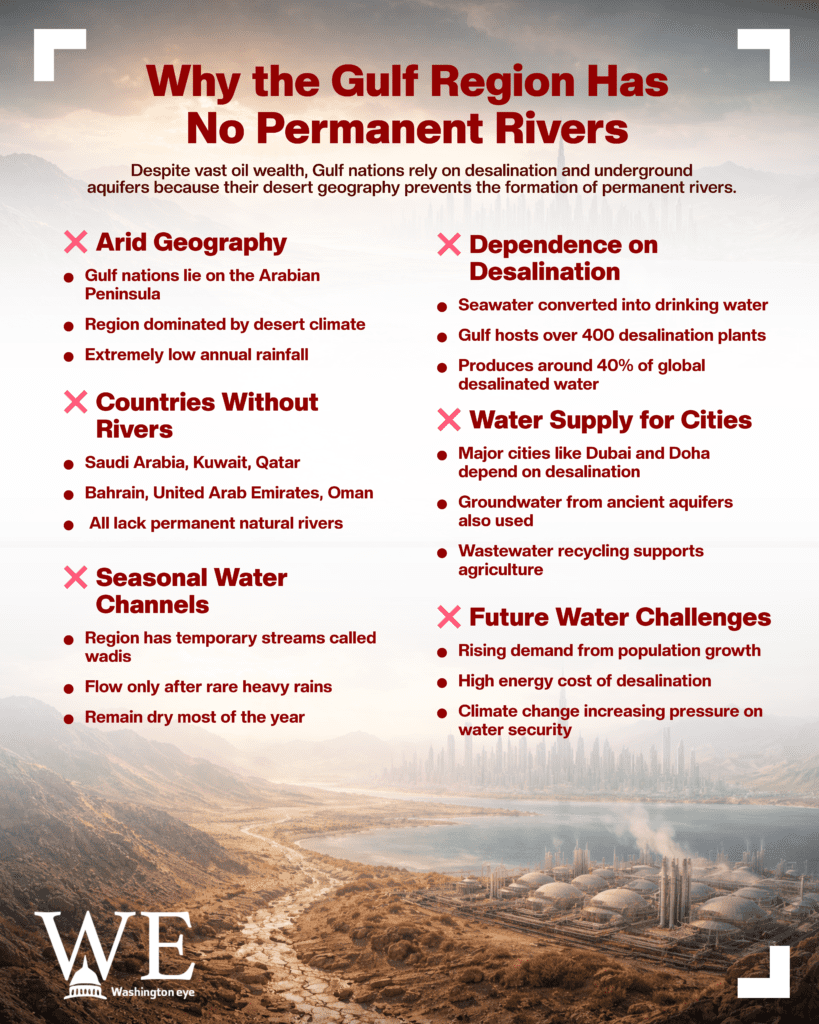
The countries surrounding the Persian Gulf are among the richest in oil and gas, yet they share a striking geographical reality: most of them have no permanent rivers. The Gulf region, mainly comprising Saudi Arabia, Kuwait, Bahrain, Qatar, the United Arab Emirates (UAE), and Oman, collectively known as the Gulf Cooperation Council (GCC) states, lies in one of the driest parts of the world. Their landscapes are dominated by deserts and extremely low rainfall, leaving these nations without the large flowing rivers that shape many other civilizations.
Geographically, the Gulf states sit on the Arabian Peninsula, where the climate is hot and arid, with limited rainfall and high evaporation rates. Because rivers require sustained rainfall, melting snow, or continuous groundwater flows to exist, such conditions prevent the formation of permanent waterways. Instead of rivers, the region has “wadis”, dry valleys or channels that carry water only during rare heavy rains. These temporary streams may flow briefly after storms but disappear quickly, leaving dry riverbeds most of the year.
The absence of rivers is particularly notable in Saudi Arabia, the largest country in the Middle East and one of the biggest nations in the world without a permanent river. Despite covering more than two million square kilometres, Saudi Arabia relies on underground aquifers, wells, and desalinated seawater for freshwater supplies.
The Gulf countries share similar environmental conditions. Kuwait, Qatar, Bahrain, the UAE, and Oman also lack permanent rivers and receive very little rainfall. In many parts of the peninsula, annual precipitation is less than 100 millimetres. Because of this extreme dryness, natural freshwater sources such as lakes or rivers rarely develop. Instead, groundwater stored in ancient aquifers and seasonal wadis provide limited water for agriculture and small communities.

To survive without rivers, Gulf nations have developed advanced technological solutions. The most important is seawater desalination, a process that removes salt from seawater to produce drinkable water. Over the past few decades, the Gulf region has become the global center of desalination technology. Today, Gulf countries operate more than 400 desalination plants and produce roughly 40 percent of the world’s desalinated water.
This technology has become essential for daily life. In some countries, desalination supplies the majority of drinking water. For example, around 90 percent of Kuwait’s drinking water, about 86 percent in Oman, and roughly 70 percent in Saudi Arabia come from desalinated seawater. These facilities allow modern cities like Dubai, Doha, and Riyadh to thrive despite the harsh desert environment.
However, reliance on desalination also presents serious challenges. Desalination plants require large amounts of energy, making them expensive and environmentally demanding. They also discharge salty waste, known as brine, back into the sea, which can harm marine ecosystems. Additionally, because many plants are located near coastlines and power stations, they are vulnerable to conflict or infrastructure attacks, raising concerns about water security in the region.

Besides desalination, Gulf states use several other methods to manage water shortages. These include groundwater extraction from deep fossil aquifers, rainwater harvesting, and recycling wastewater for agriculture and landscaping. Governments have also introduced water conservation policies and invested in research on sustainable water technologies. Some cities even store strategic reserves of freshwater to cope with emergencies or disruptions.
Despite these efforts, experts warn that the Gulf region faces a fragile water future. Rapid population growth, urban development, tourism, and climate change are increasing water demand across the region. With temperatures often exceeding 50°C in summer and rainfall remaining unpredictable, dependence on technology for water supply will likely continue to grow.
The Gulf’s lack of rivers is therefore more than just a geographical curiosity, it is a defining factor shaping the region’s politics, economy, and environmental strategies. While oil transformed these desert societies into wealthy global powers, water security remains one of their most critical long-term challenges. As technology evolves and climate pressures intensify, the ability of Gulf states to manage water without natural rivers will remain a key test of resilience in one of the world’s harshest environments.