
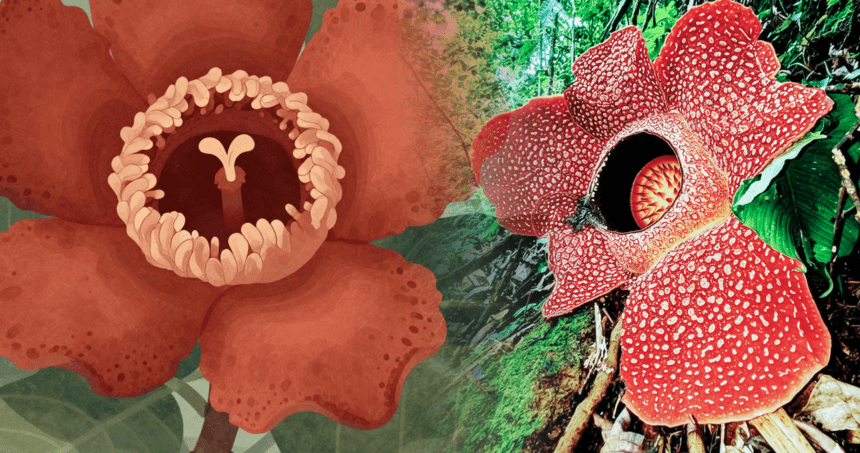
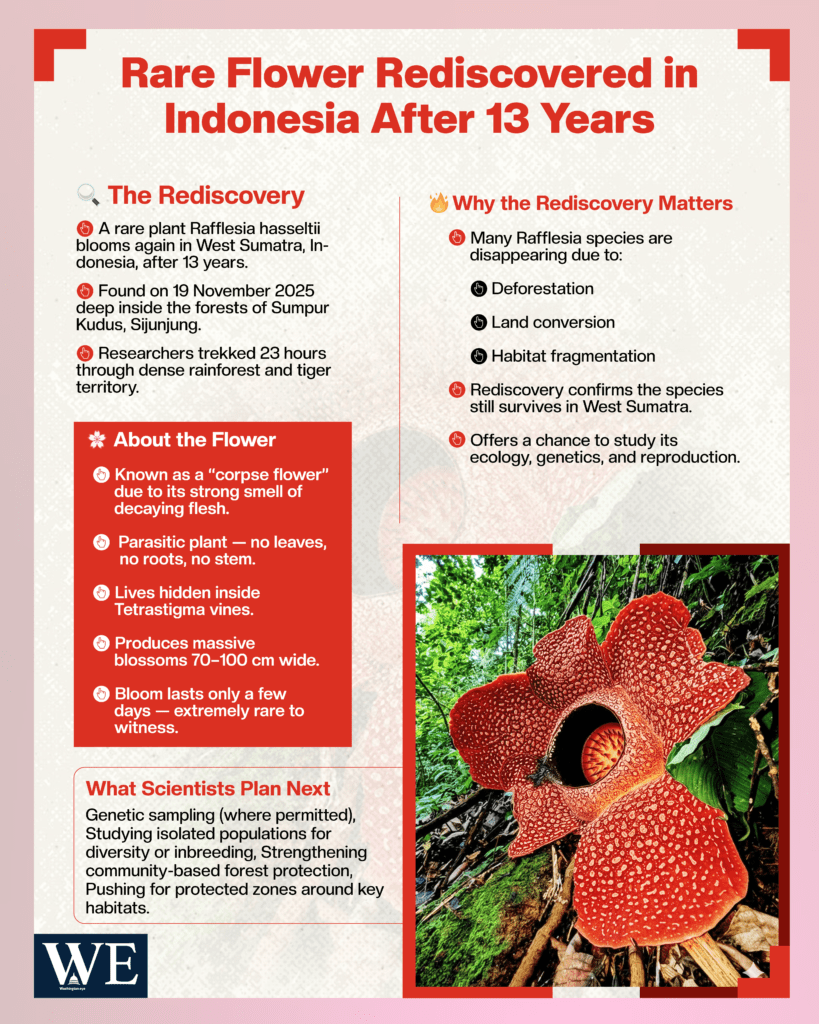
A rare and elusive species of giant rainforest flora, Rafflesia hasseltii, has been rediscovered blooming in West Sumatra, Indonesia, after a 13-year absence that had led many scientists to fear it was nearing local extinction. The extraordinary find occurred on 19 November 2025 in the deep forest of Sumpur Kudus, Sijunjung Regency, where an expedition team consisting of Indonesian conservationists and international researchers endured a 23-hour journey through dense vegetation and wildlife-rich territory to reach the site. The arduous trek took them through narrow forest paths known for tiger activity, and for many researchers, the emotional impact of finally witnessing the species bloom again after more than a decade brought tears of relief and triumph.
Rafflesia hasseltii is one of the most unusual and biologically fascinating flowering plants on Earth. It is a parasitic species that lives entirely hidden inside the tissues of a host vine from the genus Tetrastigma, lacking leaves, stems, or roots of its own. It only reveals itself when preparing to reproduce, producing a massive blossom that can reach 70–100 centimeters in diameter. With its maroon-red petals covered in bright white speckles, the flower is visually striking, yet it emits a pungent odor resembling decaying flesh to attract carrion-feeding insects, a reason it is often referred to as a “corpse flower.” Despite its dramatic appearance, the bloom lasts only a few days before collapsing, making sightings exceptionally rare even under ideal conditions.
The rediscovery is scientifically significant because many populations of Rafflesia in Sumatra and Borneo are believed to be disappearing due to rapid deforestation, land conversion, and fragmented habitat. Since the life of the plant depends entirely on the health of its host vine, the destruction of even small forest patches can silently eliminate entire hidden populations. Over the years, conservationists documented decreasing sightings, leading to concerns that R. hasseltii might be on the brink of disappearing from several known sites. This 2025 bloom not only confirms the species’ survival in West Sumatra but offers renewed opportunity to study its ecology, genetics, and reproduction.

Researchers plan to conduct genetic sampling, where permitted, to better understand the diversity between scattered populations and to determine whether isolated groups may be genetically unique or critically inbred. Conservation agencies in Indonesia are also discussing ways to strengthen community-based forest protection, given that most Rafflesia sites fall outside national parks and are vulnerable to illegal logging and agricultural expansion. The rediscovery has reignited calls to designate key habitats as protected zones and to involve local communities in stewardship initiatives.

The emotional reaction among scientists highlights how difficult and unpredictable Rafflesia research can be. The buds of the flower can take up to nine months to mature, and many never reach blooming stage due to environmental stress or natural decay. The brief blooming period, combined with inaccessible terrain, means that researchers often spend years attempting to locate a single open flower. When the team finally reached the site, the flower had already expanded into full bloom, and for many in the group, the moment symbolized the perseverance and passion that define conservation work. Local villagers who guided the researchers were equally proud that their forests still harbor a species considered one of the world’s botanical treasures.
Reactions around Indonesia and abroad have been overwhelmingly positive, with social-media users and environmental organizations celebrating the rediscovery as a rare good news story in global biodiversity. The flower’s reappearance has also triggered discussions on ethical research practices and the importance of ensuring that local botanists and indigenous guides receive proper recognition in international scientific reports. Conservation experts say that the rediscovery, while uplifting, is a reminder that species like Rafflesia exist on a razor’s edge and require urgent, coordinated action to ensure their survival.
As R. hasseltii blooms for only a fleeting moment, this rediscovery is both a scientific milestone and a symbolic message. It demonstrates that even the rarest lifeforms can persist if their habitats remain intact, and it reinforces the critical need to preserve Southeast Asia’s shrinking rainforests. With further research planned and conservation discussions underway, the 2025 bloom serves as a fragile but powerful reminder of nature’s resilience and humanity’s responsibility to protect it.