
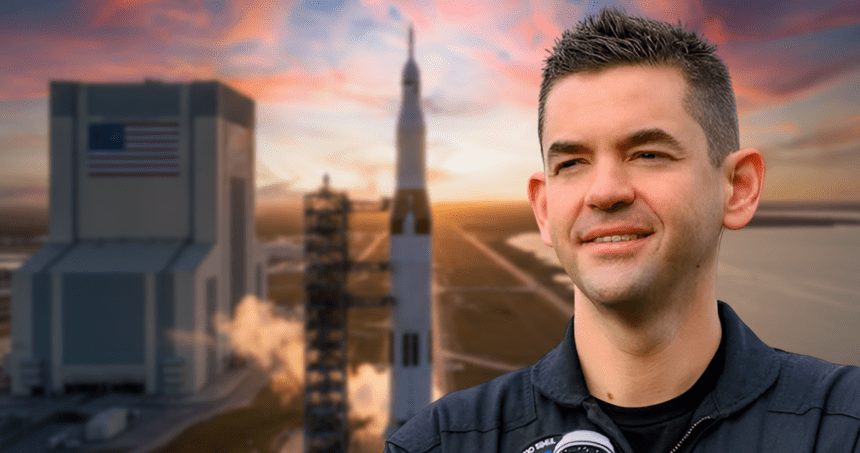
In a historic shift for U.S. space leadership, Jared Taylor Isaacman, a billionaire entrepreneur, seasoned pilot, and commercial astronaut, has been confirmed as the 15th Administrator of the National Aeronautics and Space Administration (NASA), ending more than a year of uncertainty at the helm of the agency and ushering in a new era focused on accelerated lunar and Martian exploration. On December 17, 2025, the U.S. Senate voted 67–30 to confirm Isaacman following a protracted and politically fraught nomination process, and he was sworn in on December 18, 2025, at a ceremony in the Eisenhower Executive Office Building in Washington, D.C. that included his parents and U.S. District Judge Timothy J. Kelly administered the oath. Isaacman succeeds interim administrator Sean Duffy, who had been leading NASA after the previous confirmed administrator’s term ended, and who also serves as U.S. Secretary of Transportation.
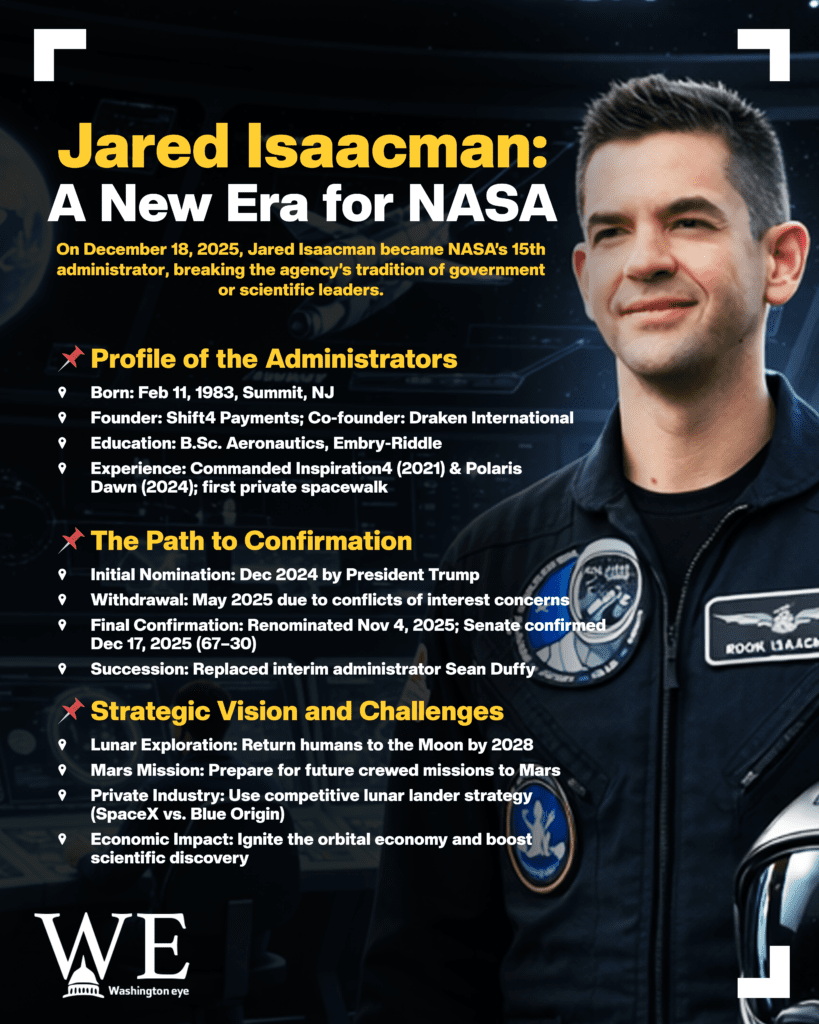
Born on February 11, 1983, in Summit, New Jersey, Isaacman’s path to NASA leadership is unconventional compared with his predecessors, many of whom came from government, scientific, or military backgrounds. Raised in a family that encouraged his love of aviation and space, he left high school at 16 to found a payment-processing venture that became United Bank Card, later rebranded as Shift4 Payments, which today processes billions of transactions worldwide. He earned a Bachelor of Science in Aeronautics from Embry-Riddle Aeronautical University in 2011, reflecting his lifelong fascination with flight. Beyond fintech, Isaacman co-founded Draken International, a private air combat training company supporting U.S. and NATO forces, and became a respected figure in aviation with thousands of flight hours and world speed records in jet aircraft.
Isaacman’s space credentials were cemented through commercial missions rather than government programs. He commanded Inspiration4 in 2021, the first all-civilian orbital flight, which orbited Earth for nearly three days and raised significant funds for charity, and he later led Polaris Dawn in 2024, achieving the first private spacewalk and sending humans farther from Earth than any crew in decades. These missions were conducted aboard SpaceX Crew Dragon spacecraft and highlighted the growing role of commercial spaceflight in expanding human access to orbit.

Despite his unique experience, Isaacman’s nomination was contentious. Originally nominated by President Donald J. Trump in December 2024, his candidacy was withdrawn in May 2025 amid a public dispute between Trump and SpaceX CEO Elon Musk, a close associate of Isaacman’s, and amid scrutiny over his ties to the commercial space sector. After months of debate and negotiations, Trump renominated him on November 4, 2025, and the Senate ultimately confirmed him, with supporters arguing that his entrepreneurial approach and firsthand spaceflight experience are assets for the agency and critics expressing concern about potential conflicts of interest with major contractors like SpaceX.
As NASA’s administrator, Isaacman inherits an agency navigating significant challenges: budget pressures and workforce reductions that have accompanied broader government efficiency efforts, debates over the direction of scientific programs, and an intensifying global space race with China. In his first statements as administrator, Isaacman emphasized NASA’s core mission to “push the boundaries of human exploration, ignite the orbital economy, drive scientific discovery, and innovate for the benefit of all humanity,” reaffirming the agency’s commitment to return humans to the Moon by 2028 and laying groundwork for eventual crewed missions to Mars, goals aligned with recent U.S. space policy priorities. On his first day in office, he also signaled a competitive strategy for NASA’s lunar lander development by stating that either SpaceX or Blue Origin will be chosen based on who completes a viable landing system first, injecting urgency into the Artemis mission timeline and reinforcing the role of private industry in achieving national space goals.
Isaacman’s leadership marks a notable evolution in NASA’s history, expanding the influence of commercial spaceflight perspectives in shaping national strategy while challenging the traditional model of government-scientist leadership. Traditionally, NASA administrators like Thomas Keith Glennan, James Webb, and Daniel Goldin came from scientific, administrative, or policy backgrounds, setting precedent for decades of exploration through public-sector innovation. With Isaacman at the helm, NASA enters an era where public-private partnerships, rapid innovation cycles, and ambitious exploration targets define the agency’s trajectory, with implications for scientific research, international cooperation, and U.S. leadership in the cosmos. The world will watch closely as Isaacman’s tenure unfolds, balancing commercial expertise with NASA’s enduring mission to explore the final frontier.