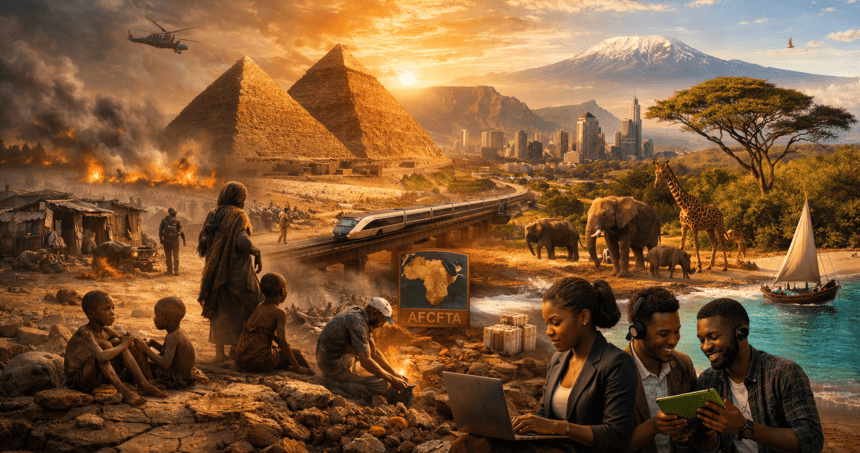
Africa is often described in global discourse through the language of poverty, crisis, and aid. These narratives dominate headlines during droughts, conflicts, or political instability, reinforcing a long-standing image of a struggling continent. Yet this portrayal sharply contrasts with another reality: Africa as a land of iconic deserts, world-class tourist destinations, cultural heritage, and growing economic ambition. The question, therefore, is not simply is Africa poor, but why is its global image so narrowly framed?
Africa is the world’s second-largest continent, home to 54 countries, vast geographical diversity, and more than 1.4 billion people. From the Sahara Desert, the largest hot desert on Earth, stretching across North Africa, to the lush rainforests of the Congo Basin, and from the beaches of Zanzibar to the wildlife-rich savannas of the Serengeti and Maasai Mara, Africa’s physical and cultural landscapes are among the most diverse on the planet. Countries like Morocco, Egypt, Kenya, Tanzania, South Africa, Namibia, Rwanda, and Senegal attract millions of tourists annually, contributing significantly to national economies.
Tourism alone challenges the idea of Africa as uniformly poor. Egypt’s pyramids of Giza, one of the Seven Wonders of the Ancient World, symbolize not only ancient civilization but also a modern tourism economy. Morocco’s cities, Marrakech, Fez, and Casablanca, blend history with global travel appeal. In Southern Africa, Cape Town is consistently ranked among the world’s top tourist cities, while Namibia’s Namib Desert and Botswana’s Okavango Delta draw eco-tourists from across the globe. These destinations reflect infrastructure, services, and global integration often absent from mainstream narratives.
Despite this, Africa is frequently portrayed through a crisis lens. This framing has deep historical roots. Colonialism disrupted indigenous governance and economic systems, extracting resources while limiting local development. Post-independence challenges, debt, governance issues, and externally imposed economic policies, further shaped global perceptions. International media, largely based outside Africa, often focuses on conflict zones, humanitarian emergencies, or corruption scandals, while underreporting everyday stability, progress, and success stories.

Poverty in Africa is real, but it is uneven. Some countries face severe challenges, particularly in regions affected by conflict, climate change, and food insecurity, such as the Sahel or Horn of Africa. However, other nations have made measurable progress in economic growth, education, and healthcare. Rwanda is often cited for governance reforms and tourism development; Kenya and Nigeria have become tech hubs for East and West Africa; Ghana and Senegal show political stability and steady growth. Treating Africa as a single economic unit ignores these distinctions.
Economically, Africa holds enormous potential. The continent possesses vast natural resources, including minerals critical for global energy transitions, such as cobalt and lithium. It also has the world’s youngest population, offering long-term demographic advantages. Initiatives like the African Continental Free Trade Area (AfCFTA) aim to create a unified market, boost intra-African trade, and reduce dependence on external economies. While challenges remain, these efforts signal a shift toward self-driven development.
Another reason Africa is portrayed as poor lies in who controls the narrative. International storytelling has often sidelined African voices, leading to oversimplified images sometimes described as “poverty branding.” These portrayals influence foreign investment, aid policies, and even tourism, shaping expectations before visitors arrive. Increasingly, African journalists, filmmakers, and digital creators are reclaiming this narrative, presenting stories of innovation, culture, entrepreneurship, and resilience alongside hardship.

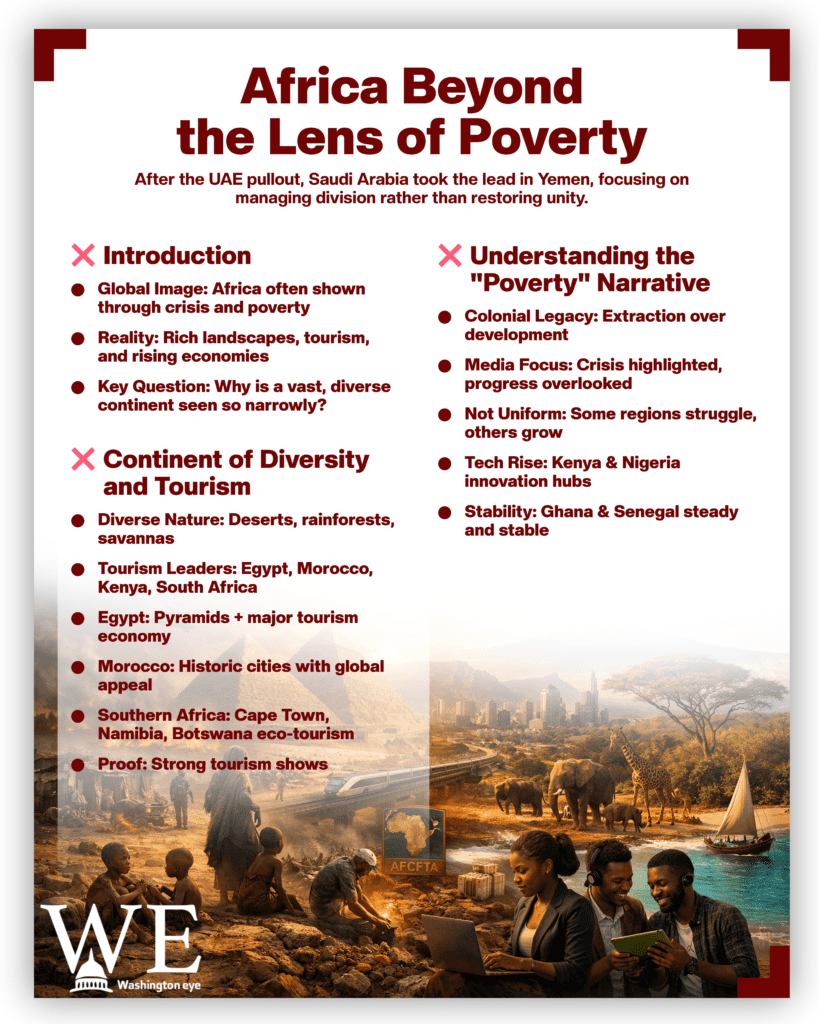
Ultimately, Africa is neither uniformly poor nor uniformly prosperous. It is a continent of contrasts, deserts and rainforests, luxury resorts and informal settlements, ancient heritage and digital innovation. The problem lies not in acknowledging poverty, but in allowing it to define the entire continent. A more balanced global perspective, one that includes Africa’s famous places, economic diversity, and local viewpoints, is essential to understanding its true reality.