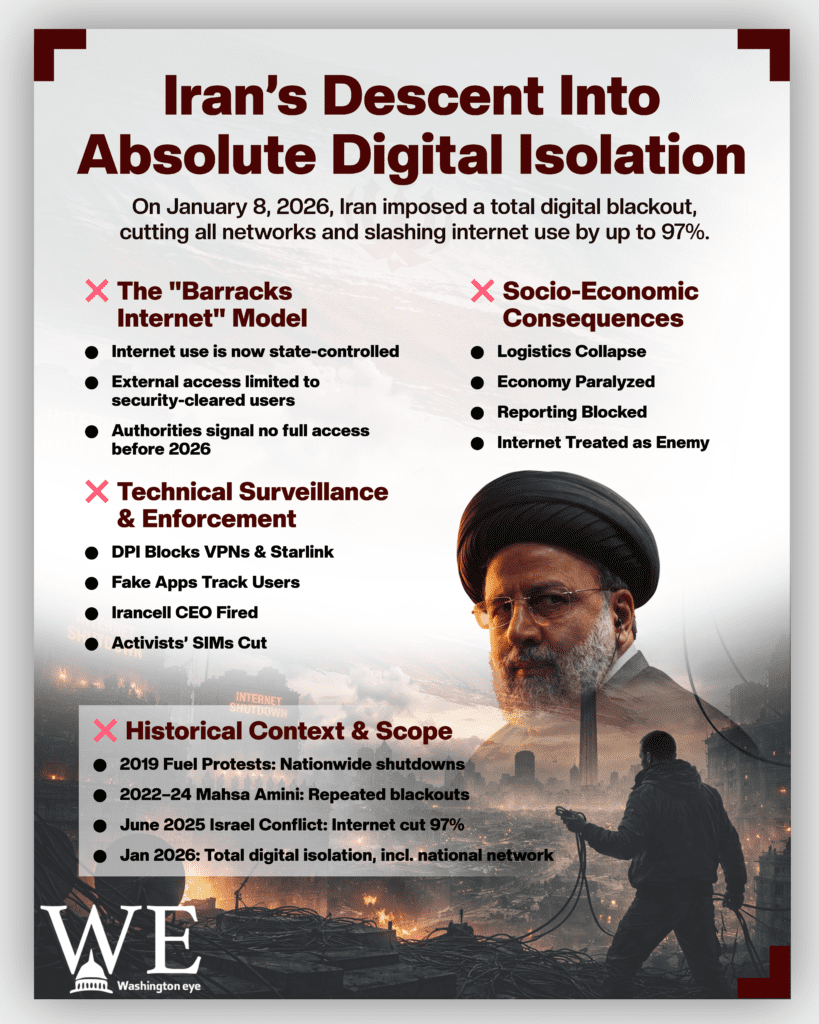
Since January 8, 2026, the twelfth day of the 2025-2026 nationwide protest, Iran has entered what cybersecurity experts describe as its most extreme information blackout to date. Beginning at 20:30 IRST, authorities imposed a near-total internet shutdown, disconnecting not only international access but also Iran’s own National Information Network. Reports from Tehran and major cities including Isfahan, Shiraz, Kermanshah, Abdanan, and Lordegan confirmed widespread internet and telephone outages, leaving millions cut off from communication.
Monitoring organization NetBlocks verified that the blackout coincided with escalating protests and rising casualties, severely limiting independent reporting. Human rights groups argue the shutdown is designed to conceal mass violence, marking a strategic shift by the Islamic Republic from broad censorship to what experts now call “Absolute Digital Isolation.”
This new phase represents a fundamental transformation of Iran’s digital architecture. According to investigative findings, senior officials have overseen a confidential state project to convert national connectivity into a sealed “Barracks Internet.” Under this system, external access is restricted to a narrow whitelist granted only to individuals with security clearance. Connectivity which was once treated as a public utility has effectively become a government-issued privilege now. State media has already warned that unrestricted internet access will not return before 2026 which signals that this policy is going to be permanent.
The transition has carried internal consequences. Filterwatch confirmed the dismissal of Irancell’s CEO for allegedly delaying shutdown orders, while foreign technology partners quietly withdraw from the market. In their place, security-linked contractors have deployed advanced Deep Packet Inspection systems designed to detect and block VPN traffic, including connections routed through Starlink terminals. Authorities have also weaponized roaming data to monitor Iranians abroad, which is a phenomenon researchers describe as “exported censorship.”
Economically, the impact has been severe. Logistics firms such as Tipax have reportedly collapsed under prolonged connectivity disruptions, compounding the damage to an economy already strained by sanctions. Indeed, Iran has a long history of internet shutdowns. Most notably during the 2019 fuel protests, the Mahsa Amini demonstrations between 2022 and 2024, and now again in 2025, but the current strategy surpasses previous efforts in scale and sophistication.
During the June 2025 conflict with Israel, internet usage fell by 97 percent after authorities cited “national security” concerns. Cybersecurity expert Amir Rashidi notes that the Iranian state increasingly treats the internet itself as an enemy, employing shutdowns, SIM deactivations, bandwidth throttling, and targeted antenna disabling, while publicly blaming power failures or aging infrastructure.
What is unfolding now suggests Iran is no longer merely censoring dissent. It is engineering a communication vacuum, one that threatens civil society, economic stability, and the country’s connection to the outside world altogether.