
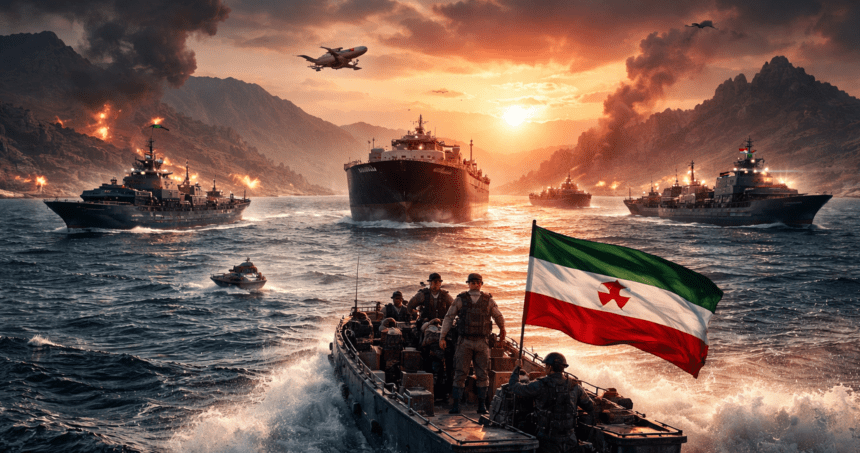
In a dramatic escalation of tensions in the Middle East, Iran has declared that the strategic Strait of Hormuz remains open to international shipping, but only for countries it does not consider hostile. The announcement, made on March 22, 2026, comes amid an intensifying conflict involving Iran, the United States, and Israel, raising global concerns over energy security and the risk of a wider war.
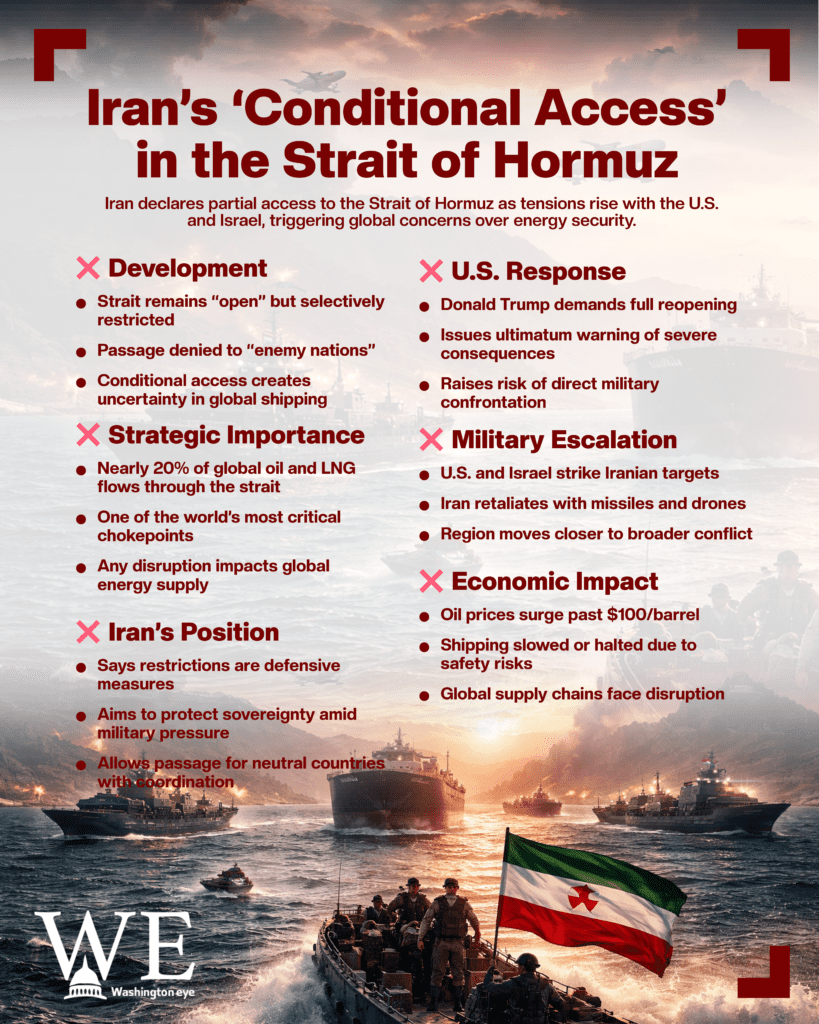
The Strait of Hormuz, located between Iran and Oman, is one of the world’s most critical maritime chokepoints. Nearly 20% of global oil and liquefied natural gas supplies pass through this narrow waterway daily. Its disruption has historically triggered global economic shocks, and the current crisis is no exception.
Iranian officials, including representatives to international maritime bodies, have emphasized that the strait is “not fully closed.” Instead, Tehran claims it is selectively restricting passage. According to Iranian statements, vessels linked to “enemy nations”, primarily the United States and Israel, along with their allies, are barred from transit. Meanwhile, ships from neutral or friendly countries such as China, India, Turkey, and Pakistan may pass, often with prior coordination for security assurances.
The move follows a sharp escalation in military hostilities. The United States and Israel have conducted strikes on Iranian military infrastructure, while Iran has retaliated with missile and drone attacks across the region. In response, Iran’s leadership argues that restricting enemy-linked shipping is a defensive measure aimed at protecting national sovereignty and deterring further aggression.

However, the United States has rejected this justification. Former U.S. President Donald Trump issued a 48-hour ultimatum demanding that Iran fully reopen the strait or face severe consequences, including potential strikes on its energy infrastructure. This warning has significantly raised fears of a direct confrontation between major powers.
The partial restriction has already had profound global consequences. Oil prices have surged past $100 per barrel, with some estimates pushing even higher due to fears of prolonged disruption. Energy-importing countries, particularly in Asia, are feeling immediate pressure, while global markets are experiencing volatility. Shipping companies have reduced or halted operations through the strait due to safety concerns, further tightening supply chains.
From a currency and economic standpoint, the impact is multifaceted. Rising oil prices have increased fuel costs worldwide, contributing to inflation in both developed and developing economies. Countries heavily dependent on Gulf oil, such as Pakistan, Japan, and European states, are facing rising import bills and weakening currencies against the U.S. dollar. In Pakistan, for example, fuel prices have already risen significantly due to the crisis, reflecting the broader economic strain.

International reactions have been swift. More than 20 countries have condemned Iran’s actions, with some offering to contribute naval forces to ensure safe passage through the strait. At the same time, Iran has signaled willingness to cooperate with international organizations like the International Maritime Organization (IMO) to ensure maritime safety, provided that hostilities against it cease.
The situation has effectively created a “conditional blockade,” where the definition of who can pass depends on geopolitical alignment. This has introduced a new level of uncertainty into global trade routes, challenging the long-standing principle of freedom of navigation under international law. From a broader viewpoint, analysts warn that Iran’s strategy reflects a shift toward asymmetric control of global energy flows.
By selectively restricting access rather than imposing a total blockade, Iran aims to pressure its adversaries while maintaining some level of international legitimacy. However, critics argue that even partial restrictions undermine global stability and risk triggering a wider war. As tensions continue to rise, the Strait of Hormuz remains at the center of a geopolitical storm. Whether diplomacy can prevail or the situation escalates into full-scale conflict will determine not only the future of the region but also the stability of the global economy.