
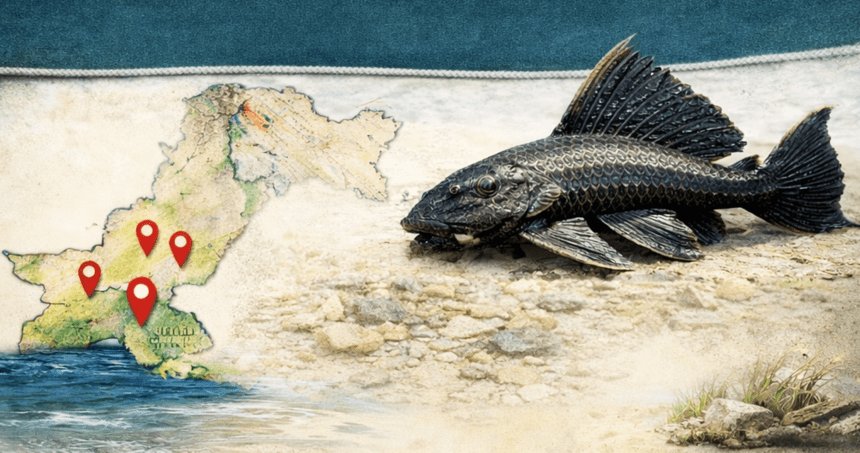
An exotic fish species native to South America has been identified in multiple freshwater ecosystems across Sindh and parts of lower Punjab, raising urgent concerns among scientists, environmentalists, and fisheries managers about its potential to destabilise local biodiversity. The fish, known as the Amazon sailfin catfish (Pterygoplichthys pardalis), was first brought to light when an unusual specimen was caught in a shallow pond (locally known as a dhand) near Sukkur and transported to Karachi Fish Harbour on January 4, 2026.
Local handlers initially described the catch as an unidentified “alien” fish, but taxonomists and conservation experts later confirmed it as the Amazon sailfin catfish, a species popular in the global aquarium trade but not native to Pakistan. Native to the Amazon River basin in South America, the species is distinguished by its armoured body covered in tough bony plates and a prominent sail-like dorsal fin.
Once regarded as a sought-after ornamental fish in home aquariums because of its striking appearance and algae-eating habits, the sailfin catfish has a darker ecological reputation: it is one of the world’s most successful aquatic invasive species. Scientists have documented its establishment in numerous regions outside its native range, including parts of North America, East Asia, Southeast Asia, and now South Asia, where it thrives in rivers, lakes, and irrigation canals.
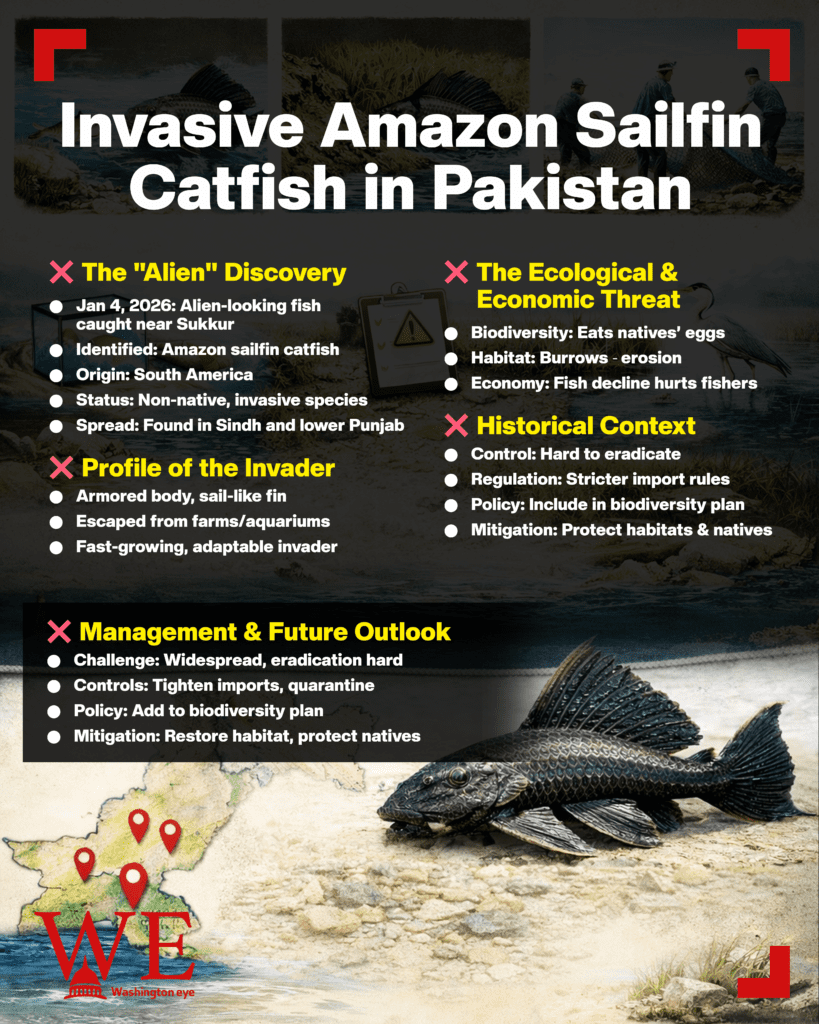
According to environmental authorities and WWF-Pakistan, the species appears to have entered natural water bodies accidentally, likely through releases from private aquariums or escapees from fish farms. The fish has since spread widely in several districts of Sindh and segments of lower Punjab. Authorities emphasise that eradication or effective control is now virtually impossible due to the species’ rapid reproduction and broad environmental tolerance.

Experts warn that the Amazon sailfin catfish poses a multipronged threat to native aquatic ecosystems. It competes aggressively with indigenous fish for food and habitat, consumes eggs and larvae of native species, and alters habitats through burrowing, which can erode riverbanks and increase water turbidity. These impacts ripple through food webs and have been linked elsewhere to declines in native fish populations.
The impacts extend beyond ecology. Fisheries that support local livelihoods could suffer economic damage as native stocks decline. Commercial and subsistence fishers fear that the invasive catfish may reduce catches of economically important species and disrupt established fishing practices.
This incident adds to a long history of exotic fish introductions in Pakistan. At least 26 non-native species, from trout and carp varieties to tilapia, have been introduced either deliberately for aquaculture and weed control or accidentally through the pet trade. Many of these earlier introductions, such as brown trout, rainbow trout, common carp, and grass carp, have established self-sustaining populations and contributed to declines in native biodiversity over decades.

Environmental groups, including WWF-Pakistan, are urging the government to adopt stricter controls on aquarium and aquaculture imports. They call for quarantine measures, improved monitoring of waterways, and public education campaigns to prevent further releases of potentially harmful species. There are also suggestions to incorporate invasive fish threats into Pakistan’s National Biodiversity Strategy and Action Plan to ensure that such risks are systematically addressed under international conservation commitments.
For now, scientists and conservationists are monitoring the sailfin catfish’s spread, studying its interactions with native fauna, and consulting with policymakers on mitigation strategies. They emphasise that while complete removal of the fish may no longer be feasible, targeted efforts, such as habitat restoration and protection of critical native species, could help buffer some of the ecological damage.
The discovery of the Amazon sailfin catfish in Pakistan serves as a stark reminder of the global challenges associated with invasive species in freshwater ecosystems, as well as the need for vigilant biodiversity management in a rapidly changing world.