
Former United States Secretary of State Hillary Clinton has said she never met convicted sex offender Jeffrey Epstein, rejecting any personal connection with the late financier during a recent congressional deposition linked to the ongoing investigation into Epstein’s network and associates. The testimony has renewed global attention on Epstein’s ties to powerful political and business figures.
The statement came during a closed-door deposition before the U.S. House Oversight Committee in Washington, D.C., where lawmakers questioned Clinton for several hours as part of a broader probe examining Epstein’s relationships with influential individuals. According to reports, Clinton told investigators she did not recall ever meeting Epstein and had no knowledge of his criminal activities or those of his associate Ghislaine Maxwell, who was later convicted for helping recruit underage victims.
The hearing was part of an expanding congressional effort to review newly released files and testimony related to Epstein, whose crimes and connections have been under scrutiny since his arrest in 2019 on federal sex-trafficking charges. Epstein died in a New York jail that same year while awaiting trial, a death officially ruled a suicide but still surrounded by controversy and conspiracy theories.
During the deposition, Clinton reportedly repeated multiple times that she had “never met him” and had no involvement in Epstein’s social circle. She emphasized that she was not aware of any wrongdoing linked to Epstein until the criminal allegations became public years later. The former presidential candidate also denied having any personal or professional interactions with Epstein or participating in any events connected to him.
Lawmakers questioned Clinton about a wide range of topics, including Epstein’s connections to political figures, wealthy donors and business leaders. Some questions focused on individuals who had appeared in Epstein’s network or in newly released documents tied to the investigation. The inquiry has drawn attention to numerous high-profile names that have been mentioned in Epstein-related files over the years, including politicians, financiers and celebrities. However, investigators have stressed that appearing in documents or logs does not necessarily imply wrongdoing.
The deposition also became tense at times. Reports said Clinton had a heated exchange with Republican Representative Nancy Mace, who pressed her on questions about individuals connected to Epstein. Clinton responded firmly, telling lawmakers that she intended to answer questions fully despite interruptions.
The investigation also involves testimony from Clinton’s husband, former U.S. President Bill Clinton, whose past association with Epstein has long been scrutinized. Bill Clinton has acknowledged that he knew Epstein and traveled on his private jet for charity-related trips after leaving the White House but has consistently denied knowledge of Epstein’s criminal conduct.
The Clintons initially resisted appearing before the committee, arguing that the inquiry could be politically motivated, but later agreed to testify as lawmakers threatened contempt proceedings if they refused. Clinton has also publicly called for the hearings to be transparent and open to the public rather than conducted behind closed doors. Beyond the Clintons, the congressional investigation continues to examine Epstein’s connections with numerous prominent figures across politics, finance and entertainment. The scandal has sparked ongoing demands for the full release of Epstein-related documents to determine who may have been aware of or connected to his activities.
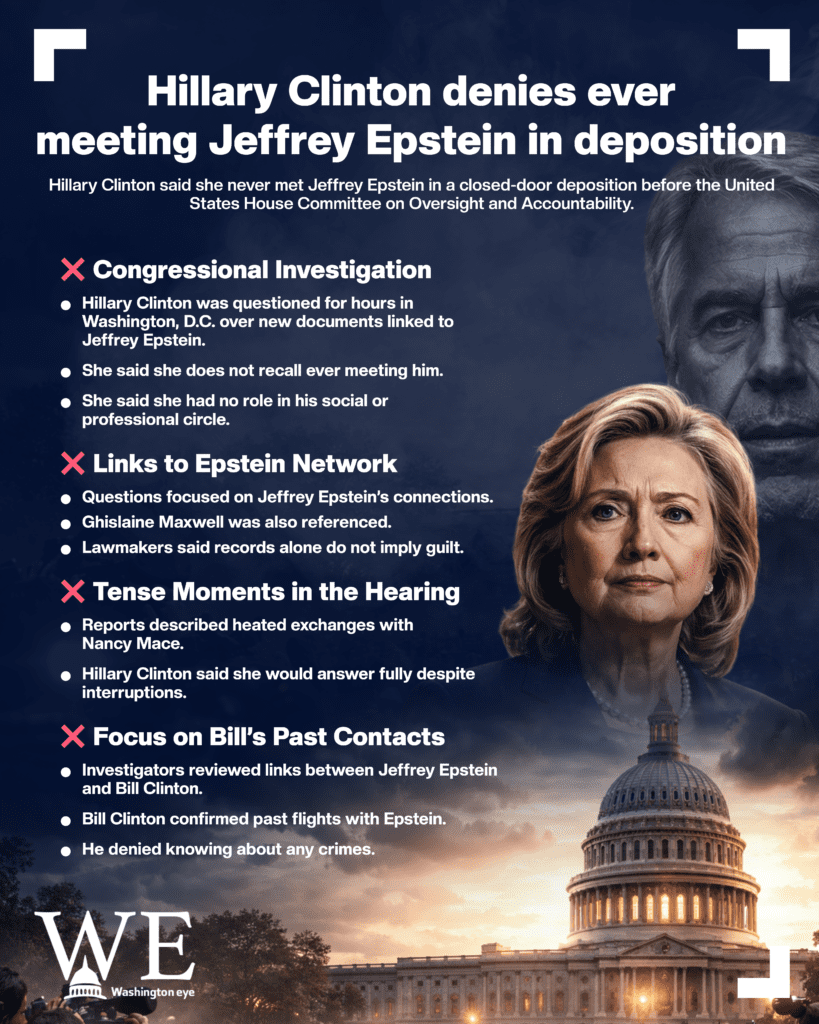
While the probe continues, Clinton has insisted that attempts to link her personally to Epstein are baseless. She has argued that the focus should instead be on uncovering the full extent of Epstein’s crimes and ensuring justice for victims. The renewed attention to Epstein’s network reflects the lasting impact of one of the most controversial criminal cases involving powerful elites in recent decades. As lawmakers continue to release testimony and documents, the issue remains politically sensitive in the United States and internationally.