
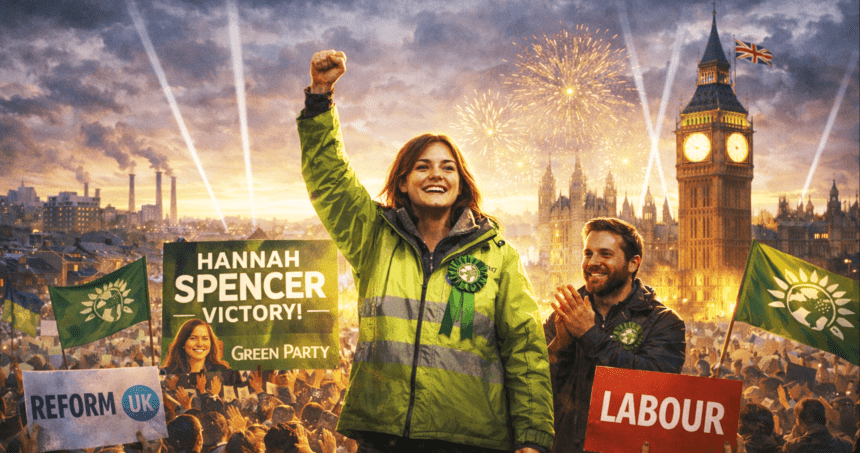
The Green Party of England and Wales has achieved a historic breakthrough after winning its first-ever Westminster by-election, marking a significant shift in British politics and delivering a major setback to the country’s traditional parties. The victory came in the Gorton and Denton constituency in Greater Manchester, where Green candidate Hannah Spencer defeated candidates from Labour and Reform UK in a closely watched contest. The by-election was held in late February 2026, drawing national attention as it tested voter sentiment following recent political debates over economic issues, climate policies, and foreign policy.
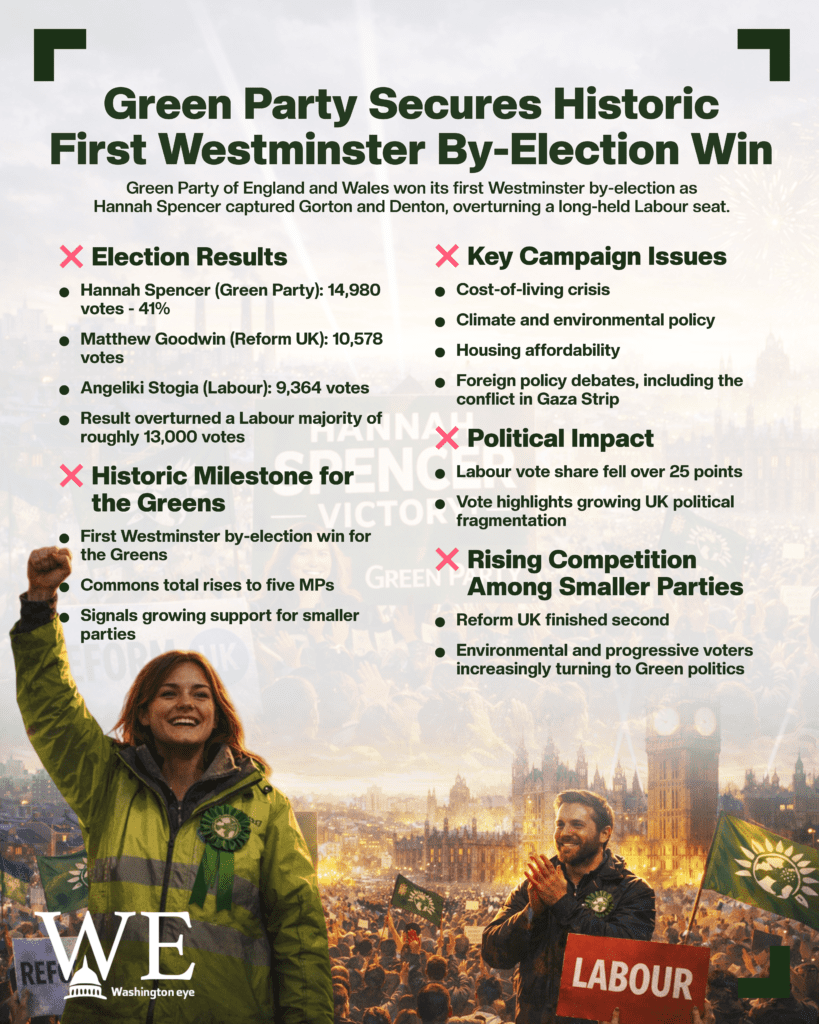
Hannah Spencer, a local councillor and plumber by profession, won the seat with 14,980 votes, securing roughly 41 percent of the total vote. Reform UK candidate Matthew Goodwin finished second with 10,578 votes, while Labour’s Angeliki Stogia came third with 9,364 votes. The result overturned a Labour majority of around 13,000 votes, making the outcome one of the most surprising political upsets in recent years.
The victory marks a milestone for the Green Party, which had historically struggled to convert growing public support into parliamentary seats during by-elections. Although the party had already secured several Members of Parliament through general elections, this was the first time the Greens captured a seat in a Westminster by-election, bringing their total number of MPs in the House of Commons to five. Analysts described the result as a “seismic moment” for smaller parties challenging Britain’s long-standing two-party dominance.

The campaign in Gorton and Denton focused heavily on issues such as the cost-of-living crisis, environmental policies, housing, and foreign policy debates, particularly the war in Gaza, which influenced voter sentiment in the diverse constituency. Many observers noted that dissatisfaction among progressive and Muslim voters with Labour’s political stance contributed to the shift toward the Green Party. At the same time, Spencer’s grassroots campaign emphasized local community engagement and economic fairness, helping her connect with voters frustrated with mainstream politics.

The by-election result was a significant embarrassment for Labour leader and Prime Minister Sir Keir Starmer, whose party had previously dominated the constituency for decades. Labour’s vote share fell sharply compared with previous elections, dropping by more than 25 percentage points. Political analysts said the loss reflected growing divisions within the party and increasing competition from smaller progressive parties.
The Green Party leadership welcomed the result as proof that voters were ready for a political alternative focused on climate action, social justice, and economic reform. Party leader Zack Polanski described the victory as a turning point that could reshape British politics and encourage more voters to support environmentally focused policies.
The party has experienced rapid growth in membership and influence in recent years, particularly among young urban voters. The by-election also intensified competition among emerging political forces. Reform UK, a right-wing party led by Nigel Farage, finished second and attempted to capitalize on voter dissatisfaction with traditional parties. However, the Greens’ strong performance demonstrated that political fragmentation is increasing across the UK’s electoral landscape.

Political commentators say the result could have wider consequences for upcoming elections, as both Labour and Conservative parties reassess their strategies in response to the Greens’ rising popularity. In particular, environmental concerns, economic inequality, and dissatisfaction with mainstream politics are increasingly shaping voter behavior. If the trend continues, the Green Party could become a stronger force in Parliament and play a larger role in shaping national policy debates.
Overall, the Gorton and Denton by-election victory represents a historic milestone for the Green Party. It highlights growing public interest in environmental politics and signals that Britain’s political system may be entering a new phase where smaller parties can challenge traditional power structures more effectively.