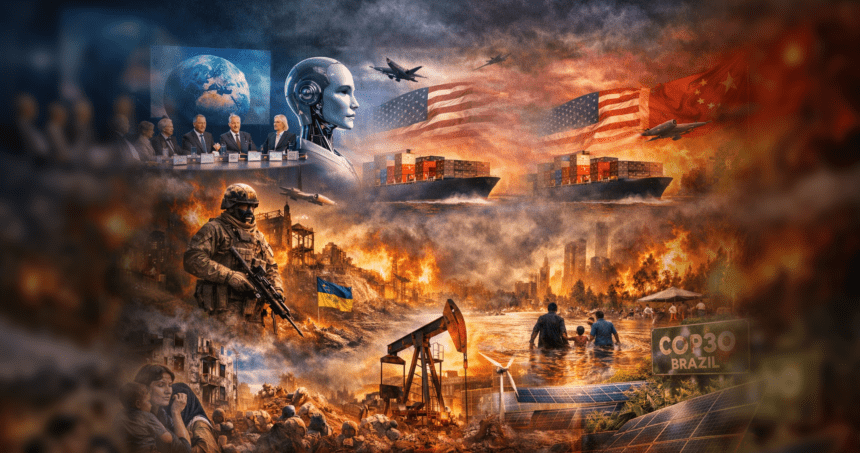
The year 2025 will go down in history as one of the most turbulent, transformational, and contested years in recent memory, marked by rising geopolitical tensions, climate emergencies, technological breakthroughs, economic strains, and profound societal shifts around the world. Across continents and sectors, leaders grappled with competing priorities from climate action to artificial intelligence, while millions of people experienced the tangible effects of conflict, extreme weather, and political volatility.
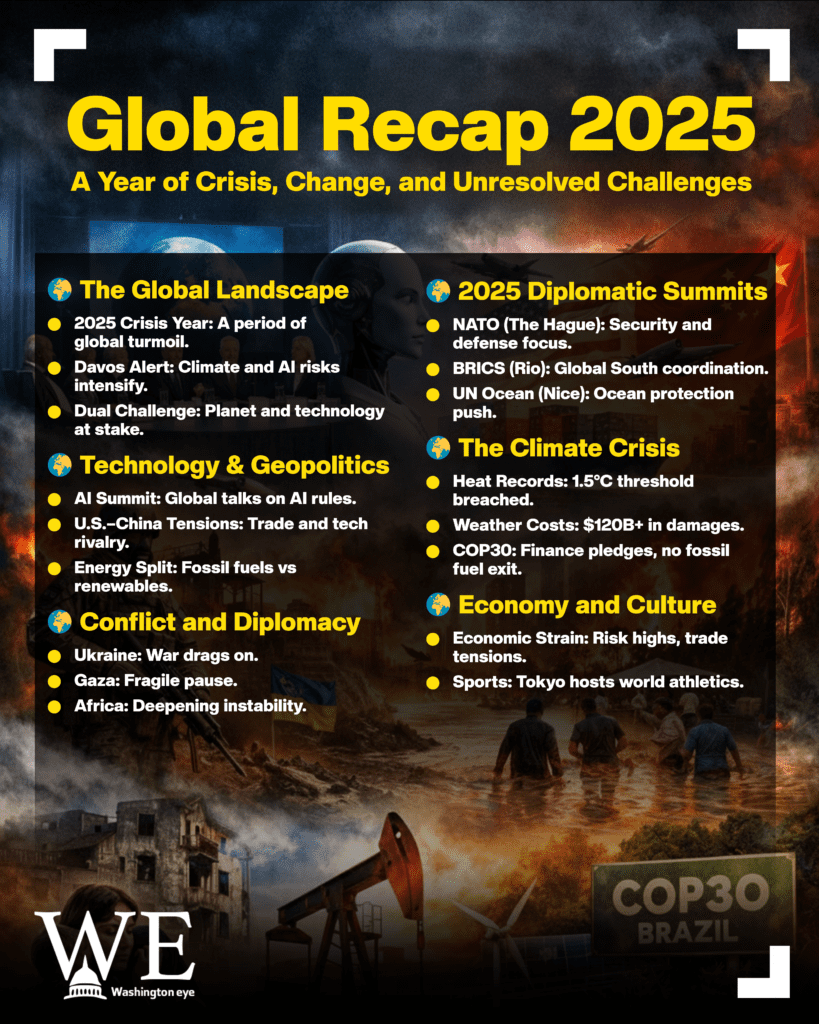
At the outset of the year, global leaders convened at the World Economic Forum in Davos, Switzerland, where U.N. Secretary-General António Guterres issued stark warnings on the accelerating climate crisis and the ungoverned rise of artificial intelligence (AI). His comments framed the double challenge of safeguarding both planetary and technological futures, as governments and corporations prepared for a year of high-stakes negotiations and power shifts.
By mid-February, the AI Action Summit in Paris brought over 1,000 delegates from more than 100 countries to discuss international cooperation on AI governance. The summit underscored how artificial intelligence had transitioned from a niche tech topic to a defining global issue in 2025, shaping economies, security, and ethical norms.
On the geopolitical front, U.S.–China relations and global power competition remained at the center of world affairs throughout the year, resulting in new tariffs, tech export restrictions, and strategic jockeying for influence. The United States, under President Donald Trump, expanded fossil fuel production and AI investment, while China accelerated its renewable energy ambitions and digital infrastructure growth. This divergence illustrated a broader competition between “hydrocarbons versus electrons, fossil fuels versus clean, electrified technologies, that defined much of the global economic narrative in 2025.
Wars and ceasefires continued to shape international headlines. The conflict in Ukraine entered its fourth year, with persistent Russian missile and drone strikes and Ukrainian resistance efforts. At the same time, after two years of hostilities, a Gaza ceasefire mediated by the United States and regional partners offered a fragile pause in fighting and opened space for humanitarian aid, though long-term peace remained elusive.
In Africa and the Middle East, civil wars and political instability drove deep human suffering. Sudan’s brutal conflict persisted with catastrophic displacement, while West African nations faced coups and governance crises that destabilized regional economies and humanitarian landscapes.
The climate crisis intensified in dramatic ways in 2025. Scientists confirmed that the year was one of the three hottest on record, and the three-year average breached the Paris Agreement’s 1.5 °C threshold for the first time. This alarming milestone was linked directly to the continued burning of fossil fuels, despite ongoing global dialogues on emissions reduction.

Extreme weather events inflicted severe losses: cyclones, floods, and wildfires resulted in more than $120 billion in insured damages, with thousands of lives lost and millions displaced across South-East Asia, North America, and China. These disasters highlighted the growing human and economic toll of climate change, prompting pledges to increase adaptation funding, though many experts called these measures insufficient.
In international diplomacy, the COP30 Climate Summit in Belém, Brazil, represented a mixed legacy. While wealthy nations vowed to triple adaptation finance by 2035, delegates failed to secure firm commitments on fossil fuel phase-outs or meaningful emission cuts. Critics said the summit exposed deep fractures in global climate unity and underscored the difficulty of balancing economic interests with environmental urgency.
Other multilateral meetings also shaped the year. The NATO Summit in The Hague focused on defense commitments in a fraught security environment; the BRICS Summit in Rio de Janeiro emphasized Global South cooperation and reform of global governance; and the United Nations Ocean Conference in Nice sought to mobilize action for ocean conservation.
In sports and culture, Tokyo hosted the World Athletics Championships, bringing together nearly 2,202 athletes from 198 nations, while global entertainment and societal trends, from influential political personalities to youth movements, punctuated the year’s narrative with moments of celebration and contention.
Economically, growth was modest in many regions. Employment expanded but at a slowing pace, and global political risk reached record highs, challenging investors and businesses worldwide. Trade disputes and shifting supply chain dynamics added complexity to recovery efforts in the post-pandemic era.
Looking back at 2025, the world experienced fierce battles, ideological, technological, and environmental, that will shape the coming decade. While moments of cooperation offered hope, unresolved conflicts and climate threats remain urgent. The year’s legacy is a reminder that the global community’s choices today will determine the breadth of tomorrow’s opportunities and challenges.