
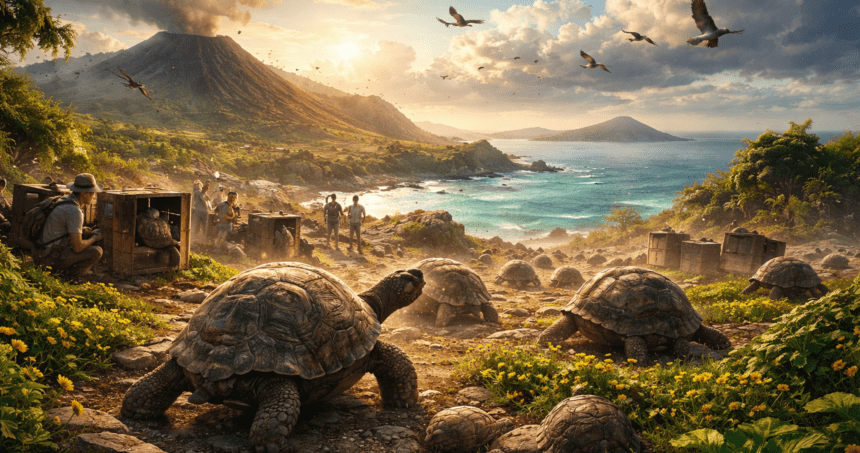
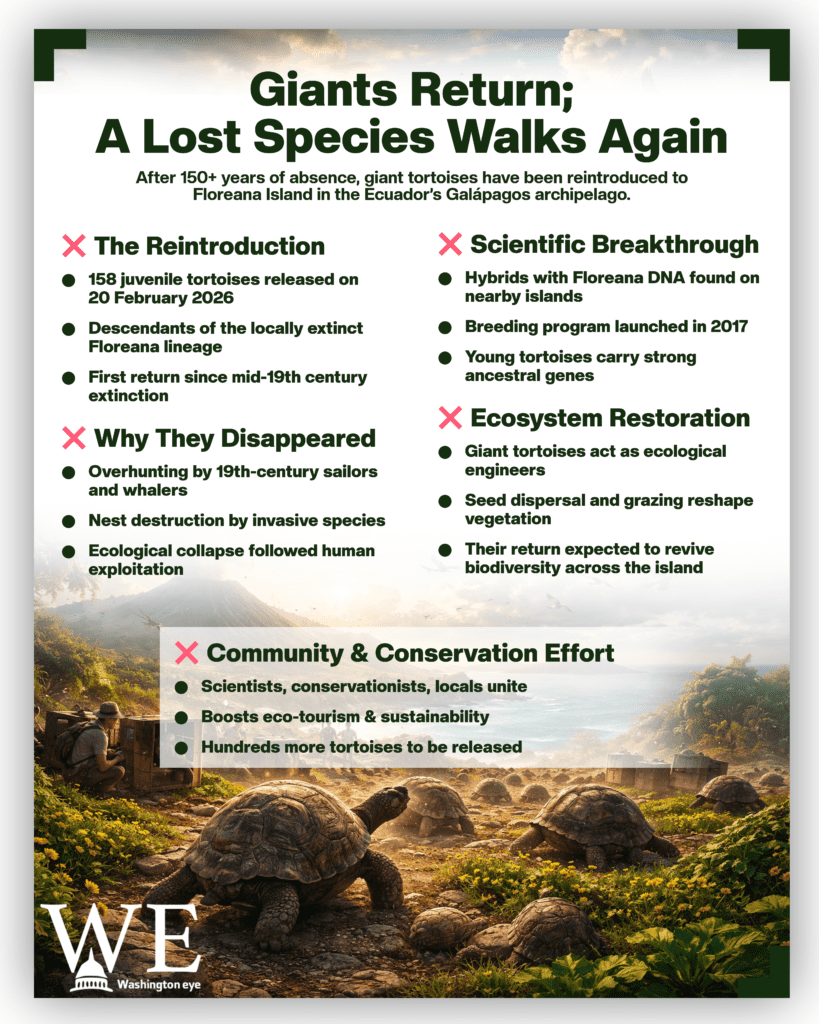
After more than 150 years without giant tortoises, Floreana Island in Ecuador’s famed Galápagos archipelago has witnessed a historic wildlife comeback, conservationists announced this week. On 20 February 2026, a group of 158 juvenile giant tortoises belonging to the lineage of the once-locally extinct Floreana giant tortoise (Chelonoidis niger niger) were released into the wild, marking the species’ return to its ancestral island for the first time since the mid-19th century.
Once abundant across Floreana, giant tortoises were driven to extinction on the island in the 1840s and 1850s. Decades of relentless hunting by whalers and sailors for food and oil, along with the introduction of invasive mammals such as rats, pigs, cats and dogs, decimated tortoise nests and hatchlings, leading to the subspecies’ disappearance by around 1850. Charles Darwin himself recorded the decline of tortoises during his visit in 1835, witnessing the dramatic consequences of human exploitation.
The reintroduction effort is the culmination of two decades of intensive scientific, ecological and community work under the Floreana Ecological Restoration Project, a partnership involving the Galápagos National Park Directorate, the Galápagos Conservancy, conservation organizations and local residents.

A Genetic Miracle and Targeted Breeding
The seeds for this revival were planted in the early 2000s, when researchers exploring Wolf Volcano on neighbouring Isabela Island discovered unusual tortoises whose physical traits suggested links to the extinct Floreana population. Subsequent genetic testing confirmed that certain tortoises on Wolf carried significant ancestry from the Floreana lineage, remnants of animals that had been historically moved between islands by sailors.

This discovery opened a rare opportunity: although the original pure Floreana subspecies no longer existed, hybrid individuals with substantial Floreana DNA were alive elsewhere in the archipelago. Building on this genetic foothold, scientists launched a targeted breeding programme in 2017 at the Galápagos National Park breeding centre on Santa Cruz Island, selecting individuals with the strongest ancestral linkage and raising their young under controlled care. By 2025, more than 600 hatchlings had been produced.
The tortoises now released are between 8 and 13 years old, large enough to fend off some introduced predators and to begin fulfilling ecological roles in the wild. Each carries between about 40 % and over 80 % of the genetic makeup of the extinct Chelonoidis niger subspecies, and their gradual reintroduction is designed to strengthen the genetic representation of that lost lineage over time.
Restoring an Ecosystem

Giant tortoises are not merely symbolic icons of the Galápagos; they are keystone species and ecological engineers. Through their grazing, long-distance seed dispersal and habitat modification, they shape plant communities, open pathways through dense vegetation, influence soil processes and create micro-habitats that benefit myriad other species. Their disappearance fundamentally altered Floreana’s ecosystem, affecting both flora and fauna across the island.
The reintroduction of these tortoises is therefore a critical step in restoring ecological balance. Conservationists hope the animals will help regenerate native plant communities, increase biodiversity, and contribute to the recovery of other threatened species, including native birds, reptiles and invertebrates. Invasive species control campaigns that began in recent years have already paved the way for some species to rebound, including ground finches, native lizards and even the rediscovery of the Galápagos rail, unseen on Floreana since Darwin’s time.
Scientific and Community Collaboration
The tortoises’ release was timed to coincide with the rainy season, when vegetation is abundant and environmental conditions are most favourable for survival. The event was attended by ministry officials, conservation partners and members of Floreana’s small resident community of around 160 people, who have been instrumental in planning and monitoring efforts.
Residents expressed pride and hope, noting that the restoration of tortoises not only benefits the island’s ecosystems but also supports local livelihoods through eco-tourism, scientific engagement and sustainable agriculture.
A Long Road Ahead
While the release of 158 tortoises is a major milestone, it represents just the beginning of a long restoration journey. Conservationists plan to introduce hundreds more over the coming years and to continue controlling invasive threats while monitoring the tortoises’ adaptation and impact. Future phases of the project include restoring other locally extinct species, such as the Floreana mockingbird and racer snake, as ecological conditions improve.
The return of giant tortoises to Floreana after more than a century and a half offers a powerful example of how science, sustained commitment and collaborative conservation can revive what was once thought irrevocably lost, not just saving a species, but rebuilding a living ecosystem.