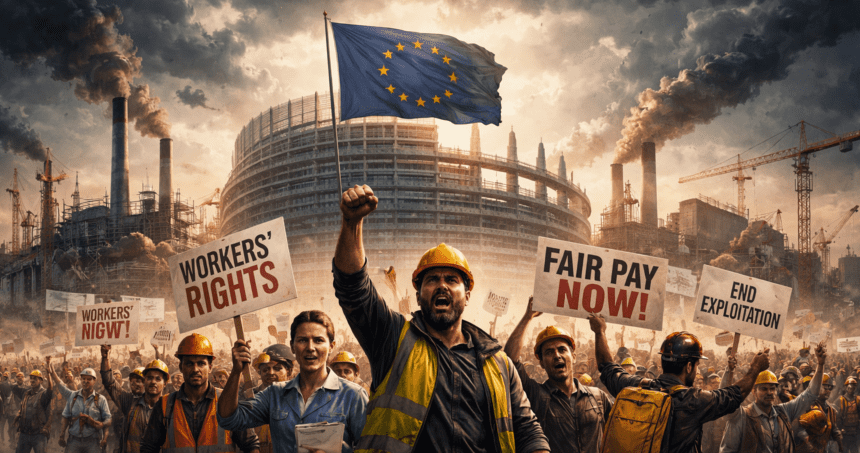
Across Europe, governments and companies are facing growing criticism for failing to fully implement or enforce labour protections designed to safeguard workers. Courts, labour unions and global organisations have recently highlighted several cases where European states and corporations have allegedly breached employment rules, raising concerns about working conditions, working hours and the rights of employees across the continent.
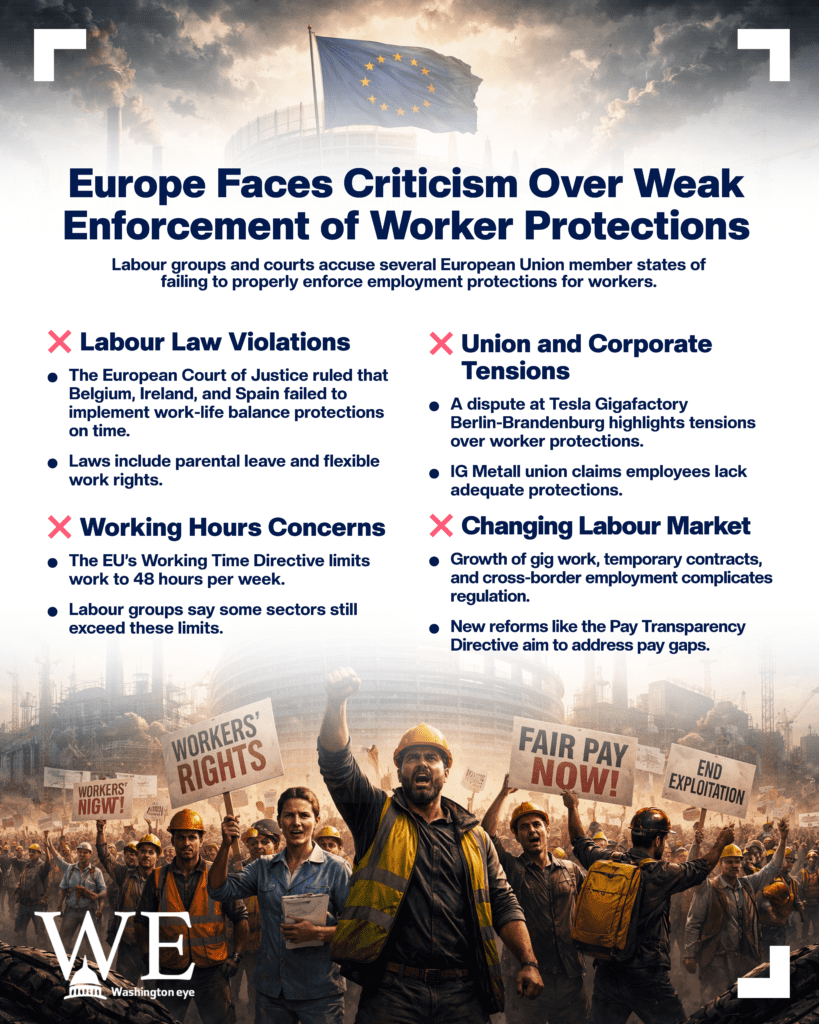
The issue has gained attention particularly since 2024–2026, as the European Union (EU) has been introducing new labour reforms while simultaneously investigating violations of existing directives. The EU’s labour framework is built around several key rules, including the Working Time Directive, which limits working hours to an average of 48 hours per week and requires daily and weekly rest periods for employees. However, labour groups argue that in many sectors, from manufacturing to gig-economy work, these rules are not always properly implemented.
One of the most notable developments came when the European Court of Justice (ECJ) ruled that several EU member states, including Belgium, Ireland and Spain, failed to put required protections for workers and caregivers into national law on time. The ruling stated that the countries had violated EU legislation by missing deadlines to implement work-life balance protections meant to support employees with families. These protections include parental leave rights and flexible working arrangements aimed at improving work-life balance across the bloc.

Labour rights organisations say the problem is broader than individual cases. According to the International Trade Union Confederation (ITUC), labour rights conditions in Europe have deteriorated in recent years, with many workers experiencing restrictions on collective bargaining, limited access to justice and weaker protection against unfair working conditions. In some countries, union leaders argue that labour reforms are being delayed or weakened in favour of economic competitiveness.

A recent labour dispute in Germany illustrates the tensions between companies and workers. At Tesla’s Gigafactory near Berlin, the powerful IG Metall trade union has attempted to gain control of the factory’s works council, claiming that employees lack adequate protections and collective agreements. Tesla has denied the accusations, stating that wages and conditions at the plant are competitive. The conflict has become symbolic of the wider debate over workers’ rights in Europe’s rapidly changing industrial sector.
The issue also reflects deeper changes in the European labour market. Over the past decade, the rise of temporary contracts, gig-economy jobs and cross-border employment has complicated labour regulation. EU authorities have responded by proposing new policies such as the Pay Transparency Directive, which aims to reduce the gender pay gap and require companies to disclose salary information.
Other reforms target contractor misclassification and the use of short-term employment contracts. Despite these efforts, enforcement remains uneven. Labour experts say some governments struggle to translate EU-level directives into national law, while others face pressure from businesses concerned about rising labour costs. In some cases, companies have been accused of bypassing working-time limits or failing to properly record employee hours, something EU courts have repeatedly ruled against.

Beyond Europe’s borders, the EU has also faced criticism over labour practices linked to migration policies and global supply chains. Human rights groups argue that outsourcing migration control to neighbouring countries can expose migrant workers to exploitation and abuse.Meanwhile, the EU is introducing new regulations aimed at banning products made with forced labour from entering the European market, a measure intended to strengthen global labour standards.
For workers themselves, the consequences of weak enforcement can be significant. Long working hours, unpaid overtime and insecure contracts can lead to financial instability and health risks. Trade unions warn that if labour laws are not properly enforced, the credibility of the EU’s social model, which promises strong worker protections, could be undermined.
European officials say reforms are already underway. Governments across the bloc are updating labour laws, increasing minimum wages and strengthening oversight of working conditions. New initiatives, including digital systems to track working hours and stricter rules on supply chains, are expected to take effect in the coming years.
However, labour advocates stress that legislation alone is not enough. They argue that stronger enforcement, better inspections and more transparency are needed to ensure that workers across Europe actually benefit from the protections promised by EU law.
As Europe attempts to balance economic competitiveness with social protection, the debate over labour rights is likely to intensify. With millions of workers affected across multiple industries, the question remains whether the EU can maintain its reputation as one of the world’s strongest defenders of workers’ rights while addressing the challenges of a rapidly evolving labour market.