In early January 2026, the United States under President Donald J. Trump launched a dramatic military operation against Venezuela that sent shockwaves across the world and re-shaped Washington’s diplomatic posture toward several countries. On Jan. 3, U.S. forces carried out a coordinated strike in and around Caracas and other strategic sites, capturing Venezuelan President Nicolás Maduro and his wife and bringing them to the United States to face federal charges dating back to 2020. The operation, dubbed Operation Absolute Resolve by U.S. officials, followed months of increasingly hostile rhetoric from Trump and his advisers that Venezuela posed a direct national security threat to the United States and the wider Western Hemisphere.
What began as a controversial intervention against Maduro has quickly evolved into a broader challenge to established international norms and sovereign rights, with Trump publicly signalling a willingness to pressure or even threaten other nations. In the immediate aftermath of the Venezuela assault, Trump’s administration made clear that it intended to turn up the heat on several governments it believes are failing to align with U.S. strategic objectives or security demands.
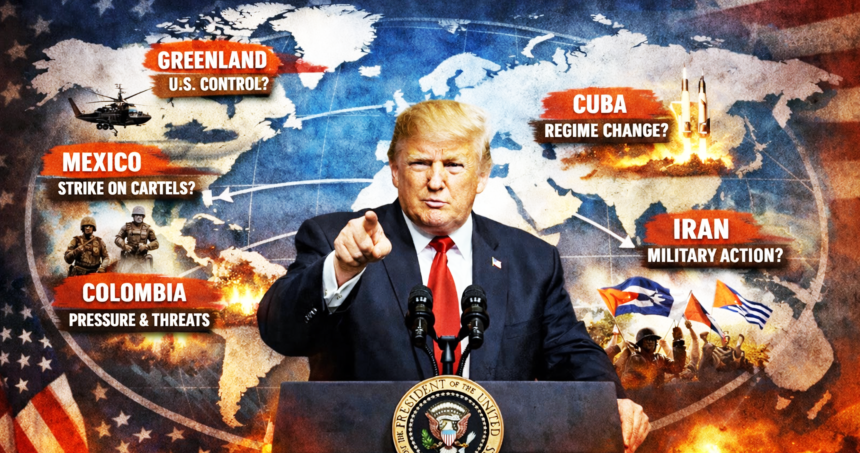
Perhaps the most unusual and geopolitically sensitive of these is Greenland. A semi-autonomous territory of the Kingdom of Denmark, Greenland has long been of strategic interest to the U.S. because of its location in the Arctic and proximity to Russia. In January, Trump revived his controversial ambition, first reported during his previous administration, to bring Greenland under American control. White House officials said acquiring the territory was a “national security priority” and that use of the U.S. military remained “always an option,” though Washington claimed it preferred negotiation or purchase.
The idea of a U.S. takeover prompted swift rebukes from Copenhagen and European capitals. Danish Prime Minister Mette Frederiksen publicly urged Trump to drop “threats to take over Greenland,” calling the comments unacceptable and harmful to NATO unity. Greenland’s own leaders insisted their future must be decided by Greenlanders, not Washington. European allies from France to the United Kingdom issued statements affirming that “Greenland belongs to its people” and defending the territory’s sovereign rights.
Closer to Venezuela, Trump turned his attention to Colombia, accusing President Gustavo Petro of failing to curb drug trafficking and signalling that Colombia could face similar pressure or military action if it did not change course. Trump’s repeated characterisation of Petro as being complicit in cocaine production escalated tensions, prompting Colombia’s foreign ministry to decry the comments as undue interference in domestic affairs. Large protests also erupted in Bogotá and other cities, with demonstrators waving national flags and denouncing what they called an “assault on Colombian sovereignty.”
Mexico, long seen in Washington through the prism of border security and drug enforcement, also featured in Trump’s post-Venezuela rhetoric. Trump warned that the United States would take action if Mexico did not do more to counter drug cartels and illegal trafficking, suggesting that “land strikes” against cartel infrastructure inside Mexican territory might be imminent. His comments provoked alarm in Mexico City, where leaders reiterated their commitment to sovereignty and rejected any notion of foreign military intervention.
Another nation feeling the impact of Trump’s heightened posture is Cuba. Trump publicly stated that Cuba “looks like it’s ready to fall” without more decisive engagement or a change in policy, a phrasing that critics interpreted as a veiled suggestion of heightened pressure or even future coercive measures. Havana condemned the language as provocative and disrespectful of Cuba’s independent political path.
Beyond the Americas and the Arctic, Trump also made pointed remarks about Iran, warning that the Islamic Republic “would be hit very hard” if the ongoing domestic protests there led to more casualties. While not an immediate follow-up to Venezuela, the statement underscored Trump’s willingness to threaten military consequences far beyond the Western Hemisphere in pursuit of what he frames as U.S. security and moral interests.
International reactions to these cascading threats have been sharp. The United Nations and a number of nations have condemned the U.S. intervention in Venezuela as a violation of international law, with several calling emergency meetings at the UN Security Council. Latin American governments issued joint statements rejecting unilateral action in the region and reaffirming respect for sovereignty. European leaders, while divided in their broader views of Trump’s foreign policy, united around defending Denmark and Greenland’s autonomy. Global human rights groups and international legal scholars have warned that the U.S. actions risk normalising military threats as a tool of diplomacy.
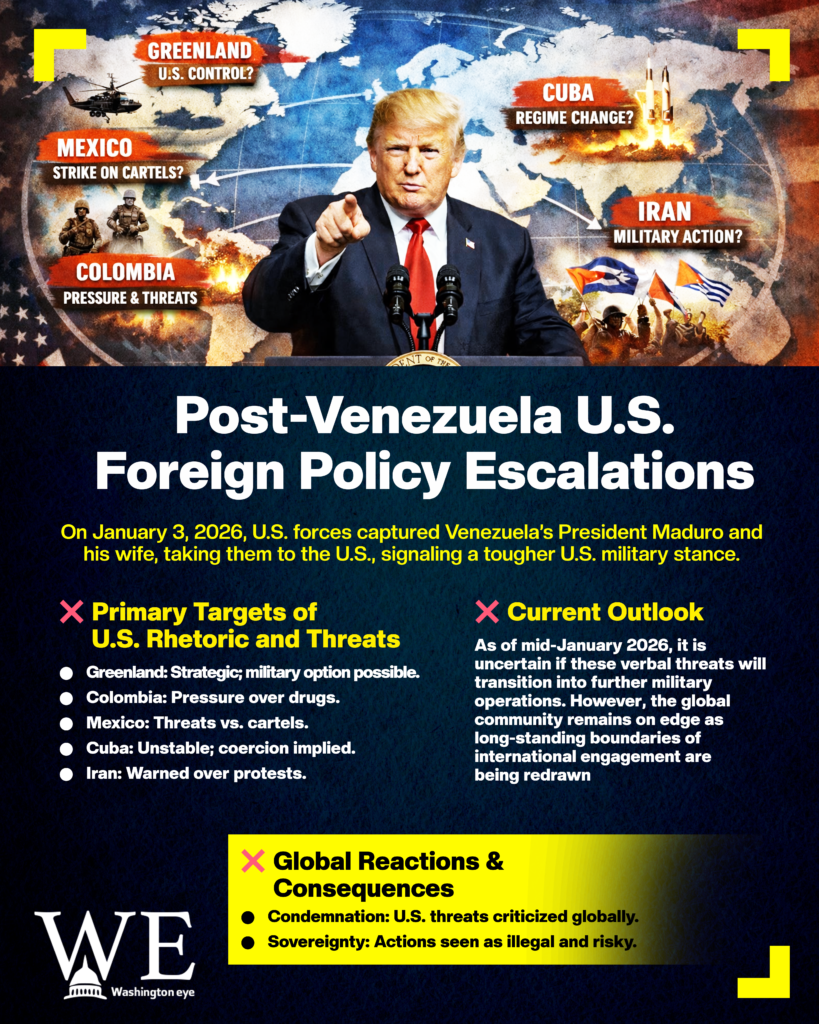
As of mid-January, it remains unclear how far Trump’s threats will escalate into actual operations beyond Venezuela. But world capitals from Bogotá to Copenhagen are watching closely, bracing for possible shifts in U.S. policy that could redraw long-standing boundaries of international engagement and put sovereign states on edge.